


Description
The 1xN Rackmount Optical Switch is a high‑performance fiber optic switching platform designed for centralized optical signal management in demanding network environments. Available from 1×2 up to 1×128 channels, this rackmount switch enables precise routing of optical signals from a single input to multiple outputs with very low insertion loss and excellent repeatability. Engineered for both single‑mode and multimode fiber networks, it supports a broad operating wavelength range from 1260 to 1650 nm for SM and 532 to 1064/1310 nm for MM configurations, making it suitable for telecom, data center, test and measurement, and defense applications.
Compared with many common 1xN optical switches on the market, this rackmount solution stands out for its combination of low insertion loss, high return loss, and extended lifetime of up to 107 switching cycles. Typical insertion loss is as low as 0.5 dB for configurations up to 64 channels and only about 1.0 dB for switches up to 128 channels, helping maintain signal integrity across complex optical paths. High crosstalk isolation of ≥70 dB and polarization dependent loss of ≤0.05 dB ensure stable, repeatable performance, even in polarization‑sensitive systems and wavelength‑diverse networks.
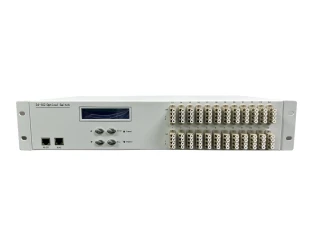
The unit is designed for seamless integration in 19‑inch equipment racks and is available in 1U, 2U, 3U, and 4U heights depending on the channel count. This scalable mechanical design allows network engineers to choose the optimal density and footprint for their environment, from compact laboratory setups to high‑density central offices and headends. A flexible interface configuration supports parallel control via RS232 and RJ45, so the switch can be easily incorporated into existing network management systems, automated test platforms, and remote monitoring architectures. The LCD display on the front panel provides at‑a‑glance visibility of the active light paths and switching status, simplifying local management and troubleshooting.
Operational reliability is enhanced by a robust electrical design that supports AC 85–256 V and DC 36–72 V power inputs, as well as optional dual power supply configurations for redundancy. This wide power range allows deployment in standard telecom sites, industrial environments, and field installations. The unit is specified for an operating temperature range of 0 to +70 °C and a storage range of –40 to +85 °C, offering dependable performance in both controlled laboratories and more challenging ambient conditions. Temperature‑dependent loss and wavelength‑dependent loss are tightly controlled (≤0.25 dB each), ensuring consistent optical performance over temperature and across supported wavelengths.
The 1xN Rackmount Optical Switch is well suited to a wide range of photonic applications. In backbone and access networks, it serves as a core element for optical signal switching, protection switching, and dynamic routing. In optical network monitoring systems, it enables non‑intrusive sampling of multiple fibers for OTDR measurements and real‑time diagnostics, reducing maintenance costs and downtime. In laboratories and production lines, it functions as an automated routing engine for testing fiber optic components, transceivers, and subsystems, increasing throughput and ensuring consistent measurement conditions. Additionally, the low loss, high isolation, and stable characteristics make it a strong candidate for secure and mission‑critical military communication links where reliability and signal integrity are paramount.
Fiber type, test wavelength, pigtail style, connector interface, and rack height can all be customized, allowing users to tailor the switch to specific network architectures and test setups. Standard options include single‑mode 9/125 μm and multimode 50/125 or 62.5/125 μm fibers, with connector choices such as LC/PC, LC/APC, SC/PC, SC/APC, FC/PC, and FC/APC. Custom wavelengths and fiber types are also available for specialized systems, including emerging bands and unique test requirements. This high‑density rackmount optical switch provides a scalable, configurable, and robust platform for modern optical infrastructures that demand precision, flexibility, and long‑term stability.
1xN Rackmount Fiber Optic Switch 1 to 128 Channels Low Loss
Specifications
| Number Of Ports: | 1 – 128 |
|---|---|
| Wavelength Range: | 400 – 2000 nm |
| Insertion Loss (typical): | 0.5 dB |
| Return Loss: | 9 dB |
| Connector: | None, LC/PC, LC/APC, SC/PC, SC/APC, FC/PC, FC/APC, Custom |
| Channel Number (N): | 1<N≤128 |
| Testing Wavelength (nm): | 532, 650, 780, 850, 980, 1310, 1490, 1550, 1625 |
| Crosstalk (dB): | SM (9/125) ≥ 70; MM (50/125, 62.5/125) ≥ 70 |
| Lifetime (cycles): | 10 million |
| Rack Mount: | 1U, 2U, 3U, 4U, Custom … |
Got questions about specs? Use the inquiry form to ask.
 Download Data Sheet

Features
- Wide Channel Range (1×N to 1×128) – Scalable rackmount optical switch supporting from 1×2 up to 1×128 channels, ideal for small labs to large fiber test beds and network matrices.
- Low Insertion Loss, High Optical Performance – Typical insertion loss as low as 0.5 dB (≤64 channels) and 1.0 dB (≤128 channels), with return loss ≥ 50 dB (SM) and crosstalk ≥ 70 dB for clean, high‑isolation signal routing comparable to leading lab- and telecom‑grade switches.
- Highly Stable & Repeatable Switching – PDL ≤ 0.05 dB, wavelength‑ and temperature‑dependent loss ≤ 0.25 dB, and repeatability ≤ 0.02 dB provide consistent measurements in automated test setups and long‑term monitoring systems.
- Fast, Reliable Mechanical Switching – Mechanical 1×N architecture with switching time ≤ 10 ms (adjacent channel) and a long mechanical lifetime of up to 107 switching cycles, suited for continuous, unattended operation.
- Broad Wavelength Coverage (Singlemode & Multimode) – Supports 1260–1650 nm SM and 532–1064/1310 nm MM, with standard test wavelengths at 1310/1490/1550/1625 nm and 532/650/780/850/980/1310 nm to cover most telecom, datacom, and laser applications.
- High Optical Power Handling – Handles optical input power up to 500 mW, allowing use with high‑power sources, EDFAs, and high‑brightness laser systems in R&D and production environments.
- Flexible Fiber Types & Connector Options – Compatible with SM 9/125 and MM 50/125, 62.5/125 fibers, with pigtail options (250 µm, 900 µm, custom) and connector choices including LC/PC, LC/APC, SC/PC, SC/APC, FC/PC, FC/APC, or custom on request.
- Telecom‑Grade AC/DC Dual Power Supply – Wide‑range AC 85–256 V (typ. 110/220 V) and DC 36–72 V (typ. 48 V) input, with optional dual redundant power supply to increase system reliability in carrier and data‑center environments.
- Intuitive Local Control with LCD Display – Front‑panel LCD display module clearly indicates light path status, channel selection, and alarm messages, simplifying on‑site operation and troubleshooting.
- Built‑In Self‑Test & Alarm Functions – Integrated fault self‑checking and alarm warning via LCD provide early indication of breakdowns, power issues, or abnormal optical behavior, reducing downtime and maintenance costs.
- Remote Network & Serial Management – Parallel interface support including RS‑232 and RJ45 allows easy integration into remote control systems, network management platforms, and automated test equipment (ATE) over LAN or serial links.
- Standard 19″ Rackmount Design (1U–4U) – Available in 1U, 2U, 3U, or 4U 19″ rackmount chassis (483 × 250 mm footprint) with height matched to channel count, making it simple to deploy in telecom racks, lab benches, and production lines.
- Wide Operating Temperature Range – Designed for 0 to +70 °C operation and −40 to +85 °C storage, suitable for controlled labs, central offices, and demanding industrial or field‑deployed systems.
- Versatile Application Coverage – Optimized for optical signal switching and routing, optical network monitoring, fiber‑optic component and system testing, and military and secure communications where low loss and high reliability are critical.
- Customizable Configurations – Channel count, wavelength range, fiber type, connector style, rack height, and control interfaces can be customized, enabling tailored solutions for OEM integration, manufacturing test racks, and specialty research setups.
- Turnkey Integration with Fiber Systems – Works seamlessly with OTDRs, power meters, light sources, transceivers, and monitoring equipment to create automated optical test and switching platforms comparable to high‑end matrix switches in the market.
Applications
- Optical Fiber Network Protection and Restoration – Automatically reroute optical signals in carrier, enterprise, and data center networks for path protection (1+1, 1:N) and rapid restoration during fiber cuts or equipment failures.
- Optical Signal Switching and Routing – Dynamically select and connect one input fiber to any of up to 128 output fibers for flexible optical layer routing in FTTx, DWDM, CWDM, and metro/access networks.
- Centralized Optical Distribution in Test Labs – Use as a core optical matrix in R&D and manufacturing labs to distribute one laser source or signal to many test stations, DUTs (devices under test), or measurement paths.
- Automated Fiber Optic Component Testing – Combine with OTDRs, OSA, power meters, and BER testers for multi‑port, multi‑device characterization of patch cords, splitters, WDM modules, transceivers, and amplifiers without manual reconnection.
- Optical Network Monitoring and OTDR Access – Integrate with OTDRs or monitoring units to scan multiple fibers or network segments from a single rackmount platform, enabling proactive fault localization and in‑service monitoring.
- Remote Fiber Test Systems (RFTS) – Deploy at central offices or hubs to remotely switch OTDR signals to many field fibers, supporting fiber health diagnostics and SLA monitoring for telecom operators and ISPs.
- Data Center and Cloud Infrastructure Management – Implement automated optical patching between core switches, routers, and DWDM shelves for flexible capacity planning, reconfiguration, and maintenance with minimal downtime.
- Telecom Central Office and POP Cross‑Connect – Replace or complement manual patch panels with electronically controlled 1xN switching for efficient ODF (optical distribution frame) management and service provisioning.
- Long‑Haul and Metro DWDM Line System Control – Route supervisory channels, test wavelengths, or service wavelengths to different spans or equipment for commissioning, troubleshooting, and network optimization.
- Reconfigurable Test Bed for New Optical Technologies – Create flexible experimental setups in universities, research institutes, and development labs for photonics, coherent systems, OFDM, and advanced modulation studies.
- Military and Defense Optical Communications – Use in secured fiber networks for command, control, communications, and sensor links, enabling rapid path reconfiguration, redundancy, and covert routing in hardened environments.
- Industrial and Transportation Fiber Networks – Manage optical links for smart grid, railway signaling, pipeline monitoring, and intelligent transportation systems where remote, reliable path switching is required.
- Broadcast and Media Signal Distribution – Route high‑bandwidth video and audio transmission over fiber between studios, control rooms, and remote sites, supporting live production, contribution links, and disaster recovery paths.
- Optical Sensor Network Multiplexing – Connect one interrogation unit to many sensor fibers (FBG strain sensors, temperature, pressure, vibration, or perimeter security sensors) for distributed sensing applications.
- Fiber Health and Inventory Management – Use as a central hub to periodically test dark fibers and spare routes, tracking attenuation, reflection events, and availability across large campus or metropolitan fiber plants.
- Redundant Link Management for Critical Facilities – Provide automatic or manual switchover between primary and backup optical paths in data centers, hospitals, financial institutions, and control rooms.
- Multi‑Wavelength Source and Instrument Sharing – Share expensive optical sources (lasers at 850, 1310, 1550 nm, and custom wavelengths) or measurement instruments across many fibers or devices to reduce CAPEX in production lines.
- Education and Training in Fiber Optics – Demonstrate practical optical switching concepts, loss budgeting, and network architectures in university and technical training labs using an easy‑to‑observe rackmount platform with LCD status display.
- Field Test Benches in Portable Racks – Integrate into field‑deployable rack systems for large fiber rollout projects, allowing technicians to switch test signals among many fibers directly from a centralized controller via RS232 or RJ45.
- System Integration into Network Management Platforms – Connect through serial or Ethernet interfaces to NMS/EMS software for remote control, status monitoring, alarm reporting, and automated scripts for path reconfiguration.
Frequently Asked Questions
What is a 1xN rackmount optical switch and how is it used in fiber optic networks?
What are the key performance specifications of this rackmount optical switch?
Which fiber types, wavelengths, and connector options are available for this optical switch?
What control interfaces and monitoring features does the 1xN rackmount optical switch provide?
How is the rackmount optical switch powered and what are the available rack sizes?
What is the lifetime and reliability of this optical switch compared to similar products?
Can the 1xN rackmount optical switch be customized for specific applications?
Got more questions? Use the inquiry form to ask the supplier directly.
Similar Products

Your inquiry has been received.
Create an account by adding a password
Why create an account?
- Auto-complete inquiry forms
- View and manage all your past messages
- Save products to your favorites
- Close your account anytime — no hassle