


Description
Discover the precision and reliability of our Optical Switches, designed to meet the demands of modern optical networks. These switches are engineered with meticulous attention to detail, ensuring low insertion loss and high stability, making them an ideal choice for various optical applications. The robust construction and advanced technology incorporated into these switches guarantee high reliability, even in challenging environments.
Our Optical Switches operate over a wide wavelength range, providing flexibility and adaptability for diverse network configurations. The epoxy-free optical path enhances performance by minimizing potential contamination and ensuring a clean signal transmission. Whether you require latching or non-latching configurations, these switches offer seamless integration into your existing systems, providing efficient and reliable operation.
With a compact design and lightweight construction, these switches are easy to install and maintain. The high repeatability and low crosstalk ensure consistent performance, while the ability to handle significant power levels makes them suitable for a variety of applications. Experience the superior quality and performance of our Optical Switches, crafted to deliver exceptional results in any optical network setting.
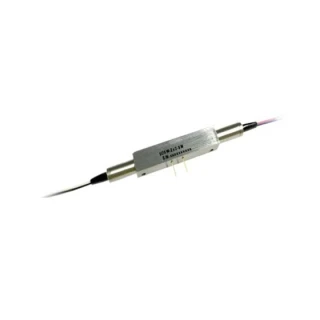
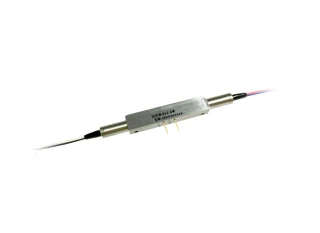
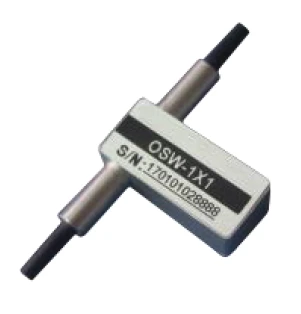
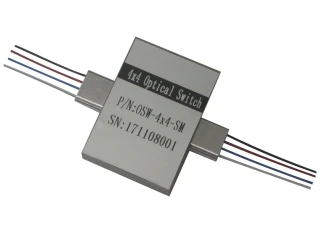
Mechanical Miniature 1×2 Optical Switch
Specifications
| Number Of Ports: | 1 – 2 |
|---|---|
| Wavelength Range: | 650 – 1669 nm |
| Insertion Loss (typical): | 0.5 dB |
| Return Loss: | 30 dB |
| Wavelength Range (nm): | 650 to 1310 / 1260 to 1670 |
| Testing Wavelength (nm): | 650/780/850/980/1064/1310 / 1310/1490/1550/1625/1650 |
| Insertion Loss (dB): | Typ.: 0.5, Max.: 0.8 |
| Return Loss (dB): | ≥30 / ≥50 |
| Crosstalk (dB): | ≥35 / ≥55 |
| PDL (dB): | ≤0.05 |
| WDL (dB): | ≤0.25 |
| TDL (dB): | ≤0.25 |
| Repeatability (dB): | ±0.02 |
| Power Supply (V): | 3.0 or 5.0 |
| Lifetime (Cycle): | 10^7 |
| Switching Time (ms): | ≤8 |
| Power Handling (mW): | ≤500 |
| Operating Temperature (°C): | -20 to +85 |
| Storage Temperature (°C): | -40 to +85 |
| Weight (g): | 16 |
| Dimension (mm): | (L)27 × (W)12.6 × (H)8.5 (±0.2) |
| 5V Latching Voltage: | 4.5-5.5 V |
| 5V Latching Current: | 36-44 mA |
| 5V Latching Resistor: | 125 Ω |
| 5V Non-Latching Voltage: | 4.5-5.5 V |
| 5V Non-Latching Current: | 26-32 mA |
| 5V Non-Latching Resistor: | 175 Ω |
| 3V Latching Voltage: | 2.7-3.3 V |
| 3V Latching Current: | 54-66 mA |
| 3V Latching Resistor: | 50 Ω |
| 3V Non-Latching Voltage: | 2.7-3.3 V |
| 3V Non-Latching Current: | 39-47 mA |
| 3V Non-Latching Resistor: | 70 Ω |
Got questions about specs? Use the inquiry form to ask.
 Download Data Sheet

Features
- Low Insertion Loss for Maximum Signal Integrity – Typical insertion loss of 0.5 dB (max. 0.8 dB) minimizes optical power penalties, ensuring clean, high‑quality transmission in demanding fiber optic networks.
- Ultra-Wide Wavelength Operating Range – Supports 650–1310 nm and 1260–1670 nm, covering key windows for multimode and singlemode applications (including 650, 780, 850, 980, 1064, 1310, 1490, 1550, 1625, 1650 nm).
- Exceptional Crosstalk Performance – Crosstalk as low as ≥35 dB (MM range) and ≥55 dB (SM range) provides excellent channel isolation, ideal for dense routing, monitoring, and reconfigurable optical add/drop multiplexers (OADM).
- High Return Loss for Stable Network Operation – Return loss up to ≥50 dB reduces back-reflection and improves system stability in precision measurement, test & measurement, and telecom environments.
- Low PDL, WDL, and TDL – Polarization dependent loss ≤0.05 dB, wavelength dependent loss ≤0.25 dB, and temperature dependent loss ≤0.25 dB guarantee consistent performance across varying operating conditions and optical spectra.
- High Stability and Long-Term Reliability – Robust mechanical design rated for up to 107 switching cycles, delivering reliable operation in 24/7 network systems, industrial setups, and R&D laboratories.
- Fast Switching Time – Switching time ≤8 ms enables rapid route changes for protection switching, dynamic network reconfiguration, and automated test systems.
- Epoxy-Free Optical Path – Epoxy-free design in the optical path eliminates contamination risks, improves long-term optical stability, and supports high-power handling up to 500 mW.
- Latching and Non-Latching Configurations – Available in both latching and non-latching types to optimize for low power consumption (latching) or simple drive control (non-latching) depending on system requirements.
- Flexible Electrical Drive Options – Operates from 3 V or 5 V supply with clearly defined coil resistance and current ratings for easy integration with standard control electronics and driver circuits.
- Compact and Lightweight Package – Small footprint of approximately 27 × 12.6 × 8.5 mm and weight of only 16 g allows dense packing on boards, in modules, and in space-constrained optical subsystems.
- Broad Operating Temperature Range – Designed for -20 to +85 °C operation and -40 to +85 °C storage, suitable for telecom central office, field-deployed, and industrial environments.
- Versatile Fiber and Connector Configurations – Supports SM (9/125 µm) and MM (50/125 µm, 62.5/125 µm) fibers, with optional 250 µm or 900 µm pigtails, and a full range of connectors (FC/PC, FC/APC, SC/PC, SC/APC, LC/PC, LC/APC, ST/PC, or bare fiber).
- Multiple Standard Test Wavelengths – Factory-tested at common telecom and datacom wavelengths for both singlemode and multimode applications, ensuring traceable and repeatable optical performance.
- Ideal for Network Protection and Monitoring – Optimized for metropolitan area networks, system monitoring, configurable OADM, optical protection switching, and automated measurement setups.
- Easy System Integration – Clearly defined route states, pin configurations, and sensor status signals simplify hardware design and allow fast plug‑and‑play integration into existing optical platforms.
- Cost-Effective Mechanical Optical Switching – Mechanical switch architecture offers low insertion loss and long life at a competitive cost, suitable for high-volume deployments and OEM integration.
- Custom Configurations Available – Custom wavelengths, fiber types, cable lengths, and connector options can be provided on request to match specific network architectures and laboratory setups.
Applications
- Metropolitan Area Network (MAN) Protection and Restoration – Use 1×2 mechanical optical switches to build redundant fiber paths, implement automatic line protection switching (OLP), and quickly reroute traffic during fiber cuts or equipment failures.
- Optical Add-Drop Multiplexers (OADM) and Reconfigurable OADM (ROADM) – Integrate the switch into configurable OADM modules to dynamically add, drop, or bypass specific wavelength channels in metro and regional DWDM systems.
- Optical Network Monitoring and Test Access – Provide non-intrusive access points for OTDR/OSA/BER testers, enabling in-service monitoring, performance verification, and troubleshooting of backbone and distribution fiber links.
- Automatic Line / Path Protection in Fiber Links – Implement 1+1 and 1:1 protection schemes in long-haul, metro, and campus networks, automatically switching traffic to backup fibers when primary paths degrade.
- Fiber Plant and PON (FTTx) Health Monitoring – Use low-loss switches in passive optical networks to sequentially connect multiple distribution fibers to a single OTDR or monitoring port for centralized, remote health checks.
- System Redundancy for Transceivers and Transponders – Share a single fiber route between two transceivers, or route one transceiver to diverse fiber paths, increasing system reliability while reducing hardware cost.
- Optical Source and Detector Selection – Switch between multiple lasers, LEDs, or photodiodes at wavelengths from 650 nm to 1670 nm, enabling flexible light source selection in R&D labs, burn-in stands, and calibration rigs.
- Laboratory R&D and Prototyping – Reconfigure complex optical testbeds, interferometers, and fiber-based experiments without physically re-patching fibers, improving repeatability and reducing handling errors.
- Manufacturing Test and Burn-In Systems – Integrate mechanical optical switches into automated test equipment (ATE) to multiplex many devices-under-test (DUTs) to a limited number of test instruments in production lines.
- Optical Component Characterization – Route signals to different DUTs (filters, splitters, amplifiers, isolators, circulators, etc.) when measuring insertion loss, return loss, crosstalk, and polarization dependence across wide wavelength ranges.
- Fiber Type and Wavelength Routing – Take advantage of the wide wavelength range (650–1670 nm) to switch between multimode and single-mode paths, or to direct different spectral bands to dedicated measurement or processing channels.
- Network Reconfiguration and Lab Switching Matrices – Combine multiple 1×2 switches into larger switching matrices for test labs, demo racks, and network emulation environments where frequent reconfiguration is required.
- Remote Reconfiguration in Field-Deployed Systems – Use the electrically controlled latching/non-latching options to remotely lock in an optical path state, ideal for remote nodes, outdoor cabinets, and unmanned POPs.
- Fiber Routing in Sensing and Instrumentation – Switch optical paths in distributed fiber sensing systems (DAS/DTS/DSS) or industrial monitoring setups to interrogate multiple sensor arrays with a single interrogator.
- Instrumentation and Measurement Equipment Integration – Embed the compact 1×2 switch into optical spectrum analyzers, power meters, and network analyzers to automatically select internal/external paths or reference channels.
- Optical Loopback and Self-Test Functions – Implement internal loopback paths in transceiver modules, line cards, and optical subsystems for built-in self-test (BIST) and factory acceptance testing.
- Signal Bypass and Maintenance Mode – Provide bypass routes around optical amplifiers, EDFAs, VOAs, or other active components during maintenance, firmware upgrade, or failure conditions.
- Educational and Training Laboratories – Use robust mechanical optical switches in university and training labs to demonstrate optical networking concepts, protection schemes, and WDM routing without complex electronics.
- Multi-Wavelength Test Benches – Combine the low insertion loss and excellent return loss performance to route 650 nm, 780 nm, 850 nm, 980 nm, 1064 nm, 1310 nm, 1490 nm, 1550 nm, 1625 nm, and 1650 nm sources in characterization setups.
- Satellite, Aerospace, and Harsh-Environment Systems – Leverage the epoxy-free optical path, high stability, and wide operating temperature range (−20 °C to +85 °C) for rugged optical communication or sensing links in challenging environments.
Frequently Asked Questions
What is the wavelength range for the OpticalSwitches?
What is the typical and maximum insertion loss for the OpticalSwitches?
What are the operating and storage temperature ranges for the OpticalSwitches?
What are the power supply options for the OpticalSwitches?
What is the switching time for the OpticalSwitches?
What is the power handling capacity of the OpticalSwitches?
Are custom configurations available for the OpticalSwitches?
Got more questions? Use the inquiry form to ask the supplier directly.
Similar Products


Your inquiry has been received.
Create an account by adding a password
Why create an account?
- Auto-complete inquiry forms
- View and manage all your past messages
- Save products to your favorites
- Close your account anytime — no hassle