
Description
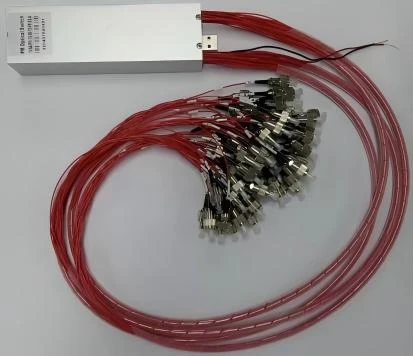
Discover the cutting-edge Optical Switches designed to enhance your optical network systems with precision and reliability. These switches are engineered to provide seamless integration into various network configurations, offering up to 24 channels for versatile connectivity. The modularized design ensures flexibility, allowing for easy customization and scalability to meet the evolving demands of your network infrastructure.
Our Optical Switches are built with an epoxy-free optical path, ensuring high performance and durability. The low loss and high reliability of these switches make them an ideal choice for maintaining optimal network performance. With a wide wavelength range from 200 nm to 2300 nm, these switches are suitable for a variety of optical applications, ensuring compatibility with different fiber types and network setups.
Designed to operate efficiently in diverse environmental conditions, these switches can withstand operating temperatures from -20°C to +70°C and storage temperatures from -40°C to +85°C. The robust construction and high-quality materials ensure a long lifetime of up to 10 million cycles, providing a dependable solution for your network needs. The compact dimensions of 135x42x42 mm make these switches easy to integrate into existing systems without requiring significant space.
The Optical Switches feature a parallel interface with TTL, RS485, and RS232 compatibility, allowing for straightforward integration with your current network management systems. The quick switching time of ≤30 ms ensures minimal delay, enhancing the efficiency of your network operations. With a power supply requirement of +5V, these switches are energy-efficient and easy to power within your existing infrastructure.
If you require a specific configuration that is not listed, please feel free to contact us for custom product solutions. Our team is dedicated to providing tailored solutions to meet your unique network requirements, ensuring that you have the right tools to optimize your optical network performance.
Optical Switches Stepper Motor, Up to 24 Channels, Low Loss
Specifications
| Number Of Ports: | 1 – 24 |
|---|---|
| Wavelength Range: | 400 – 1670 nm |
| Insertion Loss (typical): | 1 dB |
| Return Loss: | 35 dB |
| Core Diameter (um): | 200 to 600 |
| Insertion Loss (dB): | Typ. ≤ 1.5, Max. ≤ 2.5 |
| Wavelength (nm): | 200 to 2300 |
| Return Loss (dB): | SM ≥ 55, MM ≥ 35 |
| Crosstalk (dB): | ≥ -50 |
| PDL (dB): | ≤ 0.1 |
| WDL (dB): | ≤ 0.25 |
| TDL (dB): | ≤ 0.3 |
| Repeatability (dB): | ± 0.05 |
| Lifetime (Cycle): | 10^7 |
| Optical Input Power (mW): | ≤ 1000 |
| Switching Time (ms): | ≤ 30 |
| Operating Temperature (°C): | -20 to +70 |
| Storage Temperature (°C): | -40 to +85 |
| Power Supply (V): | +5 |
| Dimension (mm): | 135 x 42 x 42 |
Got questions about specs? Use the inquiry form to ask.
 Download Data Sheet

Features
- Up to 24 Optical Channels (1×N) – High‑density stepper‑motor driven optical switch supporting up to 24 ports in a compact 135 × 42 × 42 mm package.
- Wide Wavelength Range: 200–2300 nm – Suitable for UV, visible, and infrared applications with single‑mode and multimode fiber options.
- Low Insertion Loss – Typical insertion loss ≤ 1.5 dB, maximum ≤ 2.5 dB for reliable signal transmission across all channels.
- High Return Loss & Low Crosstalk – Return loss ≥ 55 dB (SM), ≥ 35 dB (MM) and crosstalk ≥ –50 dB for clean, isolated optical paths in dense networks and test setups.
- Excellent Stability & Repeatability – Insertion loss repeatability of ±0.05 dB with low PDL (≤ 0.1 dB), WDL (≤ 0.25 dB), and TDL (≤ 0.3 dB) for precise, repeatable measurements.
- Fast Switching Time – Sequence switching time between adjacent channels ≤ 30 ms, ideal for automated test systems and dynamic routing.
- High Optical Power Handling – Supports input optical power up to 1000 mW, meeting demanding lab and industrial requirements.
- Long Mechanical Lifetime – Stepper‑motor mechanism rated to 107 switching cycles for long‑term reliability and low maintenance.
- Stepper Motor Drive for Precise Positioning – Motorized 1×N platform provides accurate, repeatable port selection with robust mechanical design.
- Multiple Fiber Types Supported – Compatible with SM 9/125 and MM fibers (50/125, 62.5/125, 200/220, 400/440, 600/660 µm) to match a wide range of systems.
- Flexible Connector and Pigtail Options – Available with FC/PC, FC/APC, SC/PC, SC/APC, LC/PC, LC/APC, ST/PC, fiber array, bare fiber, and 2.0 mm pigtails in standard lengths.
- Epoxy‑Free Optical Path – Clean optical design without epoxy in the light path for low contamination risk and improved long‑term stability.
- Parallel and Serial Control Interfaces – Integrated TTL parallel control lines plus RS232, RS485, or USB options for easy integration into control systems and ATE platforms.
- Built‑In Status & Error Signals – /RESET, /READY, and ERROR signals simplify system‑level monitoring and fault handling.
- Single 5 V DC Power Supply – Operates from a 5 V ±5% supply (max 500 mA) for straightforward system integration.
- Wide Operating Temperature Range – Designed for –20 to +70 °C operation and –40 to +85 °C storage for use in lab, field, and network environments.
- Modular Design – Scalable architecture for easy configuration, maintenance, and upgrade of optical switching capacity.
- High‑Reliability Construction – Industrial‑grade components and mechanical structure for 24/7 operation in telecom and datacom networks.
- Ideal for Network & Lab Applications – Optimized for ring networks, remote optical monitoring, automated test and measurement, and fiber routing in R&D.
- Custom Configurations Available – Options for channel count, fiber type, connector style, control port, and pigtail length to match specific application requirements.
Applications
Applications of 1×N Optical Fiber Switch with Stepper Motor Control
This 1×N optical switch with stepper motor actuation, low insertion loss, and high reliability is suitable for a wide range of fiber optic routing, protection, and monitoring tasks across telecom, datacom, sensing, and test environments. The broad operating wavelength range (200–2300 nm), support for SM/MM and large core fibers, and interfaces like TTL, RS232, and RS485 make it very versatile.
- Optical ring network protection and restoration
Used to reroute traffic in ring and mesh topologies for metro, access, and backbone optical networks. In the event of a fiber or node failure, the switch automatically selects an alternate path to enhance network resilience. - Remote fiber monitoring in optical networks
Enables centralized monitoring of multiple fiber links by routing selected fibers to optical time-domain reflectometers (OTDRs) or optical spectrum analyzers. Ideal for long-haul, FTTH/FTTx, and data center links where remote diagnostics and fault location are required. - Automated optical test and measurement systems
Commonly deployed in production test racks and laboratories to sequence multiple devices under test (DUTs) to a single measurement instrument. It supports automated testing of optical transceivers, amplifiers, passive components (couplers, splitters, filters), and photonic integrated circuits. - Multi-channel OTDR and OSA switching
Allows a single OTDR or OSA to sequentially test or monitor many fibers, saving equipment cost. Frequently used by network operators, fiber manufacturers, and test labs for large-scale fiber characterization and maintenance. - Optical network reconfiguration and routing
Employed in reconfigurable optical add-drop modules and optical cross‑connect subsystems to dynamically change routing of optical paths without manual reconnection. Helpful in lab environments for flexible network emulation and in field systems for service re-provisioning. - Optical power distribution and source selection
Enables switching between multiple laser sources or routing a single source to different channels. Suitable for multi-wavelength test benches, burn‑in/aging setups, calibration lines, and redundancy schemes where backup lasers or transmitters are maintained. - Fiber sensing interrogation systems
Used in fiber Bragg grating (FBG) and distributed fiber sensing (DTS/DAS) systems to multiplex many sensing lines into one interrogator. Applicable in structural health monitoring, oil and gas pipelines, power lines, railways, tunnels, bridges, and geotechnical monitoring. - Industrial and medical laser delivery management
Suitable for routing high‑power laser light (within specified power limits) to different workstations or treatment channels. Relevant in materials processing, laser marking, and some medical/biophotonics setups where multiple output ports share a single laser source. - Research and development photonics labs
Widely used in university and corporate research labs for flexible routing of beams between experimental modules: modulators, detectors, nonlinear optics stages, fiber loops, and free‑space interfaces. The modular design and epoxy‑free optical path are advantageous for precise and stable experiments. - Optical component characterization
Supports automated characterization of passive components such as filters, mux/demux devices, attenuators, and switches themselves. Integrates into swept‑wavelength measurement systems and stability tests, allowing multiple samples to be tested under the same conditions. - Data center and enterprise fiber infrastructure management
Can be incorporated into intelligent patching and automated fiber management solutions to dynamically connect or isolate links. Useful for remote loopback testing, link validation, and redundancy switching without physical patch cord changes. - Broadcast and CATV optical distribution
Employed to switch or distribute RF-over-fiber signals among multiple branches, backup routes, or headends. Helps in system maintenance, redundancy, and temporary re-routing of video or broadband feeds. - Military, aerospace, and harsh-environment fiber systems
The compact, robust design and wide operating temperature range make it suitable for mission‑critical optical links in defense platforms, avionics, and ruggedized communication systems, enabling path redundancy and signal routing under demanding conditions.
Frequently Asked Questions
What is the maximum number of channels supported by the Optical Switches?
What are the typical and maximum insertion loss values for the Optical Switches?
What is the operating temperature range for the Optical Switches?
What types of interfaces are available for the Optical Switches?
What is the maximum optical input power for the Optical Switches?
What is the switching time for the Optical Switches?
Got more questions? Use the inquiry form to ask the supplier directly.
Similar Products
Your inquiry has been received.
Create an account by adding a password
Why create an account?
- Auto-complete inquiry forms
- View and manage all your past messages
- Save products to your favorites
- Close your account anytime — no hassle