
Description
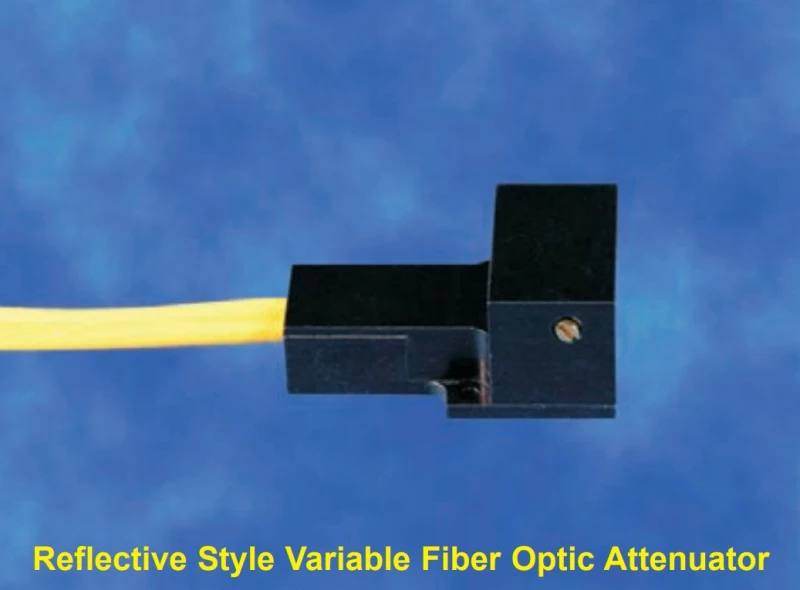
The Reflective Style Variable Fiber Optic Attenuator is a precision optical component designed for dynamic control of optical signal power in fiber optic networks. Engineered for both singlemode and multimode fiber applications, this attenuator is ideal for scenarios requiring reliable, repeatable, and adjustable attenuation. Its compact, rugged construction makes it suitable for integration into PC boards and patch panels, ensuring ease of installation and long-term durability even in demanding environments.
This variable attenuator utilizes either a neutral density filter or a high-power blocking plate, depending on the selected version. The neutral density filter version delivers mode-independent attenuation, making it particularly effective for multimode fiber systems where uniform attenuation across all modes is essential. For high-power applications exceeding 50mW, the blocking plate version provides robust performance and enhanced safety. Attenuation is easily adjusted via a side-mounted screw, allowing precise control over the optical signal without the need for disconnecting fibers.
Designed to support a wide wavelength range, including the C, L, and S bands, the Reflective Style Variable Fiber Optic Attenuator maintains low insertion loss and minimal polarization dependent loss (PDL). Its low backreflection characteristics are critical for maintaining signal integrity in sensitive optical networks. The reflective housing design enables both input and output fibers to be mounted on the same side, optimizing space and simplifying cable management in dense installations.
This attenuator is an excellent choice for optical power equalization and power control in wavelength division multiplexing (WDM) systems, multi-channel optically amplified networks, telecommunications, CATV, local area networks (LAN), and test and measurement setups. It is also widely used for receiver padding, ensuring optimal performance and protection of sensitive optical receivers. With its combination of versatility, reliability, and cost-effectiveness, the Reflective Style Variable Fiber Optic Attenuator stands out as a preferred solution for modern fiber optic network management.
Variable Fiber Optic Attenuator - Reflective Style
Specifications
| Number Of Channels: | Single Channel |
|---|---|
| Operating Wavelength Range: | 800 – 1620 nm |
| Dynamic Attenuation Range (max): | 40 dB |
| Insertion Loss (max): | 1.5 dB |
| Return Loss (min): | 40 dB |
| Wavelength Range: | 1300/1550 nm (C, L, and S bands) |
| Fiber Type: | Singlemode and multimode |
| Fiber Size: | 9/125 μm (singlemode) |
| Fiber Jacket OD: | 3 mm |
| Connector Type: | FC/Super PC or SC/Super PC |
| Return Loss: | 40 dB |
| Maximum Input Power: | 2 Watts (high power version) |
| Attenuation Control: | Turn screw adjustment |
| Mounting: | PC board mountable, with mounting holes |
| Mechanical Dimensions: | See Figure 1 (dimensions in inches) |
Got questions about specs? Use the inquiry form to ask.
 Download Data Sheet

Features
- Wide Wavelength Compatibility: Supports C, L, and S bands for versatile use in various optical networks.
- Reflective Style Design: Input and output fibers are attached on the same side, ideal for PC board and patch panel mounting.
- Variable Attenuation Control: Easily adjustable attenuation via side-mounted screw for precise optical power management.
- Neutral Density Filter & High Power Versions: Choose between uniform attenuation (ND filter) or high power handling (up to 2 Watts) for demanding applications.
- Singlemode & Multimode Fiber Options: Compatible with both singlemode and multimode fibers for broad application flexibility.
- Low Polarization Dependent Loss (PDL): Ensures consistent performance regardless of polarization state.
- Low Wavelength Dependence: Minimal variation in attenuation across supported wavelength ranges.
- Mode Independent Attenuation: Especially in multimode applications with the neutral density filter version.
- Wide Attenuation Range: Suitable for a variety of optical power equalization and control needs.
- Low Backreflection: Minimizes signal loss and interference, with return loss up to 40dB.
- Rugged & Compact Construction: Durable, space-saving design for easy integration into systems.
- Easy Mounting: Features mounting holes for secure attachment to PC boards and patch panels.
- Low Cost: Economical solution for optical attenuation requirements.
- Connector Versatility: Available with FC/Super PC or SC/Super PC connectors for seamless system integration.
Applications
- Optical Power Equalization in WDM Systems: Precisely balance optical signal levels across multiple channels in wavelength division multiplexing (WDM) networks, ensuring optimal performance and minimizing channel cross-talk.
- Optical Power Control for Multi-Channel Amplified Networks: Fine-tune and stabilize power levels in optically amplified systems, such as those using Erbium-Doped Fiber Amplifiers (EDFAs), to prevent signal distortion and maintain network integrity.
- Telecommunications Networks: Manage signal strength in long-haul and metro fiber optic communication links, enabling reliable data transmission and network scalability.
- CATV (Cable Television) Systems: Adjust and equalize optical signal levels in cable television distribution networks to ensure consistent video and data quality across all endpoints.
- Local Area Networks (LANs): Control optical power in enterprise and campus LANs, supporting high-speed data transfer and minimizing the risk of receiver overload.
- Test and Measurement Laboratories: Simulate varying network conditions, calibrate optical instruments, and perform system testing by introducing controlled attenuation in fiber optic test setups.
- Receiver Padding: Prevent optical receivers from saturation or damage by introducing precise attenuation, especially in scenarios with high input power levels.
- High Power Fiber Optic Applications: Safely manage and attenuate signals in systems handling optical powers above 50mW, such as laser delivery and industrial fiber optic setups.
- Optical Component and System Prototyping: Integrate into prototype assemblies for flexible power management during R&D and product development phases.
- Optical Sensing and Instrumentation: Adjust signal levels in fiber optic sensors and measurement devices to optimize sensitivity and dynamic range.
- Fiber Optic Patch Panels and PC Board Integration: Mount directly onto patch panels or printed circuit boards for compact, board-level optical power management in modular systems.
- Mode-Independent Attenuation in Multimode Fiber Systems: Achieve uniform attenuation across all propagation modes, essential for multimode fiber applications using the neutral density filter version.
- Research and Educational Laboratories: Demonstrate and study the effects of optical attenuation, power balancing, and network optimization in academic and training environments.
- Return Loss Optimization: Utilize low backreflection properties to minimize signal reflections in sensitive optical circuits and high-precision measurement setups.
- Field Deployments and Maintenance: Employ in field-testing scenarios to troubleshoot, balance, and maintain fiber optic links with varying power requirements.
Frequently Asked Questions
What is a reflective style variable fiber optic attenuator?
What are the main applications of the OZ Optics reflective style variable fiber optic attenuator?
How does the attenuation adjustment mechanism work?
What is the difference between the neutral density filter and high power versions?
What wavelength ranges are supported by this variable fiber optic attenuator?
What types of fiber and connectors are compatible with this attenuator?
What are the key performance features of this attenuator?
Got more questions? Use the inquiry form to ask the supplier directly.
Similar Products
Your inquiry has been received.
Create an account by adding a password
Why create an account?
- Auto-complete inquiry forms
- View and manage all your past messages
- Save products to your favorites
- Close your account anytime — no hassle