




Description
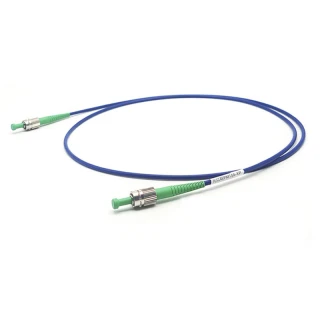
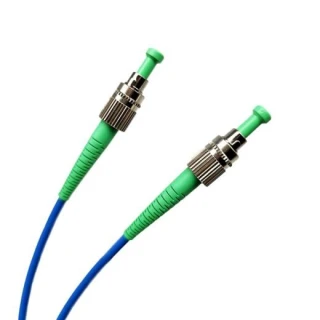
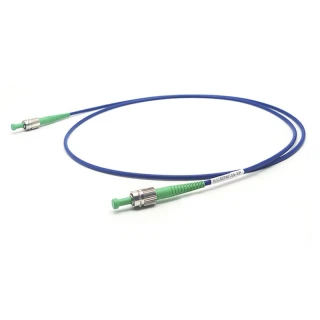
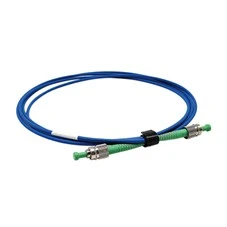
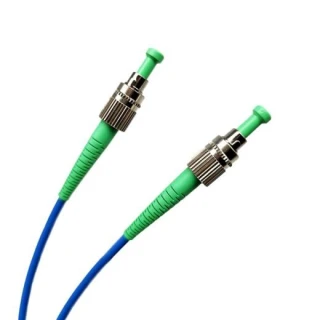
Polarization Maintaining (PM) fiber patchcords are precision‑engineered optical interconnects designed to preserve the state of polarization of light as it travels through an optical network or subsystem. Unlike standard single‑mode patchcords, PM patchcords incorporate specialized stress‑applying elements and tight mechanical tolerances so that the slow and fast axes of the fiber remain well defined and stable. This makes them an essential solution for coherent communication systems, interferometric sensors, quantum optics experiments, fiber lasers, and integrated photonics where polarization stability directly impacts system performance, accuracy, and signal‑to‑noise ratio.
These patchcords are available in several ruggedized constructions, including 0.9 mm jacketed PM patchcords for compact, low‑profile routing inside instruments, and 3 mm jacketed PM patchcords for more robust, laboratory or field‑deployable connections. For environments requiring superior mechanical protection, stainless steel armoring and reinforced cable designs are used to safeguard the fiber against crush, bend, and tensile stress. Careful control of fiber geometry, cable design, and connectorization ensures low insertion loss (typically below 0.2 dB) and high polarization extinction ratios in the 20 dB to 40 dB range, matching or exceeding the performance of high‑end PM patchcords commonly used in research and telecom-grade applications.
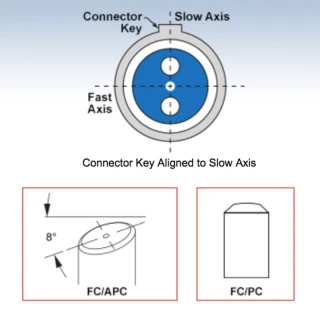
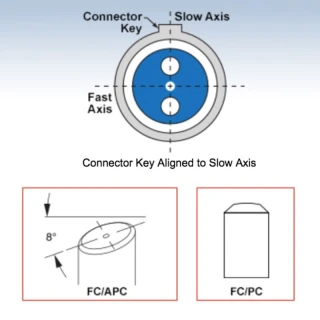
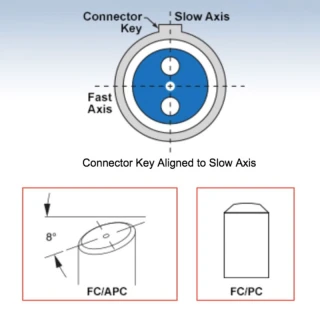
A key aspect of high‑quality PM patchcords is the way the polarization axis is maintained through the connector. These assemblies implement a high‑precision butt‑coupling technique between male and female connectors, using a positioning key and a matching keyway with very tight mechanical tolerances. The fiber’s slow axis is carefully aligned relative to this key so that, once mated, the polarization orientation remains consistent from one connection to the next. This connector construction supports excellent repeatability in both extinction ratio and insertion loss, which is critical in multi‑channel optical systems, polarization‑sensitive test setups, and long‑term deployed networks where reconnecting fibers must not change the polarization state.
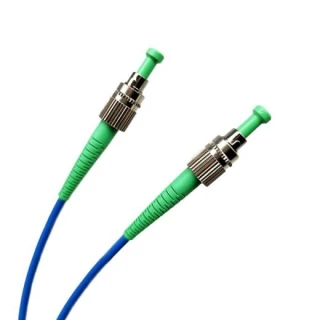
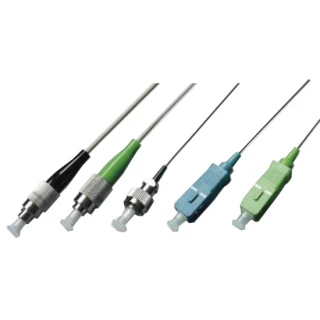
The product line supports a wide range of connector formats to integrate seamlessly into existing infrastructures. Standard terminations include FC/PC, SC, LC, MU, E2000, and MPO/MTP ® interfaces, as well as custom ferrule solutions for specialized optical assemblies. FC/PC terminations can be supplied either with a rotatable polarization axis, which enables the user to finely tune the polarization orientation after installation, or as pre‑aligned fixed‑axis terminations for maximum stability and simplicity. These designs are compatible with industry‑standard connectors and are engineered to meet stringent Telcordia‑style reliability requirements, making them suitable for both laboratory environments and demanding field applications.
For applications that require multiple polarization maintaining fibers to be terminated in a single compact connection, specialized dual‑fiber PM patchcord assemblies are offered. In these assemblies, two PM fibers are precisely aligned within a single ferrule to ensure that the polarization axes of both fibers have a well‑defined relationship to each other. The slow axes can be independently aligned and set either parallel or perpendicular, depending on the optical design requirements. This is especially useful in polarizing devices, interferometers, and integrated optical modules where two coherent channels must maintain a controlled polarization relationship for accurate measurement, interference, or coupling efficiency.
The geometry of the dual‑fiber ferrule end face can be tailored to the target system. Options include flat‑polished end faces for direct coupling into bulk optics, and angle‑polished end faces at custom orientations to reduce back reflections or to optimize coupling into angle‑sensitive components. Such flexibility allows these assemblies to integrate directly with lenses, micro‑optical benches, photonic integrated circuits, and other polarization‑critical modules without the need for additional alignment hardware. For systems requiring more than two fibers in a compact arrangement, multi‑fiber V‑groove assemblies are available, providing precise spatial and polarization alignment across multiple channels.
In high‑density environments such as data centers, coherent transmission systems, and multi‑channel test platforms, MPO/MTP ® PM fiber assemblies address the need for compact, polarization‑stable connectivity across many fibers. These multi‑fiber connectors are offered in 12‑fiber and 16‑fiber configurations, enabling parallel transmission, multi‑wavelength coherent links, or simultaneous interrogation of multiple sensing channels.
Polarization Maintaining Fiber Patchcords and Connectors
Specifications
| Insertion Loss: | 0.4 dB |
|---|---|
| Polarization Extinction Ratio (PER): | 20 dB |
| Wavelength Range: | 480 – 1625 nm |
| Core Diameter: | 8 um |
| Cladding Diameter: | 125 um |
| Extinction Ratio Range: | 20 dB to 40 dB |
| Typical Insertion Loss: | <0.2 dB |
| Jacket Diameter Option: | 0.9 mm |
| Jacket Diameter Option: | 3 mm |
| Coated Fiber Diameter: | 0.25 mm or 0.4 mm |
| Cable Size Code JD: | 0.25 or 0.4 (0.9 mm OD Hytrel tubing) |
| Cable Size Code JD: | 1 (0.9 mm OD jacketed or loose buffered fiber) |
| Cable Size Code JD: | 3 or 3A (3 mm PVC or armor cable) |
| Cable Size Code JD: | 3AS (3 mm OD stainless steel armor cable) |
| Cable Size Code JD: | 5A (5 mm reinforced armor cable) |
| Cable Size Code JD: | 5AS (5 mm OD stainless steel armor cable) |
| Connector Types: | FC/PC, SC, LC, MU, E2000, MPO/MTP |
| Connector Ferrule Diameter: | 10.0 mm |
| Reinforced Armor Cable OD: | 5 mm |
| Stainless Steel Armor Cable OD: | 3 mm or 5 mm |
| Specification Compliance: | Designed to meet Telcordia specifications |
| Extinction Ratio Repeatability: | Ensured by precision key/keyway butt-style connection |
| Available PM Fiber Configuration: | Dual fiber in single ferrule; slow axes parallel or perpendicular |
| End Face Options: | Flat or angle polished, custom orientations available |
| FC/PC Termination Options: | Rotatable polarization axis or pre-aligned fixed |
Got questions about specs? Use the inquiry form to ask.
 Download Data Sheet

Features
- High Polarization Extinction Ratio (PER) – Delivers extinction ratios typically from 20 dB up to 40 dB, ensuring excellent polarization preservation for demanding applications in coherent optics, interferometry, and high‑speed telecom.
- Low Insertion Loss – Precision butt‑style PM connections and high‑quality terminations provide typical insertion loss < 0.2 dB, maximizing optical power throughput and system performance.
- Exceptional Repeatability and Stability – Keyed PM connectors with tightly toleranced keyways ensure consistent PER and insertion loss over repeated matings, thermal cycling, and mechanical stress.
- Precise Polarization Axis Alignment – Each fiber’s slow axis is independently aligned with respect to the connector key; dual‑fiber assemblies can be supplied with axes aligned parallel or perpendicular to each other for optimal system design.
- Dual‑Fiber and Multi‑Fiber PM Solutions – Available as dual fiber PM patchcords in a single ferrule for coupling to lenses and integrated optics. For higher channel counts, compatible V‑groove and MPO/MTP® PM assemblies are available.
- MPO/MTP® PM Fiber Assemblies – Supports 12‑fiber and 16‑fiber MPO/MTP® PM connectors for compact, high‑density polarization‑maintaining links in data centers, coherent communication systems, and photonic testbeds.
- Broad Connector Compatibility – Offered with industry‑standard terminations including FC/PC, SC, LC, MU, E2000, and MPO/MTP®, enabling easy integration with existing fiber networks and lab setups.
- Rotatable or Fixed Polarization Axis Options – FC/PC PM terminations are available with either a rotatable polarization key for in‑situ axis optimization, or a pre‑aligned fixed key for maximum long‑term stability.
- Multiple Jacket Diameters and Constructions – Choice of 0.9 mm jacketed or loose buffered fiber, 3 mm PVC cable, and stainless‑steel armored options (3 mm and 5 mm OD) for applications ranging from protected lab patching to harsh‑environment field deployment.
- Enhanced Mechanical Protection – Optional Hytrel strain‑relief tubing, reinforced armor cables, and robust connector housings minimize bend‑induced loss, micro‑bending, and mechanical fatigue.
- Flat or Angle‑Polished End Faces – Available with flat‑polished or angle‑polished (APC) ferrules at custom orientations to suppress back reflections and optimize performance in high‑power or high‑sensitivity systems.
- Custom Ferrule and Multi‑Fiber Terminations – Supports custom ferrule diameters, multi‑fiber ferrules, and special key orientations for integration into lenses, collimators, fiber arrays, and other custom optical sub‑assemblies.
- PM Axis Referencing and Marking – Clear visual axis indicators (key notches, housing marks) provide easy and accurate alignment of the PM slow axis with external polarization optics and photonic devices.
- High‑Quality PM Fiber Options – Compatible with leading PANDA and elliptical‑core PM fibers (e.g., 780 nm, 980 nm, 1064 nm, 1310 nm, 1550 nm), allowing users to match wavelength range, NA, and beat length to their application.
- Low Return Loss (High Back‑Reflection Performance) – UPC and APC polishing processes yield low back‑reflection levels, supporting interferometric and coherent detection systems where reflections can degrade signal quality.
- Designed to Meet Telcordia Standards – Manufactured to comply with relevant Telcordia/G.R. specifications for reliability, temperature cycling, vibration, humidity, and durability in telecom‑grade deployments.
- Cleanroom‑Ready and Lab‑Grade Build Quality – High‑precision connector construction and tight geometrical tolerances (ferrule concentricity, end‑face geometry) ensure low modal noise and stable polarization in precision laboratory environments.
- Wide Range of Lengths and Configurations – Customizable patchcord lengths, connector combinations (e.g., FC–FC, FC–SC, LC–LC, MPO–MPO), and polarization orientations to fit both rack‑mounted systems and benchtop experiments.
Applications
- Coherent Fiber-Optic Communications
Ideal for coherent detection systems where stable polarization is critical, including advanced modulation formats (QPSK, QAM) and polarization-division multiplexing (PDM) in long‑haul and metro networks. The high extinction ratio (20–40 dB) and low insertion loss (<0.2 dB) of these polarization maintaining (PM) patchcords help maintain signal integrity over complex optical links. - High‑Speed Telecommunications Links
Used in backbone, metro, and access networks requiring reliable polarization alignment between transmitters, receivers, and inline components. The availability of FC/PC, SC, LC, MU, E2000, and MPO/MTP® terminations makes these patchcords compatible with a wide range of telecom transceivers and distribution frames. - Polarization‑Sensitive Test and Measurement Setups
Critical in fiber‑optic test benches, optical spectrum analyzers, polarization analyzers, and bit‑error‑rate (BER) test stations, where repeatable polarization state is required. The butt‑style connection with key‑aligned connectors ensures consistent extinction ratio and measurement repeatability during frequent connect/disconnect cycles. - Interferometric Fiber Sensors
Suitable for Mach‑Zehnder, Michelson, and Sagnac interferometers used in sensing applications such as strain, temperature, vibration, and acoustic detection. The PM performance and low loss help maintain interference visibility and sensitivity in distributed and point fiber sensor networks. - Fiber Gyroscopes (FOG) and Rotation Sensors
Used in polarization‑maintaining fiber gyroscopes where polarization stability is essential to minimize drift and bias errors. Dual‑fiber PM patchcords and MPO/MTP® PM assemblies support compact, multi‑channel FOG designs for aerospace, navigation, and defense systems. - Quantum Optics and Quantum Communication
Employed in quantum key distribution (QKD), entangled photon experiments, and other quantum information setups that use polarization‑encoded qubits. The high extinction ratio and precision axis alignment are crucial for preserving entanglement visibility and minimizing decoherence over fiber links. - Integrated Optics and Photonic Integrated Circuits (PICs)
Used to couple light into and out of polarization‑sensitive integrated optical chips and silicon photonics devices. Dual‑fiber and multi‑fiber PM assemblies simplify precise alignment to on‑chip polarizing elements, waveguides, and interferometers, supporting laboratory prototypes and volume PIC production testing. - Fiber Lasers and Amplifiers
Ideal for PM fiber lasers, erbium‑doped fiber amplifiers (EDFA), Raman amplifiers, and Yb/Er gain modules that require a fixed polarization state to maximize gain and maintain beam quality. These connectors ensure stable polarization between gain fibers, Bragg gratings, and delivery fibers. - Coherent LIDAR and Ranging Systems
Used in coherent and heterodyne LIDAR systems where polarization‑controlled beams improve signal‑to‑noise ratio and detection accuracy. PM patchcords maintain polarization across transmit, receive, and local‑oscillator paths, supporting applications in autonomous vehicles, atmospheric sensing, and industrial metrology. - Polarization‑Sensitive Optical Coherence Tomography (PS‑OCT)
Applied in biomedical imaging systems requiring defined polarization states to extract birefringence and structural information from tissues. PM patchcords between the light source, interferometer, and probe maintain polarization, enhancing image contrast and diagnostic capability. - Laboratory Polarization Control and Manipulation
Used in research labs for experiments involving polarization rotation, birefringence studies, and polarization‑dependent phenomena. The precise slow‑axis alignment (parallel or perpendicular between fibers) in dual‑fiber assemblies allows controlled polarization relationships between multiple channels. - Polarization‑Sensitive Spectroscopy
Suitable for ellipsometry, Raman, and fluorescence spectroscopy setups where the input and collected light polarization must be preserved. PM patchcords and dual‑fiber ferrule assemblies facilitate well‑defined polarization coupling to lenses, spectrometers, and detectors. - Multi‑Channel PM Systems via MPO/MTP® Assemblies
MPO/MTP® PM fiber assemblies with 12‑fiber and 16‑fiber connectors support high‑density, multi‑channel coherent systems, parallel optics, and polarization‑sensitive instrumentation. They enable compact routing of multiple PM channels in data centers, test racks, and coherent transceiver arrays.
Frequently Asked Questions
What are polarization maintaining (PM) fiber patchcords and when should they be used?
What extinction ratio and insertion loss can I expect from these PM patchcords?
Which connector and cable options are available for these PM fiber patchcords?
What is a dual fiber PM patchcord assembly and why is polarization axis alignment important?
How is the polarization axis maintained and aligned in these PM connectors?
Can I get custom PM patchcord configurations such as angle‑polished or multi‑fiber assemblies?
Are these PM patchcords compatible with industry standards and Telcordia requirements?
Got more questions? Use the inquiry form to ask the supplier directly.
Similar Products
Your inquiry has been received.
Create an account by adding a password
Why create an account?
- Auto-complete inquiry forms
- View and manage all your past messages
- Save products to your favorites
- Close your account anytime — no hassle