
Description
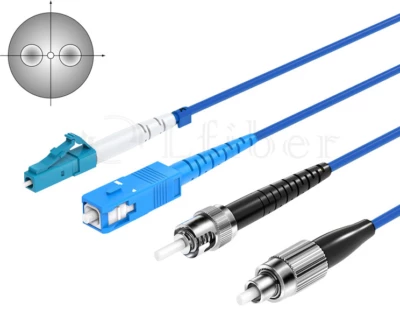
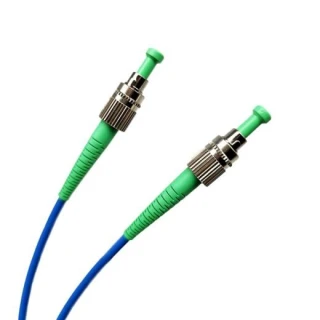
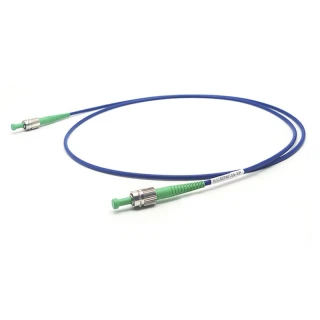
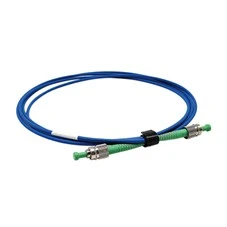
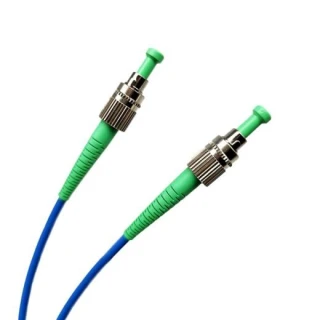
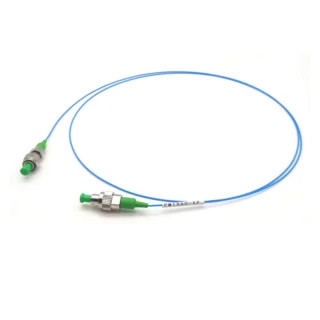
Lfiber\'s Polarization Maintaining (PM) Optical Fiber Patch Cable,is fabricated from Panda polarization-maintaining fibers and high-quality connectors that are compatible with the industry standards. It consists of a fixed length of PM single-mode fiber cable with like connectors installed on both ends (or, in the case of a hybrid cable, different connectors). For PM-applications, polarization-maintaining fiber is the optimal technical choice for high performance. Lfiber’s Panda PM fiber patch cord has excellent performance in the field after installation. It features low insertion loss, high extinction ratio, and remarkable stability.
Note:
- This PM Fiber Patch Cable is customizable, and above specifications are subject to change without notice.
- For product customization including high extinction ratios (ER ≥30 dB possible), custom ferrule terminations, special connector
types, etc., please contact our sales representative for availability.
Polarization Maintaining (PM) Fiber Patch Cable with High Extinction Ratio
Specifications
| Insertion Loss: | 1.5 dB |
|---|---|
| Return Loss: | 50 dB |
| Polarization Extinction Ratio (PER): | 20 dB |
| Wavelength Range: | 460 – 2000 nm |
| Wavelength Options: | 460, 630, 780, 830, 850, 980, 1060, 1064, 1310, 1550, 2000 |
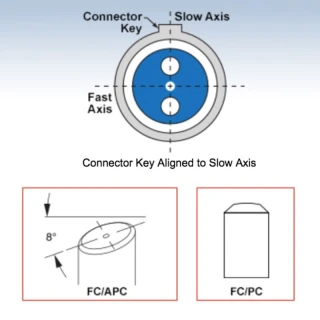
| Connector Type: | FC/UPC, FC/APC, SC/UPC, SC/APC, LC/UPC, LC/APC |
| Extinction Ratio @23 °C (dB): | ≥20 (standard grade), ≥23 (medium grade), ≥28 (high grade) |
| Fiber Type: | Polarization-maintaining (PM) Panda fibers |
Got questions about specs? Use the inquiry form to ask.
 Download Data Sheet

Features
- High-Performance Polarization Maintaining (PM) Fiber Patch Cable
Engineered for demanding polarization-sensitive applications, this PM patch cord ensures stable polarization transmission even under varying environmental and mechanical conditions. - Telcordia-Compliant Design for Carrier-Grade Reliability
Designed to meet Telcordia GR-326 and relevant industry standards, providing long-term reliability, low defect rates, and consistent performance in telecom and industrial environments. - Broad Wavelength Coverage from 460 nm to 2000 nm
Supports a wide operating wavelength range (460, 630, 780/830/850, 980/1060/1064, 1310/1550, and 2000 nm), making it suitable for visible, NIR, and telecom band applications, including fiber lasers, interferometry, and sensing. - Multiple Connector Options for Easy Integration
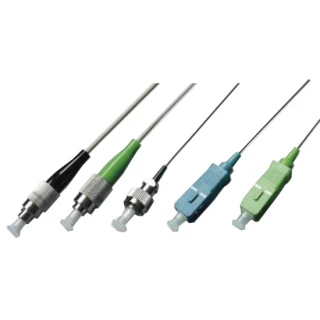
Available with industry-standard connectors including FC/UPC, FC/APC, SC/UPC, SC/APC, LC/UPC, LC/APC, and other types upon request, ensuring compatibility with most commercial fiber optic systems and instruments. - Low Insertion Loss for Maximum Signal Throughput
Optimized connector end-face geometry and high-quality PM fibers deliver low insertion loss, with typical values as low as ≤0.2–0.3 dB at 1310/1550 nm and ≤0.3 dB at 980/1060/1064 nm, minimizing power penalties and system loss budgets. - High Extinction Ratio for Superior Polarization Preservation
Offers graded performance levels with extinction ratios of ≥20 dB (standard), ≥23 dB (medium), and ≥28 dB (high grade), with ER >30 dB available on request, supporting precise polarization control in PM fiber sensing, interferometric, and coherent detection systems. - Excellent Return Loss for Clean Optical Interfaces
High-quality polishing and connector geometry deliver low back reflections, with return loss of ≥50 dB for UPC and ≥60 dB for APC interfaces, ideal for high-power or reflection-sensitive laser and measurement setups. - Panda PM Fiber for Stable Polarization Axis
Utilizes Panda-type polarization maintaining fiber as standard, providing high birefringence and robust polarization stability; other PM fiber types are available upon request for specialized applications or matching to existing systems. - Configurable Polarization Axis Orientation
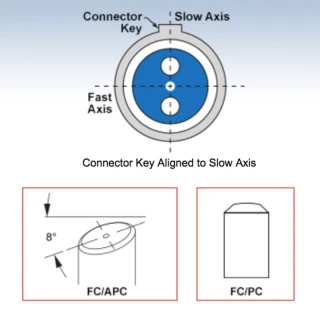
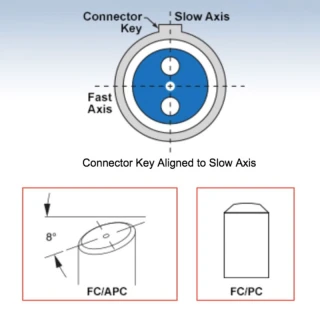
Standard configuration has the slow axis aligned with the connector key (slow-axis aligned), with an option for fast-axis alignment. This supports straightforward integration with polarization optics and alignment-critical systems. - Tight Polarization Angle Tolerances
Offers precise polarization angle control with ±3° tolerance for standard grade and ±1.5° for high grade, helping reduce alignment errors and ensuring repeatable performance in multi-channel and multi-component optical setups. - Flexible Fiber Jacket and Diameter Options
Available in multiple jacket constructions, including φ250 μm bare fiber, φ900 μm loose tube, φ2.0 mm cable, and φ3.0 mm cable, supporting integration in lab test setups, rack-mounted equipment, and field-deployed systems. - Customizable Fiber Lengths and Tolerances
Standard and custom lengths (e.g., 0.5 m, 0.8 m, 1.0 m, 1.5 m, 2.0 m, and user-defined) are offered with length tolerance of ±0.1 m or 10% of length, whichever is larger; tighter tolerances can be provided on request for precision time- or phase-critical applications. - Rugged Operating and Storage Temperature Range
Designed for stable performance over an operating temperature range of -5°C to +70°C and storage range of -40°C to +85°C, well-suited for both controlled lab environments and telecom/field deployments. - High Reliability and Long-Term Stability
Robust connectorization, strain relief, and PM fiber handling techniques ensure low drift in polarization properties and insertion loss over time, supporting long-term experiments and deployed fiber optic links. - Ideal for PM Sensing, Instrumentation, and Coherent Systems
Optimized for PM fiber sensing systems, polarization-maintaining applications, and optical testing instruments, such as coherent receivers, interferometers, fiber lasers, quantum optics setups, gyroscopes, and polarization-sensitive measurement systems.
Applications
- Polarization‑sensitive measurement systems – Ideal for connecting polarization maintaining components in PM fiber sensing systems, interferometers, and precision test setups where stable polarization is critical.
- Fiber optic gyroscopes (FOG) – Used as PM interconnects in fiber gyroscope coils and associated modules to ensure high polarization extinction ratio and long‑term stability.
- Coherent optical communication links – Suitable for coherent receivers, transmitters, and coherent transceiver testing where polarization state must be preserved from laser source to detector.
- Quantum optics and quantum communication experiments – Commonly used in quantum key distribution (QKD), entanglement distribution, and single‑photon experiments to maintain polarization-encoded quantum states.
- Polarization maintaining fiber sensing systems – Applied in distributed and point fiber sensors, including strain, temperature, pressure, and acoustic sensing where polarization stability increases measurement accuracy.
- Interferometric and metrology setups – Used in Mach‑Zehnder, Michelson, Sagnac and other interferometers for precision phase and polarization control in laboratories and production lines.
- PM fiber lasers and amplifiers – Serves as a stable pigtail and patch connection for polarization maintaining fiber lasers, EDFAs, YDFAs, and narrow linewidth sources at 780–2000 nm.
- Optical coherence tomography (OCT) – Integrated into polarization‑sensitive OCT systems to maintain the input and reference polarization states for high‑contrast imaging.
- Telecom and datacom test setups at 1310/1550 nm – Used in lab and field testing of optical transceivers, DWDM/CWDM components, and network elements requiring controlled polarization.
- Polarization mode dispersion (PMD) and PDL characterization – Provides stable PM connections to analyzers and polarization controllers for accurate PMD/PDL measurements.
- R&D in photonics and integrated optics – Ideal for coupling light into polarization‑sensitive photonic integrated circuits (PICs), waveguides, and on‑chip devices.
- Nonlinear optics experiments – Used in setups for second‑harmonic generation, four‑wave mixing, supercontinuum generation, and other nonlinear processes where input polarization must be preserved.
- Precision spectroscopy and metrology – Suitable for high‑resolution absorption, dispersion, and polarization spectroscopy in the visible and near‑IR wavelength ranges.
- Fiber‑based polarization control loops – Employed in feedback‑controlled polarization systems and active polarization stabilization units as low‑loss PM links.
- Atomic, molecular and optical (AMO) physics labs – Used to deliver well‑defined polarization states to cold atom traps, atomic clocks, and other AMO experiments at 460, 630, 780, 830, 850 and 1064 nm.
- High‑precision testing instruments – Connects PM components to optical spectrum analyzers, polarization analyzers, power meters, and other test equipment requiring repeatable polarization alignment.
- LiDAR and range‑finding modules – Implemented in certain polarization‑sensitive LiDAR architectures and time‑of‑flight measurement systems operating around 980 nm and 1064 nm.
- Fiber‑based sensors in harsh environments – Suitable for industrial and field‑deployed sensing systems that demand stable polarization over a wide operating temperature range.
- Polarization maintaining component evaluation – Used as reference patch cords for testing PM isolators, PM circulators, PM couplers, PM wavelength division multiplexers, and other PM fiber devices.
- Custom OEM fiber assemblies – Integrated into OEM modules and instruments that require configurable wavelength, connector types (FC/UPC, FC/APC, SC/UPC, SC/APC, LC/UPC, LC/APC), and high extinction ratio performance.
Frequently Asked Questions
What is a Polarization Maintaining (PM) Fiber Patch Cable?
What are the features of the Polarization Maintaining (PM) Fiber Patch Cable?
What are the typical specifications of the Polarization Maintaining Fiber Patch Cable?
Can the Polarization Maintaining (PM) Fiber Patch Cable be customized?
What are the applications of the Polarization Maintaining (PM) Fiber Patch Cable?
Got more questions? Use the inquiry form to ask the supplier directly.
Similar Products
Your inquiry has been received.
Create an account by adding a password
Why create an account?
- Auto-complete inquiry forms
- View and manage all your past messages
- Save products to your favorites
- Close your account anytime — no hassle