
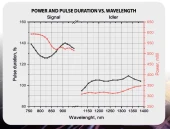
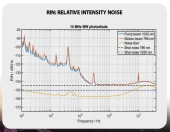
Description
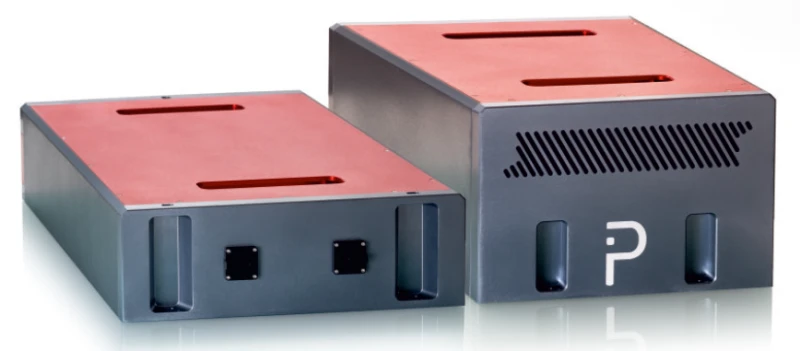
The FSX-series femtosecond lasers are a groundbreaking innovation in the field of laser technology, offering a compact and turn-key solution for a wide array of scientific and industrial applications. Designed with versatility in mind, these lasers are perfectly suited for use in biophotonics, material science, quantum computing, and basic research and development. The FSX-series stands out with its ultra low-noise performance and the ability to provide both fixed and tunable wavelengths, making it an ideal choice for researchers and professionals seeking precision and reliability.
One of the key features of the FSX-series is its multiple synchronized laser outputs, which are capable of ultra low-noise operation. This makes the FSX-series particularly effective for advanced imaging techniques such as coherent Raman imaging (CARS, SRS) and multi-spectral excitation two-photon imaging. The lasers can be equipped with a variety of options, including built-in dispersion compensation, fast power modulation, hollow-core fiber delivery, and non-linear frequency conversion modules. These features allow the FSX-series to drive multiple experiments simultaneously, optimizing both cost and space efficiency.
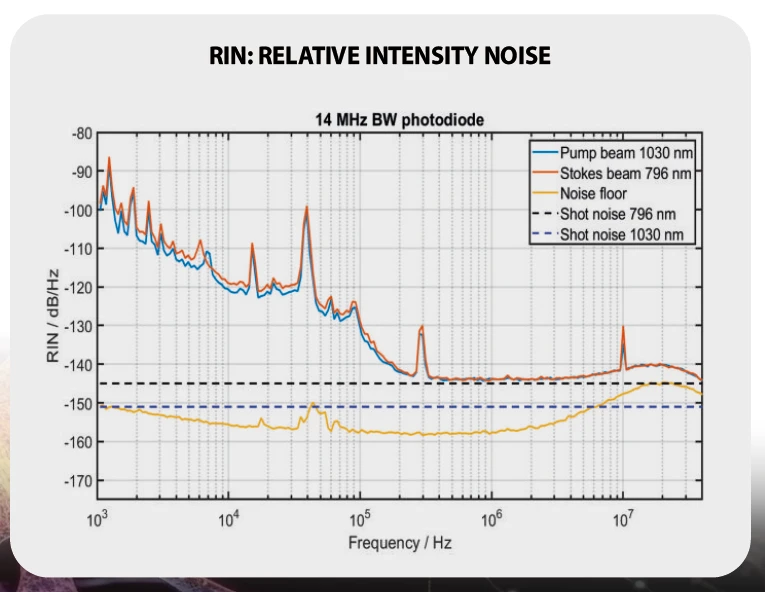
The FSX-series is engineered for ease of use and compactness, ensuring seamless integration into any laboratory or industrial setting. With high power synchronized pulses and ultra-low relative intensity noise (RIN) and phase noise, these lasers deliver exceptional performance and stability. The FSX-series supports 24/7 operation, making it a reliable choice for continuous use in demanding environments. Whether for quantum optics, amplifier seeding, FLIM microscopy, spectroscopy, neuroscience, or optogenetics, the FSX-series femtosecond lasers provide unparalleled precision and adaptability.
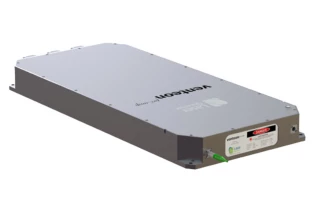
FSX-Series Femtosecond Lasers: Tunable, Ultra Low-Noise, Multi-Wavelength
Specifications
| Center Wavelength: | 1030 nm |
|---|---|
| Repetition Rate: | 100000 – 100000 kHz |
| Pulse Energy: | 0.0001 mJ |
| Pulse Duration: | 140 fs |
| Pointing Stability (RMS): | 30 urad |
| Polarization: | Unspecified |
| Spatial Mode (M^2): | <1.2 |
| Amplification Scheme: | Not Specified |
| First Wavelength: | 1030 nm |
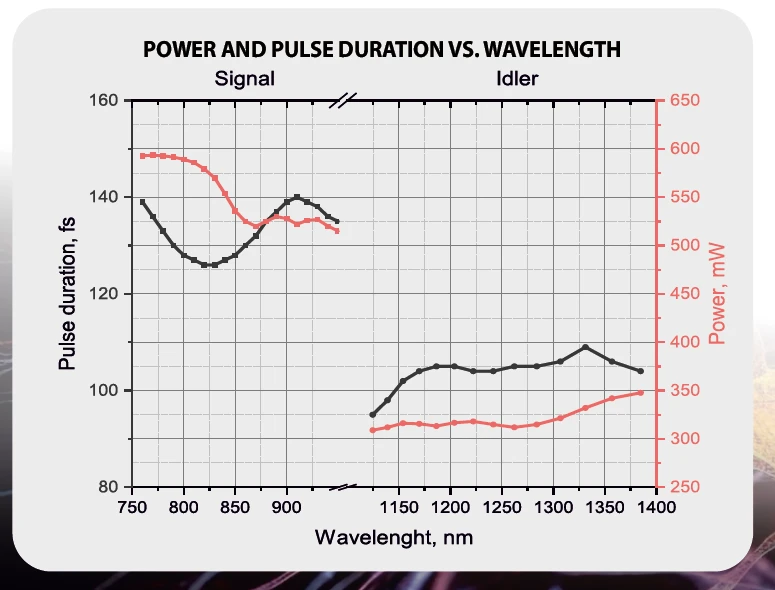
| Second Wavelength: | 765 - 940 nm (tunable in range) |
| Third Wavelength: | 1120 - 1570 nm (tunable in range) |
| Pulse Duration: | <140 fs |
| Average Output Power Per Wavelength: | >10 W |
| Pulse Energy: | >100 nJ |
| Pulse Repetition Rate: | 100 MHz *on request 40 - 250 MHz |
| Beam Quality, M^2: | <1.15, TEM00 |
| Pointing Stability: | 30 µrad rms (12 h) const. temperature, <5 µrad / °C @ 18 - 27 °C |
| Power Supply: | 90 – 264 VAC, 47 – 63 Hz |
| Power Consumption: | <500 W |
| Warm-up Time: | <10 min |
| Operation Temperature: | 18 °C - 27 °C |
| Storage Temperature: | -10 °C - 65 °C |
Got questions about specs? Use the inquiry form to ask.
 Download Data Sheet

Features
- Versatile Applications: Ideal for biophotonics, material science, quantum computing, and basic R&D.
- Ultra Low-Noise Performance: Features multiple ultra low-noise, wavelength tunable synchronized laser outputs.
- Broad Wavelength Range: Offers fixed and tunable wavelengths from 765 nm to 1570 nm.
- Compact and Turn-Key: Easy to use with a compact design, suitable for 24/7 operation.
- High Power and Synchronized Pulses: Provides high power with synchronized pulses for demanding applications.
- Advanced Modulation Options: Includes built-in dispersion compensation and fast power modulation.
- Multi-Experiment Capability: Can drive multiple experiments simultaneously, saving costs and space.
- Precision and Stability: Offers excellent beam quality (M2 <1.15, TEM00) and pointing stability (30 µrad rms).
- Environmental Adaptability: Operates efficiently within a temperature range of 18 °C - 27 °C.
- Powerful Output: Delivers >10 W average output power per wavelength with pulse durations <140 fs.
- Flexible Wavelength Options: Single wavelength options at 780, 920, and 1030 nm, with tunable ranges available.
- Comprehensive Support: Warranty options available, with additional features like AOM on stokes wavelength and dispersion pre-compensation.
Applications
- Coherent Raman Imaging (CARS and SRS): Ideal for label-free chemical imaging using synchronized femtosecond pulses, low relative intensity noise, and tunable wavelength outputs for high-contrast biological and materials analysis.
- Two-Photon Fluorescence Microscopy: Supports deep-tissue multiphoton imaging in neuroscience, developmental biology, zebrafish imaging, organoids, spheroids, and live-cell studies.
- Second-Harmonic and Third-Harmonic Generation Microscopy: Enables SHG and THG imaging of collagen, muscle tissue, membranes, interfaces, and non-centrosymmetric biological or material structures.
- Fluorescence Lifetime Imaging Microscopy (FLIM): Provides stable ultrashort pulses for fluorescence lifetime measurements, metabolic imaging, FRET studies, and quantitative bioimaging.
- Neuroscience and Optogenetics: Suitable for neuronal excitation, calcium imaging, optogenetic stimulation, brain-slice studies, and in vivo multiphoton neuroscience experiments.
- Multispectral Excitation Microscopy: Tunable and synchronized laser outputs enable excitation of multiple fluorophores, multiplexed imaging, and advanced multimodal microscopy workflows.
- Biophotonics and Biomedical Research: Supports advanced imaging of primary cells, zebrafish, Drosophila brains, neuronal networks, tissue samples, organoids, and 3D biological models.
- Quantum Optics and Quantum Technology: Ultra-low noise femtosecond pulses are well suited for quantum optics experiments, photon-pair generation, nonlinear optics, entangled photon studies, and quantum computing research.
- Ultrafast Spectroscopy: Applicable for pump-probe spectroscopy, transient absorption spectroscopy, time-resolved photoluminescence, nonlinear spectroscopy, and carrier dynamics measurements.
- Nonlinear Optical Spectroscopy: Enables multi-wavelength excitation for nonlinear optical studies, frequency conversion, harmonic generation, and ultrafast light-matter interaction experiments.
- Amplifier Seeding: Stable 1030 nm femtosecond output can be used for seeding ultrafast fiber amplifiers, regenerative amplifiers, and high-power femtosecond laser systems.
- Supercontinuum Generation: High peak power femtosecond pulses support broadband supercontinuum generation in photonic crystal fibers, nonlinear fibers, and bulk nonlinear media.
- Terahertz Generation: Suitable for THz generation and detection using nonlinear crystals, photoconductive antennas, optical rectification, and ultrafast time-domain spectroscopy setups.
- Two-Photon Polymerization and 3D Microfabrication: Enables high-resolution 2P polymerization for micro-optics, microfluidics, biomedical scaffolds, photonic structures, and precision 3D nanofabrication.
- Laser Micromachining and Materials Processing: Femtosecond pulses are applicable for precision ablation, surface structuring, thin-film processing, micro-drilling, and low-heat-affected-zone material modification.
- Photonic Device Fabrication: Supports fabrication and testing of waveguides, integrated photonic circuits, microresonators, optical sensors, and nonlinear photonic devices.
- Semiconductor and Nanomaterials Research: Useful for ultrafast characterization of semiconductors, 2D materials, nanostructures, perovskites, and photovoltaic materials.
- Chemical and Molecular Imaging: Enables label-free detection of lipids, proteins, water, polymers, and other molecular species through Raman-based and nonlinear imaging techniques.
- Live-Cell and Tissue Imaging: Low-noise, compact, turn-key operation supports long-duration imaging of live biological samples with stable femtosecond excitation.
- Developmental Biology Imaging: Suitable for high-resolution imaging of zebrafish embryos, Drosophila models, organoids, spheroids, and dynamic biological development processes.
- Ophthalmic and Vision Research: Applicable for multiphoton imaging of retinal tissue, zebrafish eye samples, ocular structures, and vision-related biological models.
- Metabolic Imaging: Enables label-free and fluorescence-based imaging of metabolic activity, including NADH/FAD fluorescence lifetime studies and lipid-rich tissue analysis.
- Multimodal Microscopy Platforms: Supports combined CARS, SRS, TPEF, SHG, THG, and FLIM imaging from a single synchronized femtosecond laser source.
- Fiber Delivery for Microscopy and Spectroscopy: Compatible with advanced beam delivery options such as hollow-core fiber del
Frequently Asked Questions
What is the Prospective Instruments FSX-Series femtosecond laser used for?
What wavelengths are available with the FSX-Series femtosecond laser?
What pulse duration and repetition rate does the FSX femtosecond laser provide?
How much output power and pulse energy are available from the FSX-Series?
Is the FSX-Series suitable for CARS and SRS coherent Raman imaging?
What beam quality and stability does the FSX femtosecond laser offer?
What options are available for the FSX-Series femtosecond laser?
Got more questions? Use the inquiry form to ask the supplier directly.
Similar Products
Your inquiry has been received.
Create an account by adding a password
Why create an account?
- Auto-complete inquiry forms
- View and manage all your past messages
- Save products to your favorites
- Close your account anytime — no hassle