

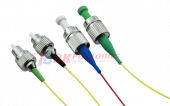
Description
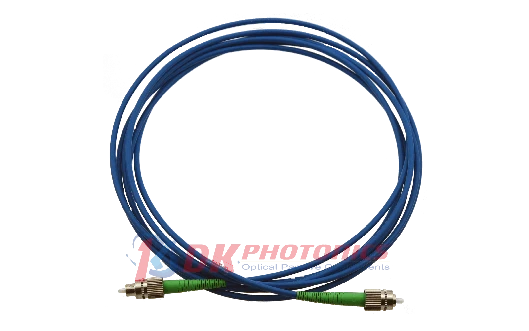
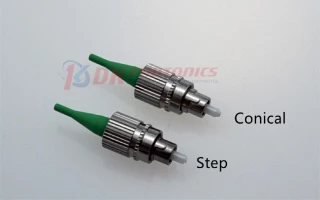
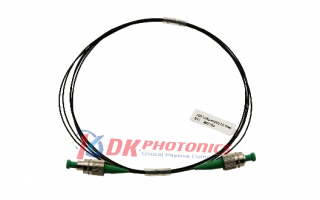
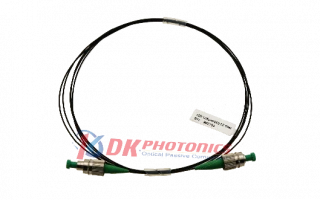
The 525nm single mode patch cord is a precision fiber optic cable designed for stable single-mode transmission at visible green wavelengths. Optimized for photonics, laser delivery, spectroscopy, microscopy, and scientific instrumentation applications, these specialty optical patch cords provide low insertion loss, high return loss, and reliable optical coupling for demanding laboratory and industrial systems. Available with multiple connector configurations including FC, LC, and SC, 525nm single mode patch cords support high-performance optical signal delivery in visible-light fiber optic applications.
What is a Visible-Wavelength Single Mode Fiber?
Visible-wavelength single mode fibers are specialty optical fibers designed to support single-mode light propagation at shorter wavelengths such as 405 nm, 488 nm, and 525 nm. Because shorter wavelengths require much smaller mode-field diameters and tighter optical tolerances, these fibers are optimized differently from conventional telecom single-mode fibers.
Visible single-mode fibers are widely used in:
- laser delivery,
- microscopy,
- spectroscopy,
- biomedical optics,
- quantum optics,
- scientific instrumentation.
Why Use 525nm Optical Fiber Components?
The 525 nm wavelength range is important in many visible-light photonics applications including:
- green laser systems,
- fluorescence microscopy,
- spectroscopy,
- biomedical imaging,
- optical instrumentation.
Single mode operation at 525 nm enables precise beam delivery, stable optical coupling, and improved spatial beam quality for demanding scientific and industrial applications.
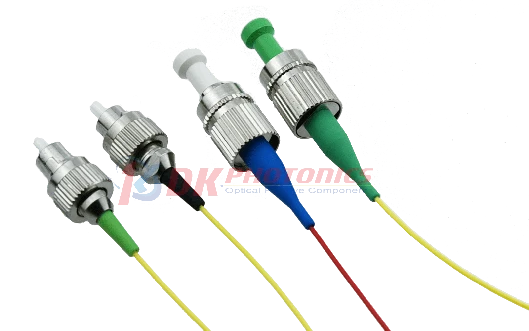
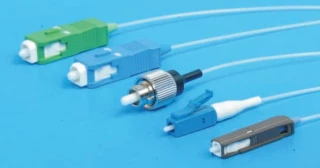
525nm single mode patch cords are available with multiple connector configurations including:
FC/PC
FC/APC
LC
SC
ST
Connector selection depends on:
- return loss requirements,
- precision,
- laser stability,
- system compatibility.
APC connectors are commonly preferred for minimizing back reflections in sensitive laser and photonics systems.
Understanding Insertion Loss and Return Loss
Low insertion loss is critical for minimizing optical attenuation in visible-light fiber systems. High return loss helps suppress back reflections that can destabilize laser systems and reduce optical measurement accuracy.
High-performance 525nm patch cords are designed to provide:
- low insertion loss,
- stable optical coupling,
- high return loss,
- reliable long-term optical performance.
Challenges of Visible-Wavelength Single Mode Fiber Transmission
Single-mode transmission at visible wavelengths requires much smaller mode-field diameters and tighter optical alignment tolerances compared to telecom wavelengths such as 1310 nm or 1550 nm. Precision connector polishing, stable fiber geometry, and careful optical alignment are especially important for minimizing losses and maintaining beam quality in visible-light fiber systems.
525nm Single Mode Patch-Cord
Specifications
| Wavelength Range: | 460 – 600 nm |
|---|---|
| Cable Length: | 1 m |
| Fiber Core Material: | Silica |
| Mode Field Diameter (MFD): | 3.4 ± 0.5 um @460 nm |
| Test Wavelength: | 525 nm |
| Insertion Loss: | ≤2.5 dB |
| Return Loss: | ≥40 dB |
| Fiber Type: | 460-HP |
| Numerical Aperture: | 0.12 |
| Repeatability: | ≤0.2 dB |
| Optical Power: | ≤100 mW |
| Operation Temperature: | -5 to +75 ℃ |
| Storage Temperature: | -40 to +85 ℃ |
| Length Accuracy: | +/-5CM |
Got questions about specs? Use the inquiry form to ask.
 Download Data Sheet

Features
- Optimized for 525 nm Single-Mode Operation – Precisely engineered for stable single-mode transmission at 525 nm, ideal for visible-green wavelength fiber systems.
- Low Insertion Loss – High-quality fiber and precision polishing deliver minimal insertion loss, helping to maximize system power budget and signal fidelity.
- High Return Loss – Excellent back-reflection performance (high return loss) reduces signal distortion and protects sensitive laser sources at 525 nm.
- Excellent Stability and Reliability – Robust design, strict manufacturing control, and proven components ensure long-term stability in laboratory, industrial, and field environments.
- High-Precision Connectors (FC/PC, FC/APC, LC, SC, etc.) – Available with a wide range of industry-standard connectors, including PC and APC polish options for optimized back-reflection performance.
- Single-Mode Fiber Optimized for 460-HP and Similar Types – Compatible with commonly used 460-HP and equivalent single-mode fibers at 525 nm, ensuring good mode-field matching and low coupling loss.
- Custom Lengths with Tight Length Tolerance – Standard length accuracy of ±5 cm; other tolerances and custom lengths are available on request for precise system layouts.
- Various Cable Diameters and Jacket Options – Offered in 0.9 mm OD loose tube and other jacket diameters; different buffer and jacket materials available for lab, rack, and OEM integration.
- Low Polarization-Dependent Loss – Carefully controlled geometry and connector quality help minimize PDL, improving performance in polarization-sensitive systems.
- High Power Handling (Application-Dependent) – Suitable for typical low-to-medium power 525 nm fiber laser delivery and instrumentation; power-handling upgrades available for specialized use.
- Excellent Repeatability and Interchangeability – Tight connector tolerances and quality ferrules ensure consistent performance across multiple mating cycles and between different patch cords.
- Wide Application Compatibility – Designed for 525 nm fiber lasers, fiber instruments, fiber I/O ports, optical transmitters and transceivers, sensing systems, imaging setups, and R&D test benches.
- Clean and Stable Connector End-Faces – Professionally polished and inspected connector end-faces minimize scattering and contamination-related performance drift.
- Flexible Configuration Options – Available as patch cord (two connectors) or pigtail (single connector), with customizable connector types at each end for easy integration into mixed-connector networks.
- Short Lead Times on Custom Designs – DK Photonics supports rapid turnaround for custom wavelengths, lengths, connector combinations, and cable constructions.
- Compact and Lightweight – Slim cable profile and compact connectors simplify routing in crowded racks, optical tables, and integrated modules.
- RoHS-Compliant Materials – Environmentally responsible construction using RoHS-compliant materials suitable for global deployment.
- Proven in OEM and Research Environments – Suitable for integration into OEM equipment as well as for use in research labs requiring consistent, repeatable optical performance at 525 nm.
Applications
- Precision fiber laser delivery for 525 nm green lasers in materials processing, micro-machining, lithography, and semiconductor wafer inspection
- High‑stability optical links in green laser metrology systems, interferometers, and optical test benches requiring low insertion loss and high return loss
- Fiber‑coupled laser diode routing for 515–532 nm DPSS and diode lasers in OEM laser modules and compact laser heads
- Optical transmitter and transceiver interconnects in short‑reach, high‑reliability data links and optical backplanes operating around 525 nm
- Single‑mode fiber I/O ports for integrating 525 nm SM fibers into benchtop and rackmount instruments, optical sub‑assemblies, and evaluation boards
- Fiber‑optic test and measurement for connecting optical power meters, spectrum analyzers, OTDRs, and other fiber instruments at visible wavelengths
- Laboratory patching and routing of 525 nm signals in R&D labs, university optics teaching labs, and photonics research facilities
- Single‑mode pigtailed components interface for 520–530 nm isolators, couplers, WDMs, filters, and other passive devices
- Biomedical and life‑science optics including excitation delivery for fluorescence microscopy, flow cytometry, confocal imaging, and bio‑sensing at 488–532 nm
- Endoscopy and medical illumination as a stable, low‑loss delivery fiber for green laser light in minimally invasive diagnostic and therapeutic systems
- Machine vision and inspection systems using 525 nm structured light, line‑scan illumination, and precision alignment sensors
- Holography and interferometric imaging where coherent, single‑mode 525 nm delivery improves fringe contrast and image quality
- OEM integration into compact instruments, sensors, and handheld devices that require robust, reliable green single‑mode fiber patch cords
- Reference links and calibration paths in production test setups, burn‑in stations, and QA lines for 525 nm sources and components
- Prototype and system evaluation of new 520–530 nm laser sources, detectors, and fiber‑optic subsystems
Frequently Asked Questions
What is a 525 nm single mode patch cord and where is it typically used?
How do I choose the right connector type (FC, SC, LC, PC, APC) for a DK Photonics 525 nm single mode patch cord?
What are insertion loss and return loss for these 525 nm single mode patch cords, and why do they matter?
What fiber type and mode field diameter are used in DK Photonics 525 nm single mode patch cords?
Can DK Photonics customize 525 nm single mode patch cords (length, fiber, connector, jacket, pigtails)?
How accurate is the stated length of a DK Photonics 525 nm single mode patch cord and can I specify tighter tolerances?
How do I interpret the DK Photonics part number for a 525 nm single mode patch cord (e.g., SMPC-525-P-S46-90-20-FA)?
Got more questions? Use the inquiry form to ask the supplier directly.
Similar Products

Your inquiry has been received.
Create an account by adding a password
Why create an account?
- Auto-complete inquiry forms
- View and manage all your past messages
- Save products to your favorites
- Close your account anytime — no hassle