


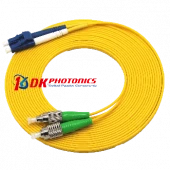
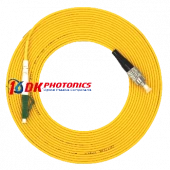
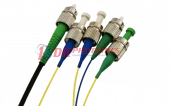
Description
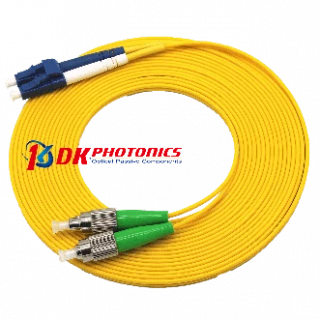
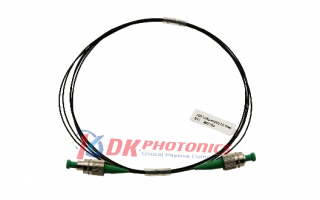
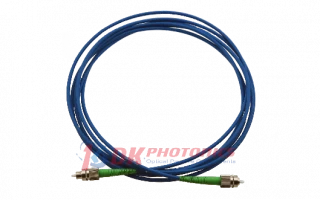
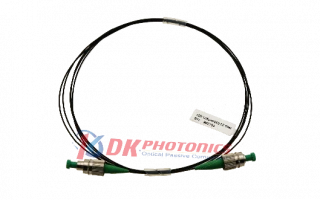
The 1064 nm Single Mode Patch Cord from DK Photonics is designed as a high‑reliability, low‑loss interconnect solution for precision fiber‑optic systems operating around the 1.0–1.1 µm wavelength range. Engineered for high return loss and low insertion loss, this patch cord provides stable, repeatable performance in demanding environments such as fiber laser systems, optical test and measurement setups, and high‑power or high‑coherence transmission links. By combining carefully selected 1060‑XP panda polarization‑maintaining fiber options with industry‑standard single mode connectors, it offers a robust and consistent connection for both R&D laboratories and OEM integration.
Single mode patch cords at 1064 nm are widely used as critical interface components between lasers, instruments, and fiber‑based modules. Typical applications include linking fiber lasers to isolators, couplers, and combiners; routing light between optical transmitters, transceivers, and receivers; and serving as input/output leads for fiber‑optic sensors and measurement instruments. The DK Photonics 1064 nm patch cord is optimized to preserve beam quality and minimize back reflections, which is particularly important for narrow‑linewidth and pulsed laser sources operating near the Nd:YAG 1064 nm line. High return loss reduces feedback into sensitive laser cavities, improving stability and extending the lifetime of the source.
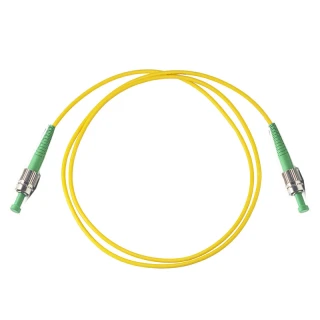
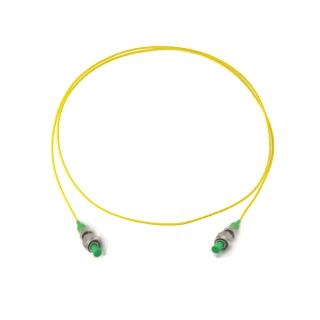
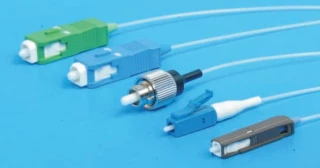
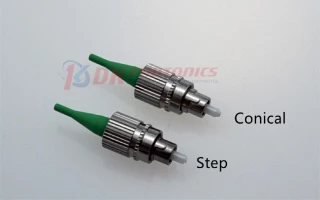
To ensure compatibility across a wide variety of systems, these patch cords are available with multiple connector types, such as FC, SC, and LC in both PC and APC polishing styles. The connector choice follows standard naming conventions, where the patch cord is identified by the connector interface on its ends (for example, FC/PC–FC/PC or FC/APC–SC/APC). APC polished connectors are typically preferred for high‑power or low‑back‑reflection applications, while PC connectors are often used in general laboratory and test setups. The key width of FC connectors is aligned with common industry practice in the 980–1700 nm range, and versions with narrow keys can be provided when required for compatibility with specific instruments and polarization‑maintaining components.
The underlying fiber and cable construction are chosen for long‑term stability and mechanical robustness. Using high‑quality 1060‑XP panda fiber in many configurations, the patch cord can provide excellent polarization performance when matched to polarization‑maintaining systems, while standard single mode variants focus on low attenuation and low mode distortion. The typical mode field diameter at 1064 nm is tightly controlled to match widely used single mode fibers in this wavelength band, which helps minimize splice loss and connector loss when integrating the patch cord into existing networks or experimental setups. The cable is usually jacketed with a 0.9 mm loose tube for flexible routing and easy handling in benchtop or rack‑mount environments, with length options tailored to system layouts.
Precision manufacturing and stringent quality control contribute to the excellent repeatability and reliability of these patch cords. Connector endfaces are polished and inspected to meet high‑grade optical standards, limiting surface defects that can lead to scattering and increased insertion loss. Each assembly is typically tested for insertion loss, return loss, and mechanical integrity to ensure that it meets or exceeds the specified performance. This makes the 1064 nm Single Mode Patch Cord well suited not only for low‑power instrumentation but also for more demanding industrial and field applications where stable, long‑term performance is critical.
Typical use cases span from integrating fiber‑coupled 1064 nm lasers into material processing and micromachining systems, to linking interferometric measurement setups, optical coherence tomography stages operating near 1 µm, and various fiber‑optic sensor configurations. In many of these systems, even small variations in insertion loss or back reflection can affect signal‑to‑noise ratio, measurement repeatability, or process quality. By using a dedicated 1064 nm single mode patch cord designed for high return loss and low insertion loss, users gain a more controlled and predictable optical interface, improving overall system performance and reducing the need for frequent recalibration.
The product line supports a broad range of customized configurations through a structured part‑number system. Users can specify wavelength band, performance grade, fiber type (such as 1060‑XP panda or other single mode fibers), cable outer diameter, length, and connector type and polish at each port. Length accuracy is tightly controlled, with a standard tolerance on the order of a few centimeters, suitable for applications where precise path length is important, such as timing‑sensitiv
1064nm Single Mode Patch-Cord
Specifications
| Wavelength Range: | 980 – 1600 nm |
|---|---|
| Cable Length: | 2 m |
| Fiber Core Material: | Silica |
| Mode Field Diameter: | 5.9 ± 0.5 um @ 980 nm, 6.2 ± 0.5 um @ 1060 nm,9.5 ± 0.5 um @ 1550 nm |
| Test Wavelength: | 1064 nm |
| Connector Type: | FC |
| Insertion Loss: | ≤0.5 dB |
| Return Loss (PC): | ≥40 dB |
| Fiber Type: | 1060-XP |
| Numerical Aperture: | 0.14 |
| Repeatability: | ≤0.2 dB |
| Operation Temperature: | -5 to +75 °C |
| Storage Temperature: | -40 to +85 °C |
| Length Accuracy: | +/-5CM |
Got questions about specs? Use the inquiry form to ask.
 Download Data Sheet

Features
- Optimized for 1064 nm Single-Mode Operation – Precisely designed for 1064 nm wavelength to ensure low dispersion and stable single‑mode transmission in fiber laser and instrumentation systems.
- Low Insertion Loss – High‑quality 1060‑XP panda fiber and precision connectors deliver very low insertion loss, maximizing optical power throughput and system efficiency.
- High Return Loss / Low Back Reflection – UPC/APC polished connectors provide excellent return loss performance, reducing back‑reflection and improving laser and transmitter stability.
- High Stability and Reliability – Robust construction, high‑grade materials, and stringent manufacturing control ensure long‑term reliability in laboratory, production, and field environments.
- Premium 1060‑XP Panda Fiber – Uses industry‑proven 1060‑XP panda polarization‑maintaining fiber platform (also available in SM version), enabling high performance in precision optical setups.
- Multiple Connector Options (FC / SC / LC and Others) – Available with FC, SC, LC and other common connector types; connector configuration can be customized (e.g., FC/APC–FC/APC, FC/UPC–SC/UPC, etc.).
- PC and APC Polishing Choices – Offered with PC (UPC) or APC end‑face polishing to match system requirements for insertion loss and return loss.
- Customizable Fiber Lengths – Standard and custom lengths available; default length tolerance is ±5 cm, with tighter tolerances available on request for precision applications.
- Flexible Cable Diameters and Jacket Types – Supports 0.9 mm loose tube, 2.0 mm or 3.0 mm jacketed cables and various sheathing materials to suit routing, protection, and handling needs.
- Excellent Mechanical Durability – Strong strain‑relief boots and robust connector housings designed for repeated mating cycles and handling without degradation of optical performance.
- Low Polarization‑Dependent Loss (PDL) – Carefully controlled fiber and connector geometry minimize PDL, enhancing performance in polarization‑sensitive setups.
- High Power Handling Capability – Suitable for many 1064 nm fiber laser and amplifier interfaces when properly specified, supporting stable operation in high‑power optical paths.
- Tight Manufacturing Tolerances – Mode Field Diameter (MFD) and core alignment are strictly controlled to reduce splice/connection losses in demanding optical networks.
- Cleanroom‑Grade Connector End Faces – Factory‑polished and inspected under strict quality standards to minimize contamination and scratches, improving long‑term connector performance.
- Broad Compatibility with 980–1700 nm Systems – Connector standards and keying are compatible with common 980–1700 nm equipment; for this range, default FC key width is 2.2 mm (narrow 2.0 mm key available on request).
- Ideal for Fiber Lasers and Amplifiers – Engineered for stable coupling into 1064 nm fiber laser cavities, pump delivery lines, and amplifier stages.
- Perfect for Fiber Instruments and Test Setups – Suited for use with optical spectrum analyzers, power meters, interferometers, and research setups requiring precise and repeatable connections.
- Reliable Fiber I/O Port Connectivity – Provides robust input/output connections for optical modules, benchtop instruments, and integrated photonic devices.
- Compatible with Optical Transmitters and Transceivers – Use as a stable patch interface to 1064 nm and near‑IR transmitters, transceivers, and integrated laser modules.
- Custom‑Engineered Solutions Available – DK Photonics supports custom connector types, fiber types, cable structures, lengths, and performance grades with short lead times.
Applications
- Fiber Lasers and Amplifiers – Ideal for linking seed lasers to amplifier stages, connecting pump diodes, and routing 1064nm output in CW or pulsed fiber laser systems (MOPA, Q-switched, mode-locked, and ultrafast lasers).
- Laser Material Processing – Used as robust delivery fibers for 1064nm laser marking, engraving, micromachining, drilling, and precision cutting systems, where stable beam quality and low insertion loss are critical.
- Fiber-Optic Test and Measurement – Employed as reference and connection leads in optical test benches, OTDR setups, optical power meters, spectrum analyzers, and interferometric measurement systems operating near 1.0–1.1 μm.
- Fiber-Optic Instruments and Lab Setups – Suitable for connecting benches of research instruments, breadboards, and R&D prototypes where repeatable, high-return-loss 1064nm single-mode connections are required.
- Fiber I/O Ports for Laser Systems – Used as input/output patch leads between bulk-optic laser heads and fiber-coupled modules, collimators, or pigtails, ensuring efficient and stable coupling at 1064nm.
- Optical Transmitters and Transceivers – Connects 1064nm transmitters, receivers, and transceiver modules to the rest of the optical system in short-reach links, instrumentation networks, and custom communication setups.
- Coherent Communication and Sensing Links – Appropriate for short-distance coherent links and heterodyne detection paths around 1 μm, where polarization-maintaining or low-polarization-noise connections are beneficial.
- Fiber-Based Interferometry – Used in Michelson, Mach–Zehnder, Sagnac, and other interferometric configurations for precision metrology, vibration analysis, and path-stable reference arms at 1064nm.
- Optical Coherence Tomography (OCT) and Imaging – Suitable for 1.0–1.1 μm imaging systems and OCT setups that require low-loss, stable single-mode patch cords between sources, couplers, and detection modules.
- Scientific and Industrial Metrology – Ideal for frequency-stabilized 1064nm laser distribution, frequency comb routing, wavelength reference systems, and precision timing transfer in labs and industrial environments.
- Laser Ranging and LIDAR Systems – Used to route 1064nm signals in time-of-flight ranging, Doppler LIDAR, and 3D scanning systems, connecting lasers, collimators, receivers, and detector modules.
- Fiber Gyroscopes and Inertial Sensors – Applicable for internal connections in fiber optic gyros and high-stability sensing coils operating near 1 μm, where low loss and excellent long-term reliability are essential.
- Polarization-Sensitive Experiments – When specified with appropriate fiber (e.g., Panda type), suitable for polarization-maintaining links in quantum optics, nonlinear optics, and polarization-sensitive measurement setups.
- Nonlinear Optics and Frequency Conversion – Used to connect 1064nm pump lasers to nonlinear crystals, waveguides, or specialty fibers for SHG, OPO/OPA, supercontinuum generation, and other nonlinear processes.
- Fiber Sensor Networks – Suitable for 1064nm-based FBG sensors, interferometric sensors, and distributed sensing (strain, temperature, vibration) as patch leads between sensing elements and interrogation units.
- Medical and Biomedical Laser Systems – Integrates into medical diagnostic and treatment platforms using 1064nm lasers (e.g., dermatology, surgery, therapy) for internal laser routing and connection to fiber-delivery modules.
- Defense, Aerospace, and LIDAR Platforms – Used in ruggedized 1064nm laser subsystems for range finding, target designation, and airborne LIDAR, where high return loss and long-term stability are required.
- OEM Integration in Laser Modules – Designed for OEMs to integrate as internal patch cords in compact laser heads, optical modules, and subsystems, benefiting from customizable fiber type, jacket, and connector options.
- Production Testing and Burn-In Lines – Deployed in high-volume manufacturing environments for repetitive connection of 1064nm components (TOSA/ROSA, modules, lasers) where durability and connector reliability are important.
- General 1064nm Single-Mode Interconnects – Any application requiring a reliable, low-loss, high-return-loss 1064nm single mode connection between FC/SC/LC and other standard connectors in laboratory, industrial, or telecom-style setups.
Frequently Asked Questions
What is a 1064 nm single mode patch cord and where is it typically used?
What connector and polish options are available for DK Photonics 1064 nm single mode patch cords?
How do I specify or order a custom 1064 nm single mode patch cord from DK Photonics?
What are the typical optical performance characteristics (insertion loss and return loss) of these 1064 nm patch cords?
What type of fiber is used in DK Photonics 1064 nm patch cords, and why is panda fiber mentioned?
What length tolerances and mechanical options are available for these single mode patch cords?
How do DK Photonics 1064 nm single mode patch cords compare to similar products from other vendors?
Got more questions? Use the inquiry form to ask the supplier directly.
Similar Products

Your inquiry has been received.
Create an account by adding a password
Why create an account?
- Auto-complete inquiry forms
- View and manage all your past messages
- Save products to your favorites
- Close your account anytime — no hassle