


Description
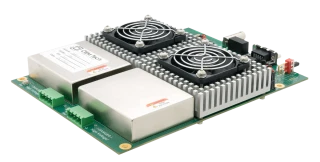
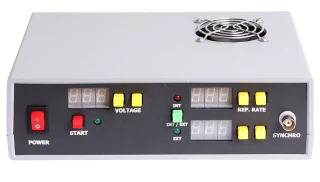
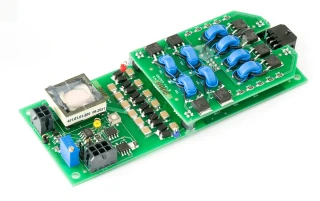
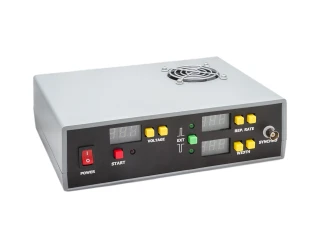
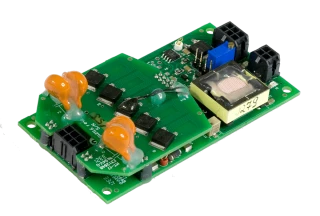
QBU Pockels cell driver series is specially designed to control Pockels cells by applying a fast switching high voltage. The modules require +24 V DC power supply and pulse generator to set an operating frequency and pulse width. An output voltage level can be programmed in working range by user either manually (through onboard configuration trimpot) or remotely (applying a DC voltage to the respective pin).
Triggering by an external low voltage arbitrary TTL signal allows modules to work in next scenarios:
- push-up (= normally off scheme), when a base voltage level equals to zero
- pull-down (= normally on scheme), when pulses from base bias voltage to ground are generated
- user-defined scheme, with arbitrary width and frequency of pulses.
QBU Pockels cell driver series is based on MOSFET technology and offers high repetition rates and fast transition time (< 15 ns) for both pulse edges.
We have also a compact version 4kV QBU-mini Pockels cell driver, a high voltage 10kV QBU-10kV Pockels cell driver and a GaN 3-4ns fast Pockels cell driver QBY.
QBU-Series High Voltage Pockels Cell Drivers with Adjustable Pulse Width
Specifications
| Power Supply: | +24 V DC |
|---|---|
| Control Types: | manual and automatic |
| Cooling: | No active cooling for low repetition rate; forced air cooling for high repetition rate |
Got questions about specs? Use the inquiry form to ask.
 Download Data Sheet

Features
- Triggering by an arbitrary external TTL signal output provides various operating schemes, any durations
- Up to 6 kV output voltage
- Up to 100 kHz repetition rate
- < 15 ns (about 10 ns typ.) both rise/fall time
- Compact easy-to-built-in design
Applications
Applications of QBU-Series Pockels Cell Drivers
QBU-series Pockels cell drivers are high-voltage pulse drivers optimized for fast electro‑optic modulation of laser beams. They support high repetition rates, fast rise/fall times, adjustable amplitude and pulse width, and uniquely long pulse durations (up to quasi‑DC), making them suitable for a wide variety of industrial, scientific, and OEM laser systems.
Laser Q-Switching and Cavity Dumping
- Active Q-switching of solid-state lasers (Nd:YAG, Nd:YVO4, Yb-based lasers) for generation of short, high-peak-power pulses.
- Cavity dumping and cavity lifetime control in mode-locked and CW lasers.
- Repetition-rate control of pulsed lasers via fast on/off modulation of cavity losses.
- Energy scaling and pulse shaping in industrial micromachining and materials processing lasers.
Electro-Optic Modulation and Beam Gating
- Fast optical shutters and beam gates for turning laser beams on and off within nanoseconds to microseconds.
- Pulse picking from high repetition rate mode-locked oscillators and amplifiers.
- Temporal gating in time-resolved experiments, fluorescence lifetime measurements, and pump–probe setups.
- Intensity modulation and pulse-width control using Pockels cells as variable attenuators.
Ultrafast and Time-Resolved Laser Experiments
- Pump–probe spectroscopy requiring precise synchronization of optical gates with ultrafast laser pulses.
- Time-resolved spectroscopy and imaging (fluorescence, transient absorption, photoluminescence).
- Streak camera and detector gating where high-voltage, fast-edge signals are required to gate the sensor.
- Laser pulse contrast enhancement via selective transmission and suppression of pre- and post-pulses.
Nonlinear Optics and Frequency Conversion Systems
- Temporal control in OPO/OPA systems using Pockels cells for precise seeding and extraction timing.
- Synchronization of pump and signal pulses in nonlinear frequency conversion setups.
- Gating and switching in harmonic generation stages (SHG, THG, etc.) for improved efficiency and stability.
- Electro-optic sampling and THz generation/detection where accurate high-voltage modulation of EO crystals is needed.
Laser Amplifiers and Chirped Pulse Amplification (CPA)
- Pockels cell switching in regenerative amplifiers for injection and extraction of pulses.
- Pulse selection and timing in multi-stage amplifier chains.
- Gain control and pulse energy management through cavity and beamline gating.
- CPA systems requiring long hold times and stable high-voltage levels between triggers (benefiting from pulses up to DC).
Scientific and Laboratory Instrumentation
- General-purpose Pockels cell driving in physics and photonics research laboratories.
- Electro-optic sampling setups for measuring ultrafast electric fields.
- Optical clocking and signal routing in advanced optical communication testbeds.
- Laboratory beamline safety shutters requiring fast and reliable optical cut-off.
Microscopy and Imaging
- Time-gated imaging to improve contrast and reject background or scattered light.
- Fluorescence lifetime imaging (FLIM) and time-correlated single-photon counting (TCSPC) gating.
- Two-photon and multiphoton microscopy beam gating synchronized with scanning and detection.
- Structured illumination and optical sectioning using rapidly modulated Pockels cells.
Lidar, Remote Sensing, and Rangefinding
- Lidar transmitter gating to shape and control the timing of emitted laser pulses.
- Receiver-side gating to suppress near-field signals and improve distant target detection.
- Atmospheric and environmental sensing where precise temporal windows improve signal-to-noise ratio.
- Time-of-flight measurements in industrial distance measurement and 3D mapping systems.
Quantum Optics and Quantum Information
- Fast optical switching in single-photon experiments and quantum communication testbeds.
- State preparation and measurement using polarization control with Pockels cells.
Frequently Asked Questions
What is the QBU Pockels cell driver board used for?
What power supply is required for the QBU Pockels cell driver board?
How can I program the output voltage level of the QBU Pockels cell driver board?
What are the operating schemes that the QBU Pockels cell driver board can work in?
What are the features of the QBU Pockels cell driver board?
Got more questions? Use the inquiry form to ask the supplier directly.
Similar Products
Your inquiry has been received.
Create an account by adding a password
Why create an account?
- Auto-complete inquiry forms
- View and manage all your past messages
- Save products to your favorites
- Close your account anytime — no hassle