
Description
Dual-Channel AOM Power Stabilization Servo Controller
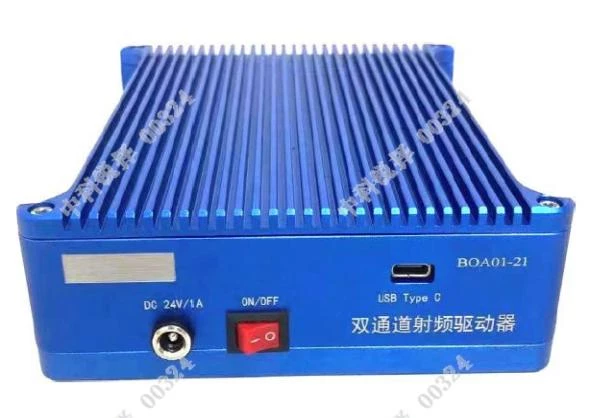
The Dual-Channel AOM Power Stabilization Servo Controller is a precision RF signal control unit designed for laser power stabilization systems using acousto-optic modulators. Built for demanding optical, photonics, and laser laboratory environments, this controller generates and regulates RF drive signals for AOM operation while supporting stable optical power output when paired with an AOM power stabilization optical module. It is well suited for applications requiring accurate laser intensity control, fast RF response, and low-noise modulation performance.
Using a high-precision dual-channel DDS architecture, the controller provides clean, ultra-low-noise RF signal generation across a wide adjustable frequency range of 60 MHz to 350 MHz. This broad frequency coverage makes it compatible with many common AOM frequency bands used in laser modulation, beam switching, optical trapping, spectroscopy, microscopy, quantum optics, atomic physics, and precision measurement systems. With frequency adjustment resolution down to 1 Hz and extremely fast frequency switching, the unit enables accurate tuning and rapid control of RF output parameters.
The controller delivers RF output power up to 2.5 W with a standard 50 Ω RF output impedance, making it suitable for driving a wide range of acousto-optic modulator configurations. By adjusting both RF frequency and RF intensity, the servo controller helps maintain consistent laser power and reduce fluctuations caused by thermal drift, optical alignment variation, laser source instability, or AOM response changes. Its dual-channel design allows independent control of two RF outputs, supporting more advanced optical setups where multiple beams, dual AOMs, or synchronized modulation channels are required.
For integration into automated optical systems, the AOM servo controller supports external trigger control with a 0–3.3 V trigger level and analog voltage input from -10 V to +10 V. This allows the device to interface with laboratory control electronics, data acquisition systems, experimental timing hardware, and closed-loop laser stabilization modules. USB Type-C communication is available for convenient software-based configuration, monitoring, and parameter adjustment, helping users streamline operation in both research and industrial laser platforms.
Operating from a 24 V supply voltage, the Dual-Channel AOM Power Stabilization Servo Controller is designed for stable long-term use in precision photonics systems. It is an ideal RF control solution for users seeking a compact, high-resolution, low-noise AOM driver controller for laser power stabilization, optical modulation, frequency shifting, and intensity regulation. Its combination of wide frequency range, dual-channel RF generation, high output power, and servo-compatible control makes it a strong choice for advanced laser power control applications.
Typical Applications
This AOM power stabilization controller can be used in laser intensity stabilization, acousto-optic modulation, optical power feedback systems, laser beam switching, RF-controlled optical attenuation, precision spectroscopy, fluorescence microscopy, interferometry, quantum optics experiments, atomic and molecular physics, optical communication testing, and other high-performance laser control systems where stable and repeatable optical output is essential.
Dual Channel AOM Power Stabilization Servo Controller 60-350MHz 2.5W
Specifications
| Frequency Range: | 60-350 MHz |
|---|---|
| Frequency Adjustment Accuracy: | 1 Hz |
| Frequency Switching Time: | 25 ns |
| Maximum RF Output Power: | 2.5 W |
| RF Output Impedance: | 50 Ω |
| External Trigger Level: | 0-3.3 V |
| Analog Voltage Input Range: | -10 to 10 V |
| Supply Voltage: | 24 V |
| Communication Interface: | USB/Type-C, optional |
Got questions about specs? Use the inquiry form to ask.
 Download Data Sheet

Features
Key Features – Dual-Channel AOM Power Stabilization Servo Controller
- Dual-channel AOM power stabilization controller designed for precision laser power control in acousto-optic modulator (AOM) based optical systems.
- Integrated RF signal generation and control enables adjustment of RF frequency and RF intensity for stable and repeatable laser output power.
- Wide RF frequency range of 60–350 MHz supports a broad selection of AOM devices and laser power stabilization applications.
- High-resolution frequency tuning with 1 Hz adjustment accuracy provides precise RF control for demanding photonics, laser, and optical measurement systems.
- Ultra-fast frequency switching time of 25 ns supports rapid modulation, fast optical switching, and dynamic laser power control.
- Up to 2.5 W RF output power delivers strong drive capability for compatible AOM power stabilization optical modules.
- High-precision dual-channel DDS architecture offers ultra-low-noise RF signal generation for stable and accurate optical power regulation.
- 50 Ω RF output impedance ensures standard RF matching and compatibility with common AOM drivers, RF cables, and optical modulation setups.
- External trigger input level of 0–3.3 V allows convenient synchronization with control electronics, timing systems, and experimental setups.
- Analog voltage input range from -10 V to +10 V enables flexible external control of RF output power and laser intensity stabilization.
- 24 V DC supply voltage provides convenient integration into laboratory, OEM, and industrial laser control platforms.
- USB Type-C communication interface supports easy connection, configuration, and software-based control; optional communication configurations are available.
- Designed for use with AOM power stabilization optical modules to reduce laser power drift and improve long-term optical output stability.
- Suitable for precision photonics applications including laser power stabilization, optical modulation, laser intensity control, spectroscopy, quantum optics, microscopy, interferometry, and laboratory automation.
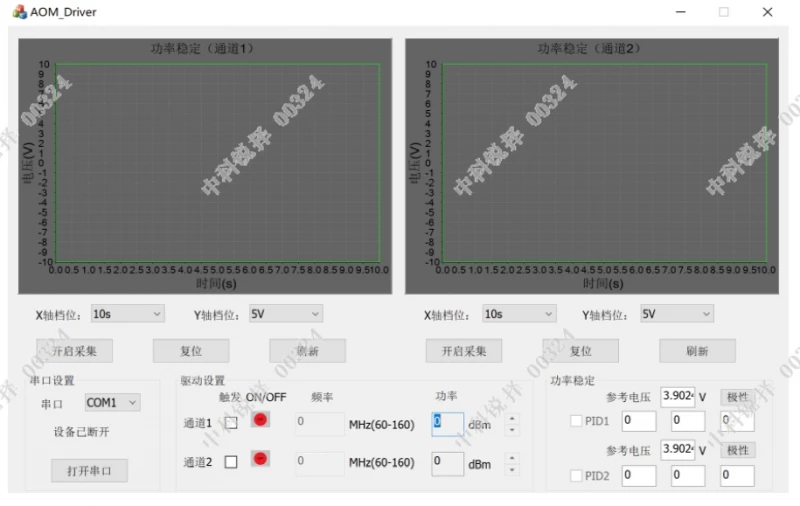
- Software control panel support allows users to configure operating parameters, monitor settings, and manage RF control functions through a computer interface.
- Compact and application-ready RF servo controller solution for researchers, system integrators, and OEM laser equipment manufacturers requiring stable dual-channel AOM control.
- Manufactured by CSRayzer Optical Technology Co., Ltd., a specialist in special optic devices for advanced laser and photonics systems.
Applications
Applications of Dual-Channel AOM Power Stabilization Servo Controller
- Laser power stabilization: Used with an AOM power stabilization optical module to maintain stable laser output power in precision optical systems.
- Dual-channel laser intensity control: Ideal for applications requiring independent RF control of two AOM channels, two laser beams, or two optical paths.
- Acousto-optic modulator RF driving: Provides high-precision RF signal generation for compatible AOMs operating within the 60–350 MHz frequency range.
- Laser noise suppression: Helps reduce laser intensity fluctuation and improve power stability for low-noise photonics experiments and optical instruments.
- Precision spectroscopy: Suitable for absorption spectroscopy, fluorescence spectroscopy, Raman spectroscopy, saturated absorption spectroscopy, and other laser-based measurement systems requiring stable optical power.
- Quantum optics and atomic physics: Used in cold atom experiments, ion trapping, atom interferometry, optical pumping, and quantum research platforms where stable laser intensity is critical.
- Optical tweezers and optical trapping: Enables stable beam power control for optical manipulation, particle trapping, and biological sample handling.
- Microscopy and bio-imaging systems: Supports stable laser illumination in confocal microscopy, fluorescence microscopy, multiphoton microscopy, and laser scanning imaging setups.
- Interferometry and metrology: Improves measurement repeatability in laser interferometers, displacement measurement systems, precision metrology, and optical sensing platforms.
- Holography and beam modulation: Provides stable RF control for AOM-based beam modulation in holographic imaging, optical beam shaping, and spatial light control systems.
- Laser material processing: Applicable in precision laser marking, laser trimming, micromachining, and laser processing systems requiring controlled and repeatable laser power.
- Semiconductor and lithography systems: Supports stable optical power delivery in semiconductor inspection, mask alignment, wafer metrology, and photolithography-related laser systems.
- Fiber laser and solid-state laser systems: Can be integrated into laser platforms using AOMs for power regulation, beam switching, and intensity stabilization.
- Laser pulse and beam switching: The fast frequency switching capability is useful for AOM-based beam gating, optical switching, and pulse selection applications.
- Frequency shifting applications: Suitable for systems using AOMs to introduce controlled optical frequency shifts for heterodyne detection, Doppler measurements, and laser frequency control.
- Optical communications and photonics testing: Useful in optical link testing, modulated light source control, fiber optic experiments, and photonic device characterization.
- LiDAR and laser ranging systems: Helps maintain consistent laser power in research and industrial LiDAR, ranging, and optical detection setups.
- OEM laser instrumentation: Suitable for integration into OEM optical instruments, laser modules, laboratory automation systems, and custom photonics platforms.
- Research laboratory laser control: Provides precise DDS-based RF frequency and amplitude control for universities, R&D laboratories, and advanced optical experiment setups.
- Automated laser power feedback systems: Supports analog voltage input and external trigger control for closed-loop laser power stabilization and automated experimental workflows.
Frequently Asked Questions
What is the CSRayzer dual-channel AOM power stabilization servo controller used for?
What frequency range does the dual-channel AOM RF driver support?
What is the maximum RF output power of the AOM power stabilization servo controller?
How fast can the controller switch RF frequency?
Does this AOM servo controller support external control inputs?
What communication interface is available for software control?
What are the advantages of a dual-channel DDS AOM RF controller?
Got more questions? Use the RFQ form to ask the supplier directly.
Similar Products
Need pricing for this product? Send a quick inquiry
Your inquiry has been received.
Create an account by adding a password
Why create an account?
- Auto-complete inquiry forms
- View and manage all your past messages
- Save products to your favorites
- Close your account anytime — no hassle