
Description
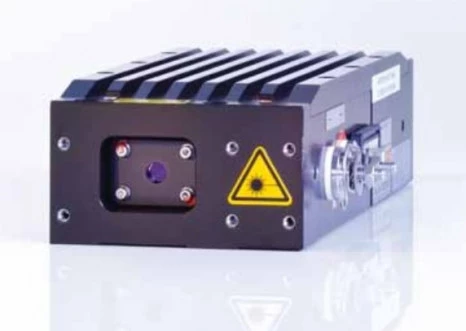
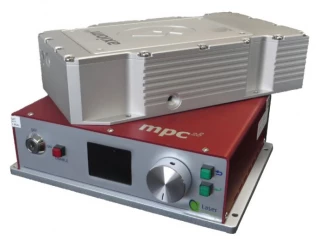
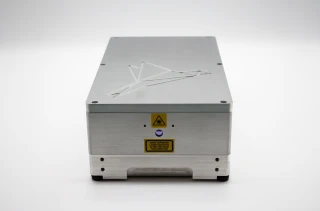
The JenLas® D2.8 is the big brother to the JenLas® D2. It is a doubled-frequency, diode-pumped thin-disc laser with high beam quality that operates at the wavelength of 532nm and offers 8W of output power. Despite the high power rating of this CW green laser, its compact OEM design allows easy integration.
The JenLas D2.8 is an extension of the long-established and tried-and-tested D2.x series. JenLas® D2. Solid-State lasers are based on disk laser technology and have been on the market for many years.
The entire JenLas® D2. Series is based on proven disk laser technology, using a thin Nd:YVO4 disk laser medium, which guarantees the maximum beam quality and stability for you. These CW green lasers are frequency-doubled and cooled using a Peltier element, which avoids the need for more expensive water cooling.
The compact design of the JenLas D2.8 makes it very easy to integrate into your existing systems. We can also offer you a range of accessories, such as fiber coupling and control electronics, many of which are designed for use in medical applications. An easy to integrate OEM module option, complete with control electronics, power supply, heat sink, and application-specific interfaces, is also available for the JenLas® D2.mini.
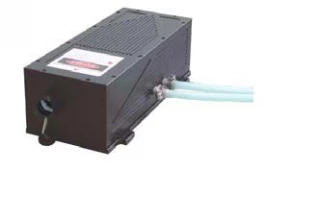
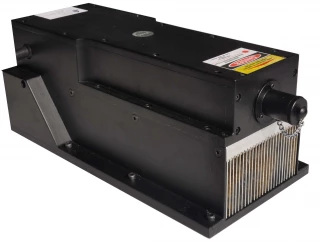
JenLas D2.8: 532nm CW Green Laser
Specifications
| Wavelength: | 532 nm |
|---|---|
| Max Output Power: | 8000 mW |
| Cooling Method: | Peltier cooling |
| Tunability: | Fixed Wavelength |
| Control Interface: | Other (not specified) |
| Laser Class: | 4 |
| Wavelength: | 532 nm |
| Ambient Temperature: | 5 °C ... 40 °C |
| Output Power: | 8 W |
| M2 (typical): | ~ 7 |
| Pulse Duration: | ~ 1 ms to cw |
| Beam Diameter: | < 2 mm |
| Ellipticity: | < 1:1.5 |
| Electrical Input Data: | 2 V, typically 32 A |
| Input Power: | ≤ 80 VA |
| Dimensions (W X H X L): | 110 mm x 55 mm x 225 mm |
| Weight: | 2.6 kg |
Got questions about specs? Use the inquiry form to ask.
 Download Data Sheet

Features
- High-Power 532 nm Green Output – 8 W cw
Frequency-doubled thin-disk laser delivering up to 8 W continuous-wave green at 532 nm, ideal for demanding industrial, medical, and OEM applications. - Thin-Disk Diode-Pumped Laser Technology
Advanced thin-disk architecture with diode pumping provides high efficiency, excellent thermal management, and long lifetime compared with traditional rod or lamp-pumped solid-state lasers. - Excellent Beam Quality for Precision Applications
Typical beam quality of M² ~ 7 with < 2 mm beam diameter and ellipticity < 1:1.5, enabling efficient coupling into 100 µm core fibers and precise beam delivery. - True cw Operation with Fast Modulation
Continuous-wave operation with switchable pulse duration from ~1 ms to cw via diode current control, allowing amplitude modulation up to 20 kHz for process flexibility. - Compact OEM Design for Easy Integration
Small laser head footprint (approx. 110 mm × 55 mm × 225 mm) and lightweight design (~2.6 kg) simplify integration into equipment, system builds, and tight spaces. - Air-Cooled via TEC – No Water Required
Peltier (TEC) cooling concept eliminates water circuits, reducing system complexity, maintenance, and risk of leakage while ensuring stable thermal behavior. - Low Electrical Power Consumption
Typical diode input of 2 V / 32 A and total input power ≤ 80 VA provide an energy-efficient green source with reduced operating costs and simplified power supply requirements. - Robust Industrial Laser Class 4 Source
Classified as a Class 4 laser according to EN 60825-1, designed for professional and industrial environments requiring high power, reliability, and safety-compatible integration. - Wide Operating Temperature Range
Reliable performance in ambient temperatures from 5 °C to 40 °C, suitable for lab setups, production floors, and mobile or field-deployed systems. - Ideal Replacement for Argon-Ion Lasers
Compact, efficient substitute for bulky Argon lasers, providing similar or higher green power with lower power consumption, reduced heat load, and simpler infrastructure. - Designed for Demanding OEM and 24/7 Use
Engineered for continuous operation in industrial and medical systems, including material processing, displays, and pumping of other solid-state or dye lasers. - Optimized for Medical, Display, and Show Applications
Stable, high-brightness green output perfectly suited for medical engineering, projection and display technology, show & entertainment lasers, and light exposure of plastics. - Flexible Integration into Laser Pumping Setups
532 nm output and beam properties tailored for efficient pumping of solid-state gain media, enabling compact, high-brightness secondary laser sources. - Stable Output and Excellent Pointing for Precision Processes
Thin-disk design and optimized mechanics support low drift and high pointing stability, critical for precision metrology, micro-processing, and alignment-sensitive applications. - Backed by Jenoptik Expertise and Support
Developed by Jenoptik, a globally recognized leader in lasers and material processing, with application engineering and technical support available for OEM integration.
Applications
- Medical Engineering and Life Sciences
- Green laser light sources for ophthalmology (e.g., retinal photocoagulation and vascular treatments) using 532 nm cw radiation
- Precision dermatology procedures such as vascular lesion treatment, pigmentation removal, and skin rejuvenation where high beam quality is critical
- Photodynamic therapy (PDT) excitation at 532 nm for targeted cancer and dermatological treatments
- Microsurgery and tissue cutting in ENT and neurosurgery with stable continuous‑wave operation
- Life-science research illumination for fluorescence excitation and confocal microscopy setups
- Laser Show and Entertainment Applications
- Professional laser show projectors requiring compact, OEM green sources with high reliability
- High-brightness beam displays at concerts, theaters, planetariums, amusement parks, and themed attractions
- Outdoor landmark laser projections and building façade illumination using cw 532 nm radiation
- Multicolor RGB laser systems where a stable 532 nm module is used as the green channel
- Display and Projection Engineering
- Laser-based projection systems (for industrial and visualization use) needing a compact 532 nm source
- Heads-up displays (HUD), head-mounted displays (HMD), and AR/VR light engines
- Laser light sources for high-brightness digital cinema, control rooms, simulators, and visualization systems
- Optical scanning and image writing in large-format display manufacturing
- Pumping of Solid-State and Nonlinear Lasers
- Green pumping of solid-state lasers (e.g., Ti:sapphire, OPOs, and other tunable or ultrafast systems) with 8 W cw at 532 nm
- Pumping of nonlinear frequency conversion stages (OPO/OPA) for wavelength extension into UV, visible, and IR
- High-brightness pump source for fiber-coupled laser modules (coupling into 100 µm core fibers possible)
- Compact pump module in laboratory benches, OEM laser systems, or industrial laser platforms
- Materials Processing and Microfabrication
- Light exposure and curing of plastic materials, polymers, and photoresists at 532 nm
- Precision marking and micro-structuring of plastics, ceramics, and certain metals using scanned cw beams
- Thin-film processing, trimming, and patterning where stable cw green output is advantageous
- Laser-assisted bonding, soldering, and selective heating of small components in electronics
- Laser sintering and photopolymerization in additive manufacturing of fine plastic components
- Substitution of Argon-Ion Lasers
- Replacement of bulky, water-cooled Argon lasers in existing 514–532 nm applications
- Energy-efficient green laser source in laboratories and OEM devices where low power consumption and TEC cooling are preferred
- Upgrading legacy systems (microscopy, spectroscopy, holography) from Argon-ion to diode-pumped thin-disk technology
- Reduced maintenance and operational costs by switching from gas lasers to solid-state 532 nm cw modules
- Industrial Metrology and Inspection
- High-precision triangulation and distance measurement using a stable cw 532 nm beam
- 2D/3D surface profiling and defect inspection in semiconductor, glass, and display manufacturing
- Laser interferometry, alignment, and calibration tasks requiring a compact, high-quality green laser
- Machine vision illumination and structured-light projection with narrow, high-contrast green lines or patterns
- Scientific Research and Laboratory Use
- Optical experiments in nonlinear optics, spectroscopy, and quantum optics at 532 nm
- Raman spectroscopy excitation in materials research, chemistry, and life sciences
- Holography, interferometry, and precision optical alignment in research labs
- Cold atom and optical trapping experiments that utilize green wavelengths
- Traffic, Sensing, and Safety Systems
- Optical signaling, traffic control, and guidance systems using visible green beams
- LIDAR and range-finding prototypes requiring compact cw green sources (with intensity modulation capability)
- Safety perimeter marking and hazard zone visualization in industrial environments
- Defense, Security, and Civil Systems
- Target designation, pointing, and tracking where visible green beams are advantageous
- Laser-based simulation and training systems requiring robust, OEM‑integrable sources
- Electro‑optical test benches, sensor calibration, and alignment systems
Frequently Asked Questions
What is the JenLas D2.8 diode-pumped thin-disk laser and what are its key specifications?
What are the typical applications of the JenLas D2.8 532 nm OEM thin-disk laser?
How does the JenLas D2.8 thin-disk, diode-pumped, frequency-doubled laser work?
What are the electrical and cooling requirements for operating the JenLas D2.8 laser head?
Is the JenLas D2.8 suitable for fiber coupling and what beam quality can be expected?
What safety considerations and laser class apply to the JenLas D2.8 532 nm laser?
How does the JenLas D2.8 compare to other 8 W 532 nm OEM lasers and what integration options are available?
Got more questions? Use the inquiry form to ask the supplier directly.
Similar Products
Your inquiry has been received.
Create an account by adding a password
Why create an account?
- Auto-complete inquiry forms
- View and manage all your past messages
- Save products to your favorites
- Close your account anytime — no hassle