


Description
The UniMir 13.4um Quantum Cascade Laser (QCL) is an advanced gas sensing laser meticulously crafted for the precise detection of xylene and propane. Boasting a single-mode distributed feedback (DFB) design, this quantum cascade laser operates in continuous-wave (CW) mode, delivering a robust output power of 5mW with exceptional stability.
With a tunable range of approximately 3 cm⁻¹ and a mode-hop-free tuning capability exceeding 1 cm⁻¹, it offers unparalleled versatility in gas detection applications. Engineered with meticulous attention to detail, this laser features a narrow linewidth of less than 100MHz and minimal divergence of less than 10mrad, ensuring high sensitivity and accuracy in measurements.
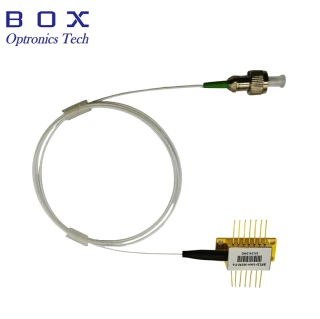
Housed in a compact high heat load (HHL) package equipped with an integrated thermoelectric cooler (TEC), thermistor, and collimating lens, the UniMir 13.4um QCL is perfectly suited for seamless integration into existing systems or deployment as a standalone solution for research and development endeavors. With its exceptional performance and reliability, this laser is poised to revolutionize gas sensing and environmental monitoring applications.
UniMir 13.4um: Narrow Linewidth Gas Sensing Quantum Cascade Laser
Specifications
| Center Wavelength: | 13.4 um |
|---|---|
| Output Power: | 5 mW |
| Laser Type: | QCL single mode DFB |
| Mode Of Operation: | CW |
| Full Accessible Wavelength Range: | ~3 cm-1 |
| Continuous Tuning Range: | >1 cm-1 |
| Side Mode Suppression Ratio: | > 25 dB |
| Linewidth (FWHM): | < 100 MHz |
| Divergence: | <10 mrad |
| Beam Quality: | TEM00 |
| Polarization: | Linear vertical |
| Output Beam Diameter (window Output): | 4 mm |
| Operating Temperature Of The Laser HHL Casing: | +10 to +50 °C |
| Operating Temperature Of The QCL Chip (for Casing Temperature Of 20°C: | -10 to +10 °C |
| Storage Temperature: | +10 to +50 °C |
Got questions about specs? Use the inquiry form to ask.
 Download Data Sheet

Features
Key Features – UN0746C005HNA Single Mode DFB CW QCL Laser at ~746 cm-1
- Single mode DFB Quantum Cascade Laser: Continuous-wave mid-infrared QCL designed for stable, narrow-linewidth emission around 746 cm-1 / approximately 13.4 µm.
- Optimized for gas sensing applications: Well suited for high-sensitivity detection and monitoring of xylenes and propane using mid-IR absorption spectroscopy.
- Room-temperature CW operation: Delivers continuous-wave infrared output at room temperature, supporting integration into laboratory, industrial, and portable gas analyzer systems.
- Guaranteed optical output power: Provides a minimum optical power of 5 mW at 746 cm-1 with the HHL package base plate maintained at +20°C.
- Very narrow linewidth: Free-running linewidth of <100 MHz when used with suitable electronics, enabling high-resolution spectroscopy and sensitive trace gas measurements.
- High side-mode suppression: SMSR >25 dB supports clean single-mode laser operation for reliable spectroscopic performance.
- Mode-hop-free wavelength tuning: Emission wavelength can be tuned by controlling the QCL chip temperature through the integrated thermoelectric cooler.
- Accessible wavelength tuning range: Offers approximately 3 cm-1 full accessible wavelength range with a continuous tuning range of >0.5 cm-1.
- Hermetically sealed HHL package: Laser is sealed inside a High Heat Load package for robust thermal management and reliable long-term operation.
- Integrated beam collimation: Built-in collimation lens provides a typical output beam diameter of 4 mm at the package window.
- Low beam divergence: Collimated beam divergence of <10 mrad supports efficient coupling into optical gas cells and spectroscopy setups.
- High-quality spatial mode: TM00 beam quality provides a clean and usable output beam for precision mid-IR optical systems.
- Linear vertical polarization: Output is linearly vertically polarized, simplifying alignment with polarization-sensitive optical components.
- Integrated TEC temperature control: Built-in Peltier thermoelectric cooler enables precise chip temperature regulation for wavelength stability and tuning.
- Built-in thermistor sensor: Integrated 10 kΩ thermistor at 25°C with β = 3892 K allows direct monitoring of QCL chip temperature.
- Stable long-term performance: Designed for stable operation over time with strong suitability for gas analyzers requiring good Allan deviation performance.
- Low power consumption: Efficient QCL design supports integration into compact and portable mid-infrared gas detection instruments.
- Operating chip temperature range: QCL chip operates from approximately -10°C to +10°C when the HHL casing/base temperature is 20°C.
- Package operating temperature: HHL casing operating range of +10°C to +50°C; avoid condensation during operation.
- Additional wavelength options available: Similar DFB QCL chips can also be supplied near 727 cm-1, 767 cm-1, or 795 cm-1 for related mid-IR sensing applications.
- Ideal for OEM mid-IR systems: Suitable for integration into laser-based gas analyzers, infrared spectroscopy instruments, environmental monitoring systems, industrial process control sensors, and portable trace gas detectors.
Applications
Applications for the UN0746C005HNA Single Mode DFB CW QCL Laser at ~746 cm-1
- Xylene gas detection and monitoring: Optimized for mid-infrared absorption sensing of xylenes in industrial, laboratory, and environmental gas analysis systems.
- Propane detection: Suitable for sensitive propane monitoring in safety systems, process control, leak detection, and hydrocarbon gas analyzers.
- Mid-infrared gas spectroscopy: Ideal light source for high-resolution QCL absorption spectroscopy, tunable diode laser absorption spectroscopy, and molecular fingerprinting near ~746 cm-1.
- Trace gas analysis: Supports high-sensitivity detection of low-concentration gases using multipass cells, Herriott cells, cavity-enhanced absorption setups, and compact OEM gas sensors.
- Industrial VOC monitoring: Applicable for volatile organic compound monitoring in chemical plants, petrochemical facilities, paint and coating operations, solvent handling areas, and emissions control systems.
- Petrochemical process monitoring: Enables real-time measurement of hydrocarbon gases in refinery streams, natural gas processing, LPG handling, and chemical manufacturing environments.
- Hydrocarbon leak detection: Useful for detecting propane, aromatic hydrocarbons, and related hydrocarbon leaks in pipelines, storage tanks, compressor stations, and industrial facilities.
- Environmental air quality monitoring: Can be integrated into air monitoring instruments for detection of hydrocarbon pollutants, aromatic VOCs, and industrial emissions in ambient air.
- Fence-line and perimeter monitoring: Suitable for continuous monitoring around refineries, chemical plants, storage terminals, and hazardous material handling sites.
- Continuous emissions monitoring: Applicable in stack gas analysis, exhaust monitoring, and industrial emission control where mid-IR hydrocarbon absorption signatures are required.
- Portable gas analyzers: Low power consumption and room-temperature CW operation make it suitable for compact, field-deployable, and battery-powered gas detection instruments.
- OEM gas sensing modules: Designed for integration into OEM mid-infrared gas analyzers requiring a single-mode DFB QCL source with narrow linewidth and stable wavelength tuning.
- Open-path gas sensing: Can be used in open-path absorption systems for monitoring hydrocarbon gases across industrial areas, storage zones, and controlled test environments.
- Combustion diagnostics: Useful for research and development involving hydrocarbon combustion, fuel characterization, engine exhaust analysis, and combustion byproduct monitoring.
- Safety and hazardous gas monitoring: Supports detection of flammable hydrocarbon gases in industrial safety systems, confined-space monitoring, and hazardous area instrumentation.
- Laboratory molecular spectroscopy: Excellent for high-resolution spectroscopic studies of molecular absorption lines in the long-wave infrared region around 13.4 µm.
- Chemical identification and fingerprinting: Suitable for infrared fingerprint-region analysis of organic molecules, especially hydrocarbons and aromatic compounds with absorption features near ~746 cm-1.
- Sensor calibration and reference systems: Can serve as a stable narrow-linewidth mid-IR source for calibration, validation, and performance testing of infrared gas sensors and spectrometers.
- Research-grade QCL spectroscopy systems: Appropriate for universities, research laboratories, and industrial R&D groups developing quantum cascade laser spectroscopy platforms.
- Homeland security and chemical plume detection: Applicable in standoff or point-detection systems for identifying hydrocarbon vapors, chemical releases, and industrial chemical hazards.
- Long-wave infrared source for custom instruments: Useful as a CW single-mode DFB QCL source in custom-built infrared analyzers, spectrometers, gas cells, and optical sensing platforms.
- Alternative wavelength gas sensing platforms: Related configurations around 727 cm-1, 767 cm-1, and 795 cm-1 can support additional mid-IR molecular absorption applications when different gas absorption lines are required.
Frequently Asked Questions
What is the UN0746C005HNA single mode DFB CW QCL laser?
Which gases can the 746 cm-1 DFB QCL laser detect?
What optical output power does the 746 cm-1 QCL provide?
How is the wavelength tuned on this DFB quantum cascade laser?
What linewidth and side mode suppression ratio does the laser offer?
What package and integration features are included with this CW QCL?
Are other mid-infrared wavelengths available besides 746 cm-1?
Got more questions? Use the inquiry form to ask the supplier directly.
Similar Products






Your inquiry has been received.
Create an account by adding a password
Why create an account?
- Auto-complete inquiry forms
- View and manage all your past messages
- Save products to your favorites
- Close your account anytime — no hassle