


Description
The UniMir 11.3um Quantum Cascade Laser (QCL) offers exceptional precision in the detection of CH3i gas, particularly suited for applications within the nuclear industry.
With its DFB single-mode operation and 10mW continuous-wave output power, this QCL ensures high sensitivity and accuracy. Its mode-hop-free tuning range of over 1cm⁻¹ and <100MHz linewidth guarantee reliable performance in gas sensing applications.
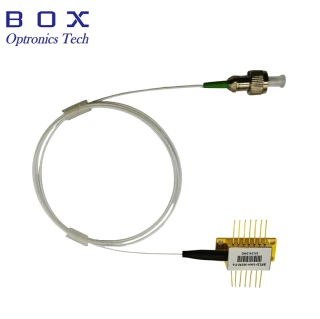
Housed in a sealed High Heat Load (HHL) package with integrated collimating lens, thermistor, and thermoelectric cooler (TEC), this quantum cascade laser is designed for seamless integration into systems or as a standalone solution for research and development purposes.
Operating at a wavelength of 11.3µm (885 cm⁻¹), this QCL laser provides a comprehensive solution for gas detection needs. Whether used for environmental monitoring, industrial safety, or process control, the UniMir 11.3µm Quantum Cascade Laser offers unparalleled performance and versatility.
UniMir 11.3um: Narrow Linewidth Gas Sensing Quantum Cascade Laser
Specifications
| Center Wavelength: | 11.3 um |
|---|---|
| Output Power: | 10 mW |
| Laser Type: | QCL single mode DFB |
| Mode Of Operation: | CW |
| Full Accessible Wavelength Range: | ~3 cm-1 |
| Continuous Tuning Range: | >1 cm-1 |
| Side Mode Suppression Ratio: | > 25 dB |
| Linewidth (FWHM): | < 100 MHz |
| Divergence: | <10 mrad |
| Beam Quality: | TEM00 |
| Polarization: | Linear vertical |
| Operating Temperature Of The Laser HHL Casing: | +10 to +50 °C |
| Operating Temperature Of The QCL Chip (for Casing Temperature Of 20°C: | -10 to +10 °C |
| Storage Temperature: | +10 to +50 °C |
Got questions about specs? Use the inquiry form to ask.
 Download Data Sheet

Features
- Single-mode DFB Quantum Cascade Laser: UN0885C010HNA is a continuous-wave DFB QCL designed for precise mid-infrared emission at approximately 885 cm-1 / 11.3 µm.
- Optimized for CH3I Detection: Engineered for high-sensitivity detection of methyl iodide in nuclear industry gas monitoring and trace gas analysis applications.
- Continuous-Wave Room-Temperature Operation: Delivers stable CW infrared output at room temperature, making it suitable for laboratory, industrial, and integrated sensing systems.
- Guaranteed Optical Output Power: Provides a minimum optical power of 10 mW at 885 cm-1 with the HHL package base plate at +20°C.
- Narrow Linewidth for Sensitive Gas Sensing: Features a very tight free-running linewidth of <100 MHz when operated with suitable electronics, supporting high-resolution spectroscopy.
- Mode-Hop-Free Wavelength Tuning: Integrated thermoelectric control enables smooth wavelength tuning while maintaining single-mode operation.
- Wide Accessible Wavelength Range: Offers a full accessible tuning range of >3 cm-1 and a continuous tuning range of >1 cm-1.
- High Side Mode Suppression: Provides SMSR >25 dB for clean single-mode emission and reliable spectroscopic performance.
- Integrated High Heat Load Package: Mounted in a hermetically sealed HHL package for robust thermal management and long-term reliability.
- Built-In Thermoelectric Cooler: Integrated TEC allows precise QCL chip temperature control for stable output wavelength and improved measurement repeatability.
- Integrated Thermistor Temperature Readout: Includes a built-in 10 kΩ thermistor at 25°C with Beta value ß = 3892 K for accurate chip temperature monitoring.
- Collimated Mid-IR Output Beam: Integrated collimation lens provides a typical output beam diameter of 4 mm at the package window.
- Low Beam Divergence: Beam divergence is <10 mrad, supporting efficient optical coupling into gas cells, multipass cells, and spectroscopic instruments.
- High-Quality Beam Profile: Emits in TM00 beam quality, enabling stable alignment and efficient mid-infrared optical system integration.
- Linear Vertical Polarization: Output is linearly vertically polarized, ideal for polarization-sensitive spectroscopy and optical setups.
- Low Power Consumption: Designed for integration into compact and portable gas analyzers where efficient electrical and thermal operation is important.
- Excellent Long-Term Stability: Suitable for continuous monitoring systems requiring stable optical performance and strong Allan deviation behavior when integrated into gas analyzers.
- Operating Chip Temperature Range: QCL chip operation is supported from -10°C to +10°C when the HHL casing temperature is maintained at 20°C.
- HHL Casing Operating Range: Laser package operating temperature range is +10°C to +50°C, with storage temperature also specified from +10°C to +50°C.
- Ideal for Mid-Infrared Spectroscopy: Well suited for tunable diode laser absorption spectroscopy, trace gas detection, environmental monitoring, nuclear safety instrumentation, and industrial process control.
Applications
- Methyl iodide (CH3I) trace gas detection: Optimized for selective detection of CH3I near 885 cm-1, supporting high-sensitivity mid-infrared gas analysis for applications where methyl iodide identification and quantification are critical.
- Nuclear industry gas monitoring: Ideal for monitoring volatile organoiodine compounds in nuclear facilities, including fuel-cycle operations, reprocessing plants, hot cells, glove boxes, radioactive waste treatment areas, and controlled laboratory environments.
- Nuclear stack and off-gas analysis: Suitable for continuous-wave laser absorption spectroscopy systems used to monitor CH3I and related iodine-containing emissions in process exhaust, ventilation ducts, and stack gas streams.
- Radioiodine species research: Enables laboratory studies of methyl iodide as an important organic iodine species relevant to nuclear safety, containment chemistry, fission product behavior, and radioactive iodine transport.
- Containment atmosphere monitoring: Can be integrated into gas analyzers designed for surveillance of containment environments where volatile iodine species may be present during normal operation, incident evaluation, or safety testing.
- Iodine filtration and scrubber efficiency testing: Useful for evaluating activated carbon filters, iodine traps, scrubbers, and abatement systems by measuring methyl iodide breakthrough, removal efficiency, and capture performance.
- Process control in nuclear waste treatment: Supports real-time monitoring of CH3I and organoiodine species during radioactive waste processing, off-gas treatment, vitrification research, and decontamination workflows.
- Portable gas analyzer integration: The compact CW DFB QCL design, room-temperature operation, and low power consumption make it suitable for integration into portable or transportable methyl iodide gas detection instruments.
- High-resolution mid-infrared spectroscopy: Provides single-mode emission, narrow linewidth, and mode-hop-free tuning for precise spectroscopy of molecular absorption features around 885 cm-1.
- Tunable diode laser absorption spectroscopy systems: Well suited for TDLAS-based gas sensors requiring stable continuous-wave infrared output, strong molecular selectivity, and mW-level optical power in the mid-IR.
- Photoacoustic gas sensing: Applicable in photoacoustic spectroscopy platforms for sensitive detection of methyl iodide and other absorbing gases in the 11.3 µm spectral region.
- Quartz-enhanced photoacoustic spectroscopy: Can be used as a mid-infrared source for QEPAS sensors targeting trace-level gas detection with compact optical layouts and high selectivity.
- Cavity-enhanced absorption spectroscopy: Suitable for advanced gas analyzers using multipass cells or optical cavities to increase absorption path length and improve detection sensitivity for low-concentration CH3I.
- Environmental monitoring around nuclear sites: Supports air-monitoring systems used for research, compliance support, and surveillance of methyl iodide or organoiodine emissions in the surrounding environment.
- Industrial hygiene and worker safety monitoring: Can be incorporated into safety systems for detecting methyl iodide exposure risks in facilities where iodine chemistry, radiochemistry, or hazardous gas handling is performed.
- Leak detection in iodine chemistry systems: Useful for identifying leaks or fugitive emissions from gas lines, reaction vessels, sampling manifolds, containment enclosures, and process equipment handling CH3I.
- Gas analyzer calibration and validation: Provides a stable single-mode infrared source for validating CH3I detection instruments, absorption cells, reference gas measurements, and spectroscopic calibration setups.
- Scientific research in atmospheric iodine chemistry: Enables investigation of methyl iodide absorption signatures and trace gas behavior relevant to atmospheric chemistry, environmental science, and halogen compound studies.
- Selective detection in complex gas mixtures: The narrow linewidth and tunable single-mode operation help distinguish target absorption lines from interfering species in multi-component gas analysis applications.
- OEM integration into mid-IR gas sensing platforms: Designed for manufacturers developing high-performance quantum cascade laser gas analyzers for nuclear monitoring, environmental sensing, process analytics, and laboratory spectroscopy.
Frequently Asked Questions
What is the UN0885C010HNA single-mode DFB CW QCL laser used for?
What output power does the UN0885C010HNA DFB QCL provide at 885 cm⁻¹?
Is the UN0885C010HNA quantum cascade laser single mode?
What wavelength tuning range is available for the 885 cm⁻¹ DFB QCL?
What package is used for the UN0885C010HNA CW QCL laser?
What are the beam specifications of the UN0885C010HNA QCL?
What temperature conditions are required to operate the UN0885C010HNA DFB QCL?
Got more questions? Use the inquiry form to ask the supplier directly.
Similar Products






Your inquiry has been received.
Create an account by adding a password
Why create an account?
- Auto-complete inquiry forms
- View and manage all your past messages
- Save products to your favorites
- Close your account anytime — no hassle