


Description
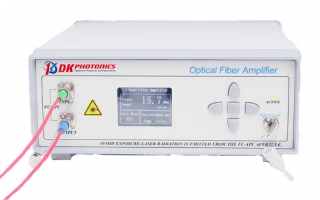
The MARS Series L-band Er-doped fiber amplifiers are high-performance optical amplifiers engineered for modern long-haul and metro optical communication networks. Designed to operate across the 1570–1603 nm L-band window, these EDFAs provide efficient amplification for single-wavelength, single-mode, or polarization-maintaining signals, making them ideal for extending reach and boosting signal quality in dense wavelength-division multiplexing (DWDM) systems and point-to-point links. With typical output power up to 20 dBm and a maximum output power of 23 dBm, the MARS Series delivers robust optical gain while maintaining low noise and excellent stability.
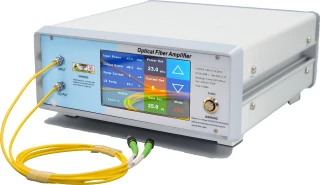
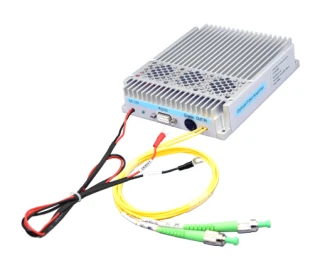
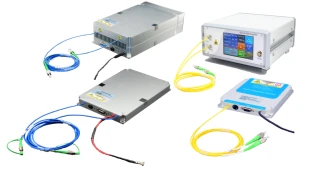
To accommodate diverse deployment scenarios, the MARS Series offers both benchtop and compact module configurations, giving system integrators flexibility in laboratory environments, production lines, and field installations. The amplifier supports ACC (Automatic Current Control) and APC (Automatic Power Control) operating modes, enabling precise and repeatable control of output power under varying input conditions. Output power can be continuously tuned over a 0–100% range, with coarse and fine adjustment modes, allowing optimization for different link budgets, fiber spans, and system designs without sacrificing signal integrity.
In optical communication infrastructures similar to those supported by other L-band EDFAs on the market, the MARS Series is well suited for SDH/SONET and ATM transmission, optical distribution networks, CATV and video transport, and high-speed Ethernet over fiber. Its gain-flattened response across the operating band helps maintain uniform amplification of signals, which is particularly important in systems where performance consistency and channel balance are critical. A typical noise figure up to 5.5 dB at 0 dBm input and 23 dBm output ensures low-added noise, supporting longer transmission distances and better overall system OSNR.
The amplifier integrates high-stability, high-reliability components in a compact architecture, with power consumption kept below 20 W for efficient operation. Input and output isolation of 30–35 dB reduces back-reflections and crosstalk, safeguarding upstream equipment and improving system robustness. Standard output fiber is SMF 9/125 µm with a length greater than 1 m, terminated in FC/APC connectors, with other connector options available to match existing network infrastructure and patch panel configurations.
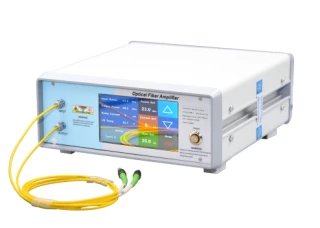
User-friendly control and monitoring are provided through an RS-232 interface, allowing straightforward integration with host computers, network management systems, or automated test setups. This digital interface enables remote configuration of output power, operating mode, and status monitoring, which is especially valuable in distributed or unmanned installations. Operating from a universal AC 100–240 V power supply and designed for an operating temperature range of 0 to 50 °C, the benchtop 19" 2U chassis and the optional module package are suitable for laboratory benches, rack-mounted systems, and OEM integration into larger optical platforms.
With its combination of tunable high output power, gain flattening, low noise figure, and flexible packaging, the MARS Series L-band Er-doped fiber amplifier offers a reliable solution for power amplification in advanced fiber optic links. It is particularly advantageous in applications that demand precise power control, stable long-term operation, and seamless integration into existing SDH, ATM, video, and Ethernet optical transmission systems.
Connet MARS L Band Er Doped Fiber Amplifier 23dBm Adjustable Output
Specifications
| Amplifier Type: | EDFA - Erbium-Doped Fiber Amplifier |
|---|---|
| Wavelength Range: | 1570 – 1603 nm |
| Min Input Power: | -5 dBm |
| Max Output Power: | 23 dBm |
| Output Fiber Type: | Single Mode |
| Part Number: | MFAS-ER-L-B |
| Input Power Range: | -5 to +10 dBm |
| Output Power (typical): | 20 dBm |
| Output Power (maximum): | 23 dBm |
| Maximum Output Power Note: | 23 dBm (L-band Er-doped fiber amplifier) |
| Noise Figure @ 0 DB Min Input, 23 DBm Output (max): | 5.5 dB |
| Gain Flatness (peak-to-peak): | 1–2 dB |
| Input/output Isolation (min): | 30 dB |
| Input/output Isolation (typical): | 35 dB |
| Output Power Tunable Range: | 0–100 % |
| Output Power Tunable Mode: | Coarse/Fine |
| Power Supply: | AC 100–240 V |
| Power Consumption (max): | 20 W |
| Operating Temperature Range: | 0 to +50 ℃ |
| Storage Temperature Range: | -40 to +85 ℃ |
| Output Fiber Type (SM): | SMF 9/125 μm |
| Output Fiber Length: | >1 m |
| Optical Connectors: | FC/APC (other options available) |
| Package Type Options: | Benchtop, Module |
| Benchtop Dimension: | 19 |
| Control Modes: | ACC or APC |
| Communication Interface: | RS232 |
| Ordering Code: | MFAS-ER-L-<P>-<PW>-FA |
| Package Code (P): | B = Benchtop, M = Module |
| Output Power Code (PW): | in dBm, e.g., 20–100 mW, 23–200 mW |
Got questions about specs? Use the inquiry form to ask.
 Download Data Sheet

Features
- High-Power L-Band Erbium-Doped Fiber Amplifier – Delivers up to +23 dBm output power in the 1570–1603 nm band, ideal for long-haul links, metro networks, and L-band system expansion.
- Wide Operating Wavelength Range (1570–1603 nm) – Optimized for the L-band window to support dense WDM systems, SDH/ATM backbones, CATV, and broadband optical networks.
- Low Noise Figure (≤ 5.5 dB at 0 dBm in / 23 dBm out) – Maintains excellent optical signal-to-noise ratio (OSNR), enabling extended transmission distance and improved system margin.
- Gain Flattening for WDM Applications – Integrated gain-flattening design ensures peak-to-peak gain flatness of 1–2 dB, minimizing channel-to-channel power variation in multi-wavelength systems.
- ACC/APC Control Modes – Supports both Automatic Current Control (ACC) and Automatic Power Control (APC) modes for stable operation under varying input conditions and long-term deployment.
- Continuously Adjustable Output Power (0–100%) – Output power is precisely tunable over the full dynamic range with coarse and fine adjustment modes, enabling easy optimization during system commissioning.
- High Stability and Reliability – Designed with proven EDFA architecture, high-quality pump lasers, and robust control electronics for 24/7 operation in demanding telecom and industrial environments.
- Excellent Input/Output Isolation (≥ 30–35 dB) – High isolation reduces back-reflection and crosstalk, protecting internal components and improving overall link stability.
- Compact & Flexible Packaging – Available in 19" 2U benchtop and module configurations, suitable for laboratory R&D, production test setups, and integration into OEM systems.
- Easy System Integration via RS232 Interface – All configurations support computer control and remote monitoring through the built-in RS232 communication interface for automation and network management.
- Telecom-Grade Power Supply & Low Power Consumption – Operates from a universal AC 100–240 V input with typical power consumption up to 20 W, compatible with global laboratory and telecom infrastructure.
- Wide Operating Temperature Range – Specified from 0 to +50 °C operating and -40 to +85 °C storage, supporting reliable field deployment in controlled and semi-controlled environments.
- Standard Single-Mode Fiber Output – Uses SMF 9/125 µm output fiber with length > 1 m for easy patch panel routing and splicing into existing optical networks.
- Industry-Standard Optical Connectors – Delivered with FC/APC connectors as standard (other connector types available on request), ensuring low back-reflection and broad compatibility.
- Ideal for Multiple Applications – Tailored for SDH/ATM transport, optical distribution networks, video and Ethernet transmission systems, and power amplification in L-band links.
- Configurable Output Power Levels – Ordering options allow selection of output power in dBm (e.g., 20 dBm, 23 dBm), enabling right-sized solutions for short, metro, or long-haul links.
- OEM-Friendly EDFA Module Option – Module package facilitates direct integration into system racks, DWDM platforms, test equipment, and custom optical subsystems.
- User-Friendly Front-Panel Control (Benchtop Version) – Benchtop units provide intuitive local control for quick setup, laboratory experiments, and manual adjustment without external software.
Applications
- SDH/SONET and ATM backbone networks – Boosting L-band signals in long-haul synchronous digital hierarchy (SDH) and Asynchronous Transfer Mode (ATM) links to extend reach and ensure stable, high‑capacity transport.
- Metropolitan and regional optical transport – Power amplification for metro/regional L-band fiber rings and point‑to‑point links, improving link budgets and enabling higher split ratios in dense urban environments.
- Optical distribution systems – Signal distribution from a central office/headend to multiple remote nodes in CATV, FTTx, and enterprise networks using L-band EDFAs as booster or distribution amplifiers.
- Video, CATV, and IP video transmission – Amplifying L-band optical carriers for analog/digital CATV, IPTV, and high‑definition video over fiber, supporting long-distance delivery with low noise and flat gain.
- Ethernet and data center interconnects – Enhancing L-band 1G/10G/40G/100G Ethernet and OTN links in data center interconnect (DCI), campus backbones, and enterprise networks to overcome fiber attenuation.
- DWDM L-band channel amplification – Operating in the 1570–1603 nm window to amplify dense wavelength-division multiplexed (DWDM) L-band channels with good gain flatness, complementing C‑band EDFAs for capacity expansion.
- Long‑haul and ultra‑long‑haul fiber transmission – Use as line amplifiers and booster amplifiers in submarine, terrestrial backbone, and railway/pipeline communication systems where low noise figure and high output power (up to 23 dBm) are required.
- Power amplifying for single-wavelength systems – Acting as a booster amplifier at the transmitter side for single-mode or polarization‑maintaining (PM) L‑band channels in point‑to‑point fiber links.
- Pre‑amplifier for sensitive receivers – Use as a low‑noise pre‑amplifier before optical receivers to improve sensitivity and extend the maximum transmission distance in L-band systems.
- ROADM and optical add/drop multiplexing nodes – Providing gain in reconfigurable optical add/drop multiplexer (ROADM) nodes operating in the L‑band, compensating for insertion loss of WSS, multiplexers, and OADMs.
- L-band capacity upgrade for existing fiber infrastructure – Adding L‑band amplification to existing C‑band networks to double useable spectrum and increase overall system capacity without laying new fiber.
- Test and measurement in optical labs – Use as a stable, tunable L-band EDFA source in R&D labs and production lines for testing L-band transceivers, filters, DWDM components, and fiber links.
- PM fiber system amplification – Amplifying polarization‑maintaining (PM) L‑band signals used in specialized communications, coherent detection experiments, and interferometric systems.
- Optical sensor and interferometric systems – Providing optical gain in L-band fiber‑optic sensing networks (e.g., distributed temperature/strain sensing), interferometers, and lidar links requiring low‑noise amplification.
- Broadcast and studio‑to‑transmitter links (STL) – Extending reach of high‑quality L-band optical studio‑to‑transmitter and contribution links for broadcast, OB vans, and remote production.
- Redundant and protected telecom links – Deployment in protected ring or mesh topologies where reliable, high‑stability L‑band amplification is required for automatic protection switching and redundancy schemes.
- Military, aerospace, and secure communications – L-band amplification in secure, long‑distance fiber communications for defense, aerospace, and critical infrastructure, benefiting from high reliability and compact structure.
- Industrial and campus networks – Extending fiber links across large industrial sites, campuses, refineries, and transportation hubs where long L-band links and multiple distribution points are needed.
- Research on advanced modulation formats – Supporting experimentation with coherent L-band transmission, advanced modulation formats (QPSK, QAM), and forward error correction schemes in academic and industrial research.
- System prototyping and OEM integration – Module version integration into OEM equipment, optical subsystems, and custom communication platforms that require a compact, RS232‑controllable L-band EDFA.
Frequently Asked Questions
What is the Connet MARS series L-band Er-doped fiber amplifier (MFAS-ER-L-B) and what does it do?
What are the key specifications of this L-band Er-doped fiber amplifier?
How is the output power controlled on the MARS series L-band EDFA, and what is the difference between ACC and APC modes?
What package options are available (benchtop vs. module) and how do they differ?
How do I select and order the correct Connet MARS L-band EDFA model for my application?
What interfaces and controls are available for remote operation and system integration?
How does the noise figure and gain flatness of this L-band EDFA affect system performance?
Got more questions? Use the inquiry form to ask the supplier directly.
Similar Products


Your inquiry has been received.
Create an account by adding a password
Why create an account?
- Auto-complete inquiry forms
- View and manage all your past messages
- Save products to your favorites
- Close your account anytime — no hassle