


Description
The MARS Series C-band high power optical fiber amplifiers are engineered for demanding optical communication, research, and sensing applications where high output power, low noise, and long-term stability are critical. Designed around advanced double-cladding fiber amplification technology and high-performance multimode pump diodes, these turnkey systems deliver continuous-wave output powers from 1 W up to 20 W in the 1530–1575 nm C-band. This power range and wavelength window align with international standards for erbium/ytterbium co-doped fiber amplifiers used in high-capacity transmission links, nonlinear optics experiments, and laboratory-scale system development.
Internally, the amplifier employs an all-fiber integrated architecture that optimizes mode matching, pump absorption, and thermal management. By making use of double-clad active fibers and carefully designed optical structure, the MARS Series converts pump power into signal power with high efficiency while maintaining a low noise figure of less than 5.5 dB at 0 dBm input. The robust optical design includes input and output isolation of 30 dB to suppress back reflections and spurious lasing, ensuring clean amplification even in complex optical setups. These characteristics are comparable to high-end C-band high power EDFAs and EYDFAs used worldwide in both industrial and academic environments.
A key advantage of this platform is its unique thermal treatment and management technology applied to the double-cladding fiber and pump assembly. This approach stabilizes the physical and optical properties of the active fiber over long operating periods, allowing the amplifier to run continuously with an output power stability of ±1% over 8 hours after warm-up at 25 ℃. Such stability is particularly valuable in precision fiber optic sensing, coherent communication experiments, and nonlinear optics research where minor power fluctuations can affect measurement accuracy or system dynamics.
System safety and reliability are further enhanced by a high-speed response protection circuit that continuously monitors both input and output optical power. In the event of a sudden drop or loss of input signal, the control electronics rapidly shut down the high-power pump diodes to prevent damage to the amplifier chain and downstream components. This protection scheme is standard in professional-grade high power fiber amplifiers and is essential for protecting sensitive optical components, maintaining operational safety in laboratory and production environments, and minimizing downtime due to fault conditions.
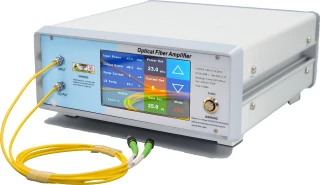
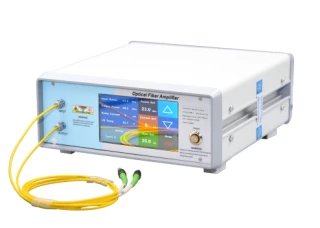
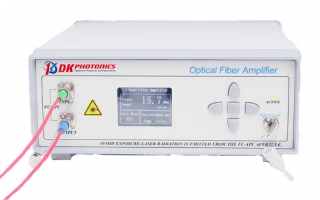
The MARS Series is implemented as an integrated, microprocessor-controlled, turn-key unit, simplifying deployment and day-to-day operation. The front-panel LCD interface provides real-time readouts of key operating parameters such as pump current, internal temperature, and output power. This interface also displays warning messages in abnormal conditions, giving operators clear, immediate feedback without the need for external monitoring systems. Such a user-friendly control scheme shortens setup time and aids in rapid troubleshooting, making the amplifiers suitable for both experienced photonics engineers and users transitioning from lower power laboratory amplifiers.
From an optical interface standpoint, the amplifiers are designed for straightforward integration into existing C-band systems. They accept input powers from -3 dBm to +10 dBm and provide tunable output power over a 10–100% range, enabling flexible gain and output power management across a wide variety of setups. Standard input fiber is SMF-28-compatible 9/125 µm fiber with NA of 0.13, while output options include standard single-mode fiber or large mode area (LMA) fiber, depending on the required output power handling and beam delivery configuration. A typical output fiber length of more than 1 m facilitates routing within optical benches or racks, and FC/APC connectors are provided as standard to minimize back reflections, with other connector options available upon request.
The product line includes multiple standard output power levels to match different application needs: 1 W, 5 W, 10 W, and 20 W at 0 dBm input. These configurations are well suited for tasks such as high power pre-amplification in long-haul and metro optical links, driving nonlinear fibers for supercontinuum generation or wavelength conversion, boosting signals for high dynamic range fiber optic sensing, and serving as pump or signal sources in advanced photonics R&D setups. In many of these use cases, the availability of stable, high power C-band amplification can significantly extend system reach or enable new experimental regimes.
Mechanically, the amplifiers are offered in rack-mountable 19-inch enclosures, using 2U or 3U heights depending on the selected output power and configuration.
C-Band High Power Optical Fiber Amplifier
Specifications
| Amplifier Type: | EDFA - Erbium-Doped Fiber Amplifier |
|---|---|
| Wavelength Range: | 1530 – 1575 nm |
| Min Input Power: | -3 dBm |
| Max Output Power: | 40 dBm |
| Nominal Gain: | 30 dB |
| Output Fiber Type: | SMF-28 |
| Part No.: | MFAS-EY-C-1 / MFAS-EY-C-5 / MFAS-EY-C-10 / MFAS-EY-C-20 |
| Input Power: | -3 to +10 mW |
| Output Power @ 0 DBm Input Power: | 1 / 5 / 10 / 20 W |
| Noise Figure @ 0 DBm Input Power: | < 5.5 dB |
| Input/Output Isolation: | 30 dB |
| Output Power Stability (8 Hrs): | ±1 % |
| Input Power Monitoring: | Yes |
| Output Power Monitoring: | Yes |
| Output Power Tunable: | Yes |
| Input Fiber Type: | SMF 9/125 μm, NA = 0.13 |
| Output Fiber Type: | SM fiber or LMA fiber |
| Output Fiber Length: | > 1 m |
| Optical Connector: | FC/APC (other options available) |
| Output Power Tunable Range: | 10–100 % |
| Operating Temperature: | 0 to +50 ℃ (0 to +30 ℃ for some versions) |
| Storage Temperature: | -40 to +85 ℃ |
| Power Supply: | AC 100–240 V |
| Power Consumption (Max): | 100 W |
| Dimension: | 19 |
| Typical Output Powers (optional): | 1 W, 5 W, 10 W, 20 W |
Got questions about specs? Use the inquiry form to ask.
 Download Data Sheet

Features
- High Output Power (1–20 W) – Delivers up to 20 W of continuous C-band output power, ideal for high‑power amplification, nonlinear optics experiments, and demanding R&D applications.
- C‑Band Operation (1530–1575 nm) – Optimized for the standard telecom C‑band, supporting optical communication, fiber sensing, and laboratory test systems.
- Double‑Cladding Fiber Amplifier Design – Uses advanced double‑clad fiber technology combined with high‑power multimode pump diodes for high conversion efficiency and excellent beam quality.
- Low Noise Figure (< 5.5 dB) – Maintains a low noise figure at 0 dBm input, improving overall system OSNR in long‑haul links and precision measurement setups.
- Excellent Power Stability (±1% over 8 hours) – Designed for long‑term, stable operation with minimal output drift after warm‑up, critical for continuous experiments and industrial operation.
- Wide Input Power Range (‑3 to +10 dBm) – Supports a broad range of input signal levels, enabling flexible integration into existing optical networks and lab benches.
- Adjustable Output Power (10–100%) – Built‑in power control enables smooth tuning of output power from 10% to 100%, simplifying optimization and system-level power management.
- High Input/Output Isolation (> 30 dB) – Provides strong isolation to protect upstream and downstream components from back‑reflections and undesired optical feedback.
- All‑Fiber, Integrated Turn‑Key System – Fully integrated, all‑fiber architecture with internal microprocessor control for reliable, alignment‑free operation.
- Real‑Time LCD Monitoring & Control – Front‑panel LCD displays pump current, temperature, input/output optical power, and status information for intuitive operation and diagnostics.
- Intelligent Protection Circuitry – High‑speed response protection continuously monitors input and output power and shuts down the high‑power pump if the input signal drops, enhancing system safety and preventing damage.
- Built‑In Input & Output Power Monitoring – Onboard monitoring of both input and output optical power enables closed‑loop control and easy performance verification.
- High Stability & High Reliability – Proprietary thermal treatment and robust optical design ensure long‑term stable performance under continuous operation.
- Compatible Fiber Types – Standard input with SMF 9/125 μm (NA=0.13) and selectable output fiber (single‑mode or LMA fiber) to match different power‑handling and beam‑quality requirements.
- Flexible Optical Connector Options – Standard FC/APC connectors with other interfaces available on request for straightforward integration into diverse fiber networks.
- Benchtop 19" Rackmount Form Factor – Available in 19" 2U or 3U chassis, suitable for laboratory racks and industrial system integration.
- Wide Operating Temperature Range (0 to +50 °C) – Engineered for dependable performance in typical laboratory and controlled industrial environments.
- Universal AC Power Input – Operates from 100–240 V AC with maximum power consumption of 100 W, simplifying global deployment.
- Multiple Power Options & Configurations – Standard output power levels of 1 W, 5 W, 10 W, and 20 W, with optional modular (OEM) packages and polarization‑maintaining (PM) versions for advanced applications.
- Ideal for Research & Industrial Use – Suited for nonlinearity research, high‑power amplification stages, fiber optic sensing systems, optical communication testbeds, and general R&D environments.
Applications
- High-Power C‑Band Optical Fiber Amplification – Ideal for boosting weak C‑band (1530–1575 nm) signals to high power levels (1–20 W) in laboratory and industrial environments where robust, turn‑key amplification is required.
- Nonlinearity Research and Nonlinear Fiber Optics – Provides high optical power and low noise figure for studying nonlinear effects in optical fibers, such as self‑phase modulation, four‑wave mixing, stimulated Raman scattering (SRS), and stimulated Brillouin scattering (SBS).
- High‑Power Pre‑Amplifier and Booster Amplifier – Serves as a high‑power booster stage after low‑power EDFAs or seed lasers, enabling power scaling for experimental laser systems, test beds, and system prototypes.
- Optical Fiber Communication and Transmission Testing – Used as a C‑band booster amplifier in long‑haul, metro, and access network simulation setups, BER testing, and optical link emulation in R&D and production laboratories.
- Fiber Optic Sensing and Distributed Measurement Systems – Supplies high power for distributed fiber sensing technologies such as:
- Distributed Temperature Sensing (DTS)
- Distributed Acoustic Sensing (DAS)
- Distributed Strain Sensing (DSS)
- Optical Time Domain Reflectometry (OTDR) and OFDR‑based systems
- Optical Coherence Tomography (OCT) and Imaging Research (C‑Band) – Provides stable, high‑power C‑band amplification for OCT setups and interference‑based imaging systems that require narrowband, amplified sources.
- Test and Measurement in Photonics Labs – Acts as a general‑purpose, high‑power C‑band amplifier for component characterization (filters, isolators, WDMs, fibers), power handling tests, and system margin analysis.
- Laser Seeding and Master Oscillator Power Amplifier (MOPA) Systems – Functions as the power amplifier stage in C‑band fiber‑based MOPA architectures for narrow‑linewidth or modulated seed lasers used in advanced communication and research.
- Coherent Communication and Modulation Format Experiments – Enhances modulated C‑band signals (QPSK, QAM, OFDM, etc.) in coherent detection testbeds where high OSNR, low noise figure, and good stability are critical.
- Optical Fiber Communication Education and Training – Suitable for university and training laboratories as a demonstrator of high‑power EDFAs, double‑clad fiber technology, gain dynamics, and amplifier safety concepts.
- Optical Line Amplifier and In‑House Transmission Links – Can be used to extend in‑building or campus‑scale experimental fiber links, providing amplification for signal distribution, test networks, and pilot deployments.
- Research & Development of High‑Power Fiber Lasers – Supports experimental work on C‑band and hybrid laser systems, gain characterization, thermal management studies, and reliability testing of high‑power double‑clad fiber designs.
- Optical Signal Regeneration and Power Equalization – Used as a controlled gain block (with tunable output power from 10–100%) for power leveling, channel equalization, and OSNR optimization in complex multi‑span test systems.
- System Integration in OEM and Industrial Platforms – Integrates into larger optical systems (measurement instruments, sensing racks, network simulators) where a compact, 19" rack‑mount, microprocessor‑controlled C‑band high‑power amplifier is required.
- Reliability and Lifetime Testing of Optical Components – Provides stable, long‑term high‑power illumination to stress‑test C‑band optical components such as connectors, coatings, WDMs, and fibers under elevated power conditions.
- Optical Safety and Protection Circuit Evaluation – The built‑in high‑speed protection circuitry (monitoring input and output power) is valuable in setups where safe shutdown upon input signal loss is needed, enabling safe experimentation with sensitive or high‑value components.
- Prototype Development for Telecom and Datacom Equipment – Assists in early‑stage development and validation of transponders, ROADMs, and advanced C‑band subsystems by providing a flexible, stable, and user‑friendly high‑power amplification stage.
- Metrology and Precision Optics Experiments – Employed in interferometric measurements, precision timing and frequency transfer experiments, and optical metrology where a stable, high‑power C‑band source is required for long optical paths.
- Scientific Experiments Using C‑Band Illumination – Supports general scientific applications that requi
Frequently Asked Questions
What is the MARS series C-band high power optical fiber amplifier and what are its typical applications?
What output power and wavelength options are available for the MARS C-band high power fiber amplifier?
How stable and quiet is the output of the MARS C-band high power EDFA?
What safety and protection features does the MARS high power EDFA include?
What fiber types and optical interfaces are available for the input and output of this C-band amplifier?
How do I operate and control the MARS series high power optical fiber amplifier?
How do I specify the correct model and options when ordering a MARS C-band EDFA?
Got more questions? Use the inquiry form to ask the supplier directly.
Similar Products


Your inquiry has been received.
Create an account by adding a password
Why create an account?
- Auto-complete inquiry forms
- View and manage all your past messages
- Save products to your favorites
- Close your account anytime — no hassle