
Description
The Laser to Fiber Coupler with Receptacle (Non-Contact Style) is a versatile and robust solution designed for efficient coupling of laser sources into optical fibers across a wide range of wavelengths, from 180 nm to 2000 nm. Unlike traditional contact-style couplers, this non-contact design features an air gap between the fiber and the lens, providing enhanced flexibility in lens selection and focal length adjustment. This adaptability allows users to fine-tune the coupling setup to accommodate changes in source wavelengths or to intentionally defocus the laser beam, which is particularly beneficial in high-power laser applications to prevent arcing when coupling into multimode fibers.
Engineered for high power handling, the coupler supports continuous wave (CW) input powers exceeding 1 Watt with GRIN lenses, over 10 Watts with aspheric lenses, and up to 100 Watts with fused silica or sapphire plano-convex and biconvex lenses. This makes it an ideal choice for demanding applications such as laser shows, spectroscopy, interferometric sensors, fluorescence measurements, and various medical, pharmaceutical, and chemical sensing tasks. The non-contact configuration is especially advantageous when dealing with high input energies, multiple wavelengths, or beams with large diameters or divergence angles. One of the standout attributes of this coupler is its excellent polarization maintaining capability, with typical polarization extinction ratios greater than 20 dB, and options available for 25 dB and 30 dB versions.
This ensures reliable performance in applications where polarization integrity is critical. The coupler also offers a wide selection of lens types, including GRIN, achromats, aspheres, and fused silica variants, catering to diverse optical requirements. Backreflection is managed effectively, with standard connectors achieving typical levels of -14 dB, and even lower levels (down to -60 dB) achievable with angled connectors and slant-polished fiber ends. This is crucial for minimizing feedback into sensitive laser sources. For users requiring high repeatability and precision, especially with angled PC (APC) connectors, the availability of angled flat (AFC) connectors ensures consistent spacing and optimal performance.
Overall, the Laser to Fiber Coupler with Receptacle (Non-Contact Style) is a cost-effective, high-performance solution for OEM laser systems and advanced photonics applications. Its combination of high coupling efficiency, broad wavelength compatibility, superior power handling, and excellent polarization maintenance sets it apart as a preferred choice for professionals seeking reliable and adaptable fiber coupling technology.
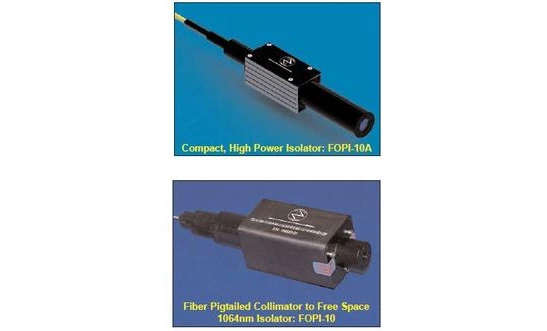
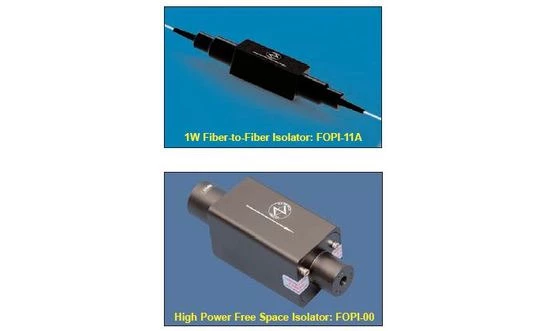
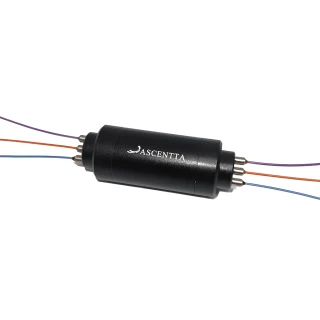
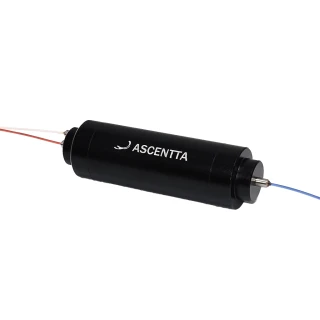
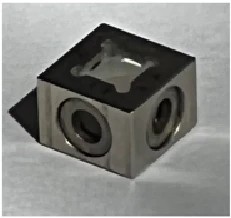
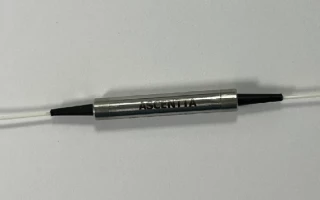
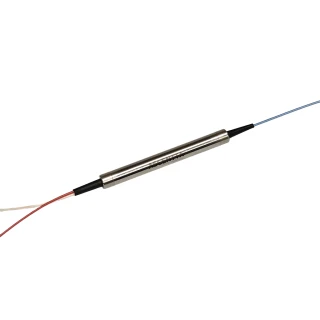
High Power Free Space and Fiber Pigtailed Isolators
Specifications
| Type Of The Device: | Isolator |
|---|---|
| Operating Wavelength: | 1064 nm |
| Max Power: | 50 W |
| Min Isolation: | 25 dB |
| Coupling Efficiency (Singlemode/PM Fibers): | Typically >60% |
| Coupling Efficiency (multimode Fibers): | >80% |
| Backreflection Levels (Standard Connectors): | Typically -14dB |
| Backreflection Levels (Angled Connectors): | Typically <-60dB |
| Available Wavelengths: | 180 - 2000nm |
| Polarization Extinction Ratio: | Typically >20dB (25, 30dB versions available) |
Got questions about specs? Use the inquiry form to ask.
 Download Data Sheet

Features
- Low Cost, High Performance: Offers an economical solution without compromising on power handling or optical performance.
- Exceptional Power Handling: Supports input powers up to 100W CW with fused silica or sapphire lenses, and >1W to >10W CW with GRIN, aspheric, and achromatic lenses—ideal for high-power laser applications.
- Wide Range of Lenses: Compatible with GRIN, achromat, aspheric, fused silica, plano-convex, and biconvex lenses, providing flexibility for diverse optical setups.
- Broad Wavelength Compatibility: Operates efficiently across a wide spectral range from 180 nm to 2000 nm, suitable for UV, visible, and IR applications.
- Excellent Polarization Maintaining Capabilities: Delivers polarization extinction ratios typically >20 dB, with 25 dB and 30 dB versions available for demanding applications.
- High Coupling Efficiency: Achieves >60% coupling into singlemode or polarization maintaining fibers, and >80% into multimode fibers for optimal light transmission.
- Low Backreflection: Standard connectors provide -14 dB backreflection; angled connectors achieve <-60 dB, minimizing feedback and signal degradation.
- Adjustable Air Gap Design: Non-contact style with adjustable fiber-to-lens distance allows compensation for wavelength changes and intentional beam defocusing—ideal for high-power and multi-wavelength coupling.
- Multiple Connector Options: Available with different connector receptacle versions, including optimized angled flat (AFC) connectors for superior repeatability and reduced backreflection.
- Superior for Challenging Beams: Handles large beam diameters, high divergence angles, and multi-wavelength sources, outperforming physical contact style couplers in demanding scenarios.
- OEM Ready & Versatile Applications: Perfect for laser shows, spectroscopy, interferometric sensors, fluorescence measurements, medical/pharmaceutical/chemical sensing, and OEM laser systems.
- Enhanced Repeatability: Recommended use of SMA connectors with Zirconia ferrules and sleeves for core diameters ≤100 μm, ensuring consistent performance.
Applications
- Laser Shows and Entertainment Systems
Ideal for high-power laser light delivery in laser shows, stage lighting, and entertainment venues, where reliable fiber coupling and high power handling are essential. - Spectroscopy
Enables efficient coupling of broadband or tunable light sources into optical fibers for absorption, fluorescence, and Raman spectroscopy applications across a wide wavelength range (180–2000 nm). - Interferometric Sensors
Used in fiber optic interferometers for precise measurement of strain, temperature, pressure, and other physical parameters, benefiting from excellent polarization maintaining capabilities. - Fluorescence Measurements
Facilitates the delivery and collection of excitation and emission light in fluorescence-based analytical instruments, supporting sensitive detection in life sciences and chemical analysis. - Medical, Pharmaceutical, and Chemical Sensors
Supports robust and repeatable coupling for fiber optic sensors used in medical diagnostics, pharmaceutical quality control, and chemical process monitoring. - OEM Laser Systems
Integrates seamlessly into custom and commercial laser systems for industrial, scientific, and medical applications, offering flexibility in lens selection and connector types. - High Power Fiber Coupling
Suitable for coupling high-power CW and pulsed lasers (up to 100W CW) into singlemode, multimode, or polarization maintaining fibers, making it ideal for materials processing, cutting, and welding. - Multi-Wavelength Light Delivery
Designed for applications requiring simultaneous coupling of multiple wavelengths, such as multi-line laser sources or broadband supercontinuum sources. - Large Beam Diameter and Divergence Handling
Accommodates input beams with large diameters or high divergence, making it suitable for free-space to fiber coupling in research and industrial setups. - Telecommunications and Data Transmission
Used in fiber optic communication systems for efficient light injection into fibers, especially where polarization maintenance and low backreflection are critical. - Quantum Optics and Photonics Research
Provides stable and repeatable coupling for quantum optics experiments, including single-photon sources and entangled photon pair generation. - Metrology and Calibration Systems
Delivers precise and stable light coupling for optical metrology, calibration of photodetectors, and reference light sources. - Environmental and Remote Sensing
Enables robust light delivery and collection in fiber optic sensors deployed for environmental monitoring, remote sensing, and distributed sensing networks.
Frequently Asked Questions
What is a non-contact style laser to fiber coupler with receptacle?
What are the main advantages of non-contact style couplers compared to physical contact couplers?
What is the typical coupling efficiency of these laser to fiber couplers?
What wavelength ranges are supported by these couplers?
How can backreflection be minimized in non-contact style couplers?
What types of lenses are compatible with these couplers?
What connector options are available and recommended for high repeatability?
Got more questions? Use the inquiry form to ask the supplier directly.
Similar Products



Your inquiry has been received.
Create an account by adding a password
Why create an account?
- Auto-complete inquiry forms
- View and manage all your past messages
- Save products to your favorites
- Close your account anytime — no hassle