Description

Ascentta’s ultra-broadband circulators, covering 1290nm to 1620nm, already boast high directivity and return loss, each with minimum values of 50dB. However, we are always looking for ways to improve our designs, which leads us to introduce the high directivity version of our ultra-broadband circulator.

These circulators cover the same range of wavelengths as our standard ultra-broadband circulators, but now with over 72.5dB of directivity, and a return loss of at least 70dB. The insertion loss is less than 2.5dB (both 1 to 2 and 2 to 3), a small change over that of the standard ultra-broadband design.

NOTE: Attached datasheet is for our standard ultra-broadband circulators, not our high directivity circulators.

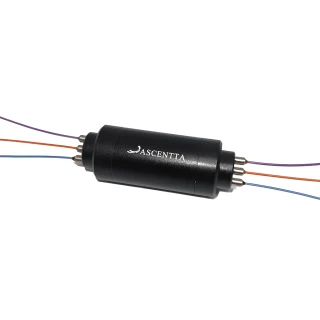
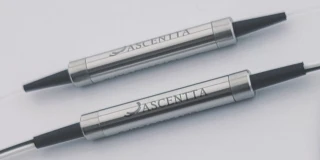
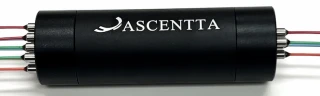
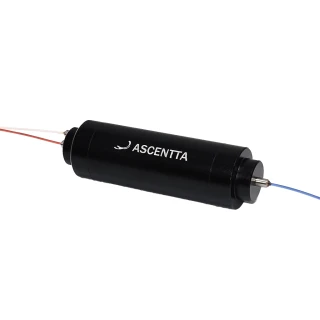
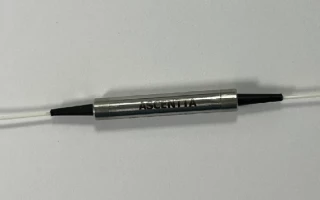
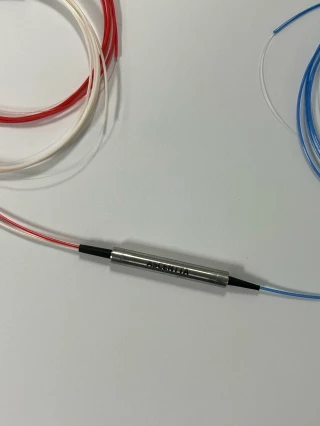
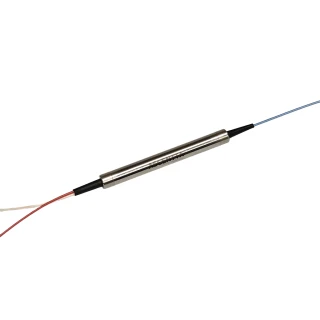
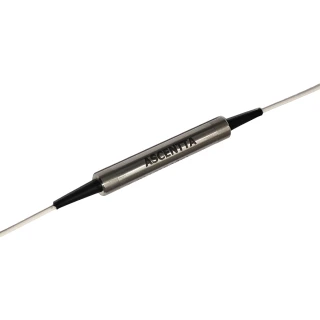
Ascentta High Directivity Ultra-broadband 3-port Optical Circulator

Specifications

Type Of The Device: Circulator
Operating Wavelength: Not Specified
Max Power: 0.3 W
Min Isolation: 20 dB
Operative Wavelength: 1290nm to 1620nm
Max Directivity: 72.5dB
Return Loss: 70dB
Insertion Loss (1 To 2, 2 To 3): 2.5dB
Manufacturer Part Number (MPN): CIRX-3-H-14501650-L-10-FA-9x73
FindLight SKU: FL-23597

Got questions about specs? Use the inquiry form to ask.

Document icon Download Data Sheet Download icon

Features

  • High directivity (aka low crosstalk)
  • High return loss
  • Low insertion loss
  • Wide bandwidth (over 300nm!)

Applications

  • Telecommunications
  • Fiber optic sensors
  • WDM systems

Export & Trade Information

ECCN: EAR99
HTS Code: 9027.90.8400
Estimated US Tariff: 0%

Importing, tariffs & codes (Quick Guide) →

Frequently Asked Questions

What is the Ascentta ultra‑broadband single‑mode 3‑port optical circulator and what wavelength range does it cover?
The Ascentta ultra‑broadband single‑mode 3‑port optical circulator is a non‑reciprocal, three‑port passive device that routes light sequentially from Port 1→2 and Port 2→3 while isolating the reverse directions. It is designed for single‑mode operation over an ultra‑wide wavelength range of 1290–1620 nm, covering O-, E-, S-, C- and L‑bands. Typical applications include fiber‑optic communications, bidirectional transmission, test and measurement setups, and optical sensing, where wideband performance and stable isolation over a large spectrum are required.
How does the 3‑port optical circulator route signals between ports (1→2→3), and what isolation can I expect?
This 3‑port optical circulator is designed so that light entering Port 1 is transmitted to Port 2, and light entering Port 2 is transmitted to Port 3. Reverse propagation is strongly suppressed: light from Port 2 back to Port 1 and from Port 3 back to Port 2 experiences high isolation. At the center wavelength and 23 °C, the typical isolation is 23 dB and the minimum specified isolation is 20 dB for all states of polarization. In addition, the device provides a minimum directivity of 50 dB between non‑adjacent ports (1→3 or 3→1), which helps prevent unwanted back‑reflections and crosstalk in complex fiber networks.
What are the typical insertion loss, PDL, PMD, and return loss of this broadband circulator?
For all states of polarization and at 23 °C, the typical insertion loss from Port 1→2 or Port 2→3 is 1.7 dB, with a maximum specified insertion loss of 2.0 dB. The polarization‑dependent loss (PDL) is ≤ 0.25 dB, ensuring stable performance with varying input polarization, which is important in real‑world fiber links. The polarization mode dispersion (PMD) is ≤ 0.2 ps, making the device well‑suited for high‑bit‑rate systems where dispersion must be minimized. The minimum return loss is 50 dB, which significantly reduces back‑reflection into upstream components such as lasers, EDFAs, or transceivers.
What optical power handling, operating temperature, and storage temperature ranges are supported?
This ultra‑broadband 3‑port optical circulator supports a maximum continuous optical power handling of 300 mW, which covers most telecom and test & measurement applications and many lab setups. The specified operating temperature range is −5 °C to +70 °C, allowing deployment in controlled indoor and light industrial environments. For long‑term storage and shipping, the approved storage temperature range is −40 °C to +85 °C. These environmental specifications are comparable to many high‑quality telecom‑grade circulators available on the market.
What fiber types, connector options, and package sizes are available for this circulator?
The standard fiber type options are SMF‑28 single‑mode fiber in 250 µm bare fiber (code B) or 900 µm tight buffer (code L); other fiber types can be requested (code X). Standard fiber lengths include 1.0 m (10), 1.5 m (15), 2.0 m (20), and 3.0 m (30), with custom lengths available on request. Connector options include none (NE), FC/APC (FA), FC/PC (FC), SC/APC (SA), SC/PC (SC), ST/PC (ST), LC/APC (LA) and LC/PC (LC), as well as custom connectors (X). The standard package is a cylindrical housing with a diameter of 5.5 mm and length of 50 mm, and a mini package 5.5 × 38 mm is also offered. Note that adding connectors slightly increases insertion loss and may affect return loss and PDL relative to bare‑fiber performance.
In which applications is a 1290–1620 nm ultra‑broadband 3‑port optical circulator typically used?
An ultra‑broadband 3‑port optical circulator covering 1290–1620 nm is ideal for systems that need wide spectral coverage or multi‑band operation. Common applications include bidirectional fiber‑optic communication links (e.g., combining upstream and downstream traffic on a single fiber), OTDR and other test and measurement setups, interferometric and fiber Bragg grating (FBG) sensing, distributed temperature/strain sensing, and optical add‑drop or reflection‑based devices. Compared with narrowband circulators specified only for C‑ or C+L‑band, this device allows experimentation or deployment across O‑, E‑, S‑, C‑ and L‑bands with consistent isolation and low PDL.
How should I specify and order a custom Ascentta 3‑port ultra‑broadband optical circulator?
Ascentta uses an ordering code that defines the port count, wavelength range, fiber type, fiber length, connectors, and package style. For this device, you would start with CIR (circulator family) and 3 for a 3‑port unit, then choose the wavelength code 1290‑1620 for the 1290–1620 nm range. Next select the fiber type (B for SMF‑28, 250 µm; L for SMF‑28, 900 µm; or X for other fibers), followed by the desired fiber length code (10, 15, 20, 30, or X for custom). Then choose connector types such as NE, FC/PC, FC/APC, SC/PC, SC/APC, ST/PC, LC/PC, LC/APC, or X for others, and finally select the package: blank for the standard 5.5 × 50 mm housing, 5.5×38 for the mini package, or X for a custom package. For assistance with non‑standard wavelengths, higher power handling, or unique mechanical or environmental requirements, Ascentta recommends contacting their sales/engineering team directly.

Got more questions? Use the inquiry form to ask the supplier directly.

Similar Products

Add to Cart