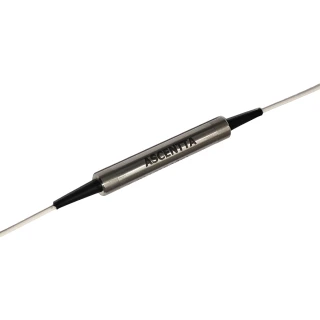
What is a single-mode polarization insensitive isolator array and what applications is the Ascentta ISA series designed for?
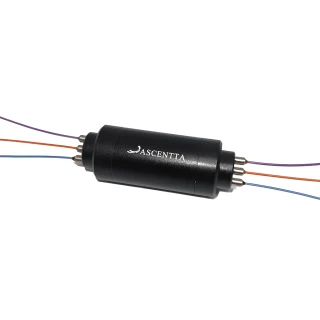
The Ascentta single-mode polarization insensitive isolator array (ISA series) is a multi-channel optical isolator built on single-mode fiber that blocks back-reflected light while transmitting forward-propagating signals with low loss. Unlike polarization-dependent isolators, it maintains performance over all states of polarization, making it ideal for systems where the input polarization is not controlled. Typical applications include EDFA and Raman amplifier protection at 1480 nm and 1550 nm, fiber laser and transmitter protection at 1310 nm and 1590 nm, WDM systems, test and measurement setups, and general lab or production environments where multiple channels (2×2 or 3×3 arrays) are required in a compact package.
What are the key optical specifications of the Ascentta single-mode polarization insensitive isolator array?
For the ISA series, typical key specifications (without connectors, at the center wavelength and 23 °C) are:
- Available wavelengths: 1310 ± 20 nm, 1480 ± 20 nm, 1550 ± 20 nm, or 1590 ± 20 nm
- Channel configuration: 2×2 or 3×3 arrays
- Isolation (all states of polarization): 30 dB typ., 25 dB min
- Insertion loss (all SOP): 0.6 dB typ. / 0.8 dB max (2×2), 1.1 dB typ. / 1.4 dB max (3×3)
- Polarization dependent loss (PDL): ≤ 0.1 dB (2×2), ≤ 0.15 dB (3×3)
- Polarization mode dispersion (PMD): ≤ 0.1 ps (typical compensated), ≤ 0.25 ps max for non‑compensated single-stage parts
- Return loss (input/output): ≥ 55 / 55 dB
- Optical power handling: up to 300 mW.
These values are competitive with similar telecom-grade isolator arrays on the market and suitable for high-performance fiber-optic systems.
How does polarization insensitivity benefit my fiber-optic system compared with a standard isolator?
In many practical fiber systems, the state of polarization (SOP) drifts over time due to temperature changes, mechanical stress, and bending of the fiber. A polarization-dependent isolator can show significant variation in insertion loss and isolation as the SOP changes, which can degrade system performance, especially in analog or high-bit-rate digital links. The Ascentta ISA series is designed to be polarization insensitive: it maintains specified isolation and low insertion loss over all SOPs, with very low PDL (≤ 0.1–0.15 dB). This makes it more robust for:
- Long fiber runs with uncontrolled polarization
- Amplifiers (EDFA/Raman) where feedback must be tightly controlled
- Multi-channel or array configurations where channel-to-channel stability is critical.
In short, polarization insensitivity helps ensure consistent performance without needing polarization controllers or specialty polarization-maintaining fibers in most use cases.
What fiber types, connector options, and fiber lengths are available for the ISA isolator array?
By default, the ISA array uses standard Corning SMF‑28 single-mode fiber and is offered in two jacket options:
- B = SMF‑28, 250 μm bare fiber
- L = SMF‑28, 900 μm tight-buffered fiber
Standard fiber lengths are:
- 10 = 1.0 m
- 15 = 1.5 m
- 20 = 2.0 m
- 30 = 3.0 m
Standard connector options are:
- NE = none (bare fiber pigtails)
- FA = FC/APC
- FC = FC/PC
- SA = SC/APC
- SC = SC/PC
- ST = ST/PC
- LA = LC/APC
- LC = LC/PC
The ordering code also allows “X” in the fiber type, length, or connector fields for other customized options (e.g., different fiber types or special connector/polish combinations). Note that adding connectors can slightly increase insertion loss and affect return loss and PDL compared with bare-fiber parts.
What are the mechanical dimensions and environmental ratings of the Ascentta ISA array?
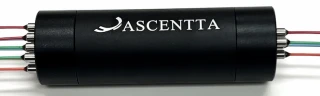
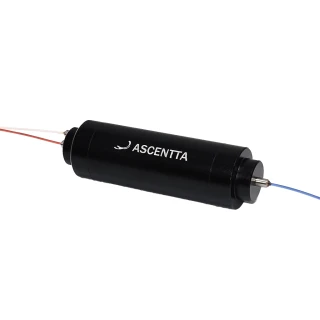
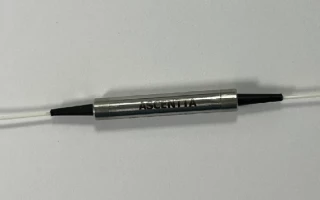
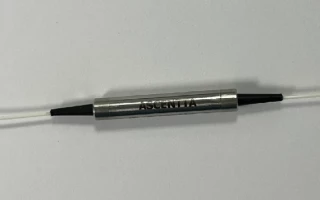
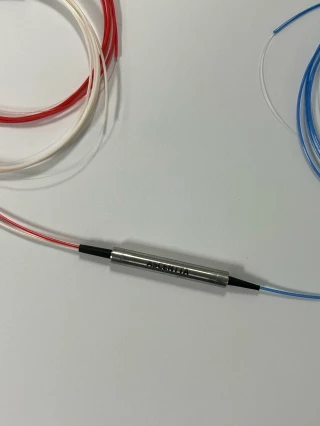
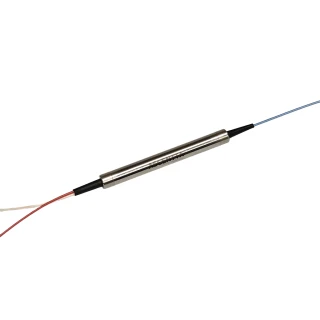
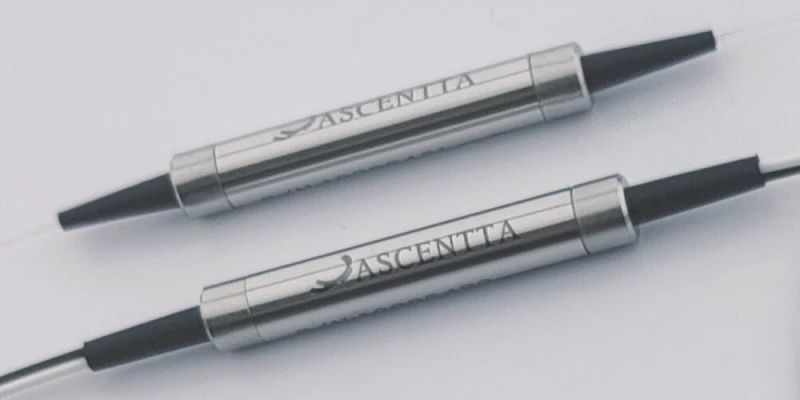
The ISA polarization insensitive isolator array is packaged in a compact cylindrical module suitable for dense integration:
- Package size: Φ 5.5 mm × 35 mm length (typical)
Environmental ratings:
- Operating temperature: −5 °C to +70 °C
- Storage temperature: −40 °C to +85 °C
These ratings are in line with many telecom and lab-grade fiber-optic components on the market. If your application requires extended temperature ranges, shock/vibration specs, or custom housings, Ascentta can often provide custom designs on request.
How do I specify and order a customized Ascentta ISA single-mode polarization insensitive isolator array?
Ascentta uses a structured part-numbering scheme for the ISA series:
ISA – [# of Channels] – [Stages] – [Wavelength] – [Fiber Type] – [Fiber Length] – [Connector]
For example, an ISA 2‑channel, single-stage isolator at 1550 nm with 1 m of 250 μm SMF‑28 fiber and FC/APC connectors might be coded like:
ISA 2 S 15 B 10 FA
Field options include:
- # of Channels: 2 = 2×2 array, 3 = 3×3 array
- Stages: S = single-stage (others by request)
- Wavelength: 13 = 1310 nm, 14 = 1480 nm, 15 = 1550 nm, 159 = 1590 nm, X = others
- Fiber Type: B = SMF‑28 250 μm, L = SMF‑28 900 μm, X = others
- Fiber Length: 10/15/20/30 (1.0 / 1.5 / 2.0 / 3.0 m), X = others
- Connector: NE/FA/FC/SA/SC/ST/LA/LC or X for others
For non-standard wavelengths, different fiber types, special arrays, or other customizations, contact Ascentta directly at sales@ascentta.com or via their website to define your exact requirements.
How does the ISA isolator array compare to similar single-channel isolators in terms of performance and integration?
Compared with typical single-channel telecom isolators from leading vendors, the Ascentta ISA array offers:
- Comparable or better isolation: 25 dB min, 30 dB typ across all SOPs
- Competitive insertion loss: typ. 0.6–1.1 dB (depending on 2×2 or 3×3 configuration), similar to many discrete single-channel units
- Very low PDL (≤ 0.1–0.15 dB) and PMD (≤ 0.1–0.25 ps), which is important for high-bit-rate and coherent systems
- Multi-channel integration in a compact Φ 5.5 × 35 mm package, reducing space and simplifying fiber management when multiple isolators are required.
For system designers who would otherwise bundle multiple discrete single-channel isolators, the ISA array offers improved density, simpler assembly, and consistent multi-channel performance, while remaining within the same performance class as high-quality stand-alone fiber isolators.

 Download Data Sheet