
Description
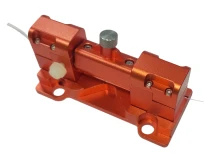
The ROFEA mechanical manual fiber polarization controller is a precision-engineered solution for reliable polarization management in single-mode fiber systems. Designed around a classic three-ring configuration with a 56 mm loop diameter, it provides smooth, repeatable control of the state of polarization (SOP) without introducing significant insertion loss. Compared with many compact controllers that rely on tight fiber bends, this large-diameter design is especially well suited for applications where minimizing bending losses is critical, such as long-haul links, high‑power transmission, and ultra‑sensitive measurement setups.
Built using durable black plastic‑steel ring leaves and robust mechanical components, this polarization controller is optimized for standard SMF‑28‑J9 single‑mode fiber. It covers a broad operating wavelength range from 1260 nm to 1625 nm, with design wavelengths at 1310 nm and 1550 nm to match the most widely used telecom and test bands. The factory‑installed fiber is carefully routed in a 3‑6‑3 loop configuration to ensure efficient polarization transformation while preserving low loss and high return performance, making it ideal for both research laboratories and system integration.
The integrated fiber exhibits mode field diameters of 9.2 µm at 1310 nm and 10.4 µm at 1550 nm, with a numerical aperture of 0.14, fully in line with standard single‑mode telecom specifications. A 125 µm cladding and 242 µm coating diameter with a Ø900 µm sealed buffer layer provide excellent mechanical protection during repeated adjustments. The combination of optimized winding and large-radius loops keeps additional bending loss to ≤0.1 dB, giving this controller a performance level comparable to similar high‑end three‑paddle units used in coherent communications, fiber sensing, and precision metrology.
In practical use, each of the three rings can be rotated over ±117.5°, allowing the user to systematically drive the fiber through all accessible polarization states. This makes the device well suited for tasks such as maximizing or minimizing signal transmission through polarizers, aligning polarization to polarization‑sensitive components, calibrating polarization‑dependent loss (PDL) and polarization‑mode dispersion (PMD) measurement systems, or preparing and analyzing polarization states in quantum communication experiments. The stable mechanical platform and smooth adjustment behavior ensure that once the desired SOP is reached, it can be held over time with minimal drift due to environmental perturbations.
With an overall size of 273.2 mm × 25.5 mm × 93 mm (length × width × height), the controller offers a compact footprint that fits easily onto standard optical tables and breadboards. The use of an FC/APC connector interface supports low‑reflection connections to modern fiber‑optic test equipment, light sources, and detectors used across telecom, datacom, sensing, and quantum optics. Thanks to mass‑production processes and refined workmanship, this manual fiber polarization controller delivers a combination of performance, reliability, and cost‑effectiveness that makes it a strong choice for experimental research environments as well as for integration into polarization‑sensitive test platforms.
Three Ring Manual Fiber Polarization Controller SMF28 FC APC
Specifications
| Operating Wavelength Range: | 1260 – 1625 nm |
|---|---|
| Insertion Loss: | Not Specified |
| Polarization Mode Dispersion: | Not Specified |
| Resolution: | Not Specified |
| Ringleaf Material: | Black plastic steel |
| Number Of Rings: | 3 |
| Ring Diameter: | 2.2 inches (56 mm) |
| Ringleaf Rotation: | ±117.5° |
| Size: | 273.2 × 25.5 × 93 mm (L × W × H) |
| Fiber Type: | SMF-28-J9 |
| Working Wavelength Range: | 1260–1625 nm |
| Design Wavelength: | 1310 nm and 1550 nm |
| Mode Field Diameter @1310 Nm: | 9.2 ± 0.4 µm |
| Mode Field Diameter @1550 Nm: | 10.4 ± 0.5 µm |
| Coating Diameter (fiber): | 125 ± 0.7 µm |
| Coating Diameter (buffer): | 242 ± 5 µm |
| Numerical Aperture: | 0.14 |
| Interlayer: | Ø9000 µm sealed buffer |
| Loop Configuration: | 3-6-3 |
| Connector: | FC/APC |
| Bending Loss: | ≤0.1 dB |
Got questions about specs? Use the inquiry form to ask.
 Download Data Sheet

Features
- High-Precision Three-Ring Polarization Control – Mechanical manual fiber polarization controller with three independent rings for finely tuning the state of polarization (SOP) of light in single-mode fibers.
- Wide Wavelength Operating Range (1260–1625 nm) – Optimized for telecom and test wavelengths with a broad working range of 1260–1625 nm and design wavelengths at 1310 nm and 1550 nm, covering O-, E-, S-, C- and L-bands.
- Optimized for Standard Telecom Fiber (SMF-28-J9) – Uses pre-installed SMF-28-J9 single-mode fiber with well-controlled mode field diameter: 9.2 ± 0.4 µm @ 1310 nm and 10.4 ± 0.5 µm @ 1550 nm for low-loss, consistent performance.
- Large Ring Diameter for Low Bending Loss – Features a 56 mm (2.2 inch) loop diameter that greatly reduces micro- and macro-bending losses, ideal for fibers and applications that are sensitive to bending-induced attenuation.
- Wide Mechanical Rotation Range – Each ringleaf can rotate by ±117.5°, enabling accurate and repeatable modulation of polarization states for complex experimental configurations.
- Supports Bare and 900 µm Buffered Fiber – Compatible with bare fibers and Ø900 µm sealed buffer fibers, making it suitable for both lab pigtails and ruggedized patch-cord style terminations.
- Low Insertion and Bending Loss – Carefully designed loop configuration (3–6–3) and large ring geometry provide bending loss ≤ 0.1 dB, minimizing signal degradation in precision measurements.
- Industry-Standard FC/APC Connector – Delivered with FC/APC connectors to ensure low back reflection and easy integration into standard fiber optic test setups and communication systems.
- Robust Black Plastic-Steel Ringleaf Construction – The black plastic-steel ring material offers excellent mechanical stability, durability, and resistance to deformation for long-term, high-repeatability use.
- Compact, Bench-Friendly Form Factor – Space-efficient housing with dimensions of 273.2 × 25.5 × 93 mm (L × W × H), suitable for crowded optical benches and test racks.
- High Cost-Effectiveness for Research Labs – Mass-produced with consistent workmanship and quality control, making it a cost-effective choice for universities, R&D labs, and production test environments compared with more complex electro-optic solutions.
- Ideal for Advanced Photonics Applications – Well suited for device testing, fiber sensing, coherent communication systems, quantum communication experiments, polarization-dependent loss/dispersion studies, and polarization mode dispersion evaluation.
- Stable Performance Across Wavelength – The pre-installed fiber and loop structure are optimized for the specified wavelength range, providing stable polarization control characteristics over key telecom bands.
- Manual, Intuitive Operation – Simple mechanical rings provide tactile, real-time control over polarization without any electronics, software, or power supply requirements.
- Professional Photoelectric Manufacturing – Designed and produced by a specialized photoelectric product manufacturer (Rofea Optoelectronics), ensuring compatibility with other high-performance fiber optic components and test systems.
Applications
- Polarization Control in Fiber Optic Component Testing
Ideal for precise polarization adjustment when characterizing fiber optic components such as isolators, circulators, couplers, wavelength division multiplexers (WDMs), filters, intensity modulators, and photonic integrated devices. The three-ring mechanical manual fiber polarization controller allows accurate SOP (State of Polarization) tuning across the 1260–1625 nm range, matching common telecom and test wavelengths at 1310 nm and 1550 nm. - Laboratory Fiber Optic Experiments and Educational Setups
Widely used in university and R&D labs for teaching and demonstrating polarization effects in single-mode fibers (SMF-28-J9). The large 56 mm loop diameter and three-ring configuration (3-6-3) simplify visualization of polarization evolution, making it suitable for educational experiments in optical communications, photonics, and fiber physics. - Quantum Communication and Quantum Key Distribution (QKD)
Suited for polarization-encoded quantum communication systems, including QKD testbeds where stable and repeatable polarization states are required. The low bending loss (≤0.1 dB) and well-controlled loop geometry help maintain high quantum channel fidelity over single-mode links at 1310 nm and 1550 nm. - Fiber Sensing Systems and Interferometric Sensors
Used to optimize polarization in fiber optic sensing architectures such as interferometric sensors (Mach–Zehnder, Michelson, Sagnac), polarization-maintaining hybrid sensors, and distributed sensing setups. By adjusting SOP, users can maximize interference contrast, sensitivity, and signal-to-noise ratio in fiber Bragg grating (FBG) sensors and phase-sensitive configurations. - Polarization Optimization in Coherent Optical Receivers
Helpful for aligning the polarization state in coherent detection systems during development, alignment, and troubleshooting. When testing coherent receivers, coherent transceivers, and advanced modulation formats (QPSK, QAM), the polarization controller enables efficient coupling into polarization-sensitive devices and maximizes coherent signal performance. - Single-Photon and Low-Light-Level Experiments
Used in single-photon counting and low-power optical setups where polarization must be controlled without introducing significant insertion loss. The carefully designed ring structure and large ring diameter help minimize bending-induced attenuation, making it suitable for delicate photon-budget-limited experiments. - Polarization Diversity and Polarization Mode Dispersion (PMD) Studies
Beneficial for generating and exploring different polarization states when studying PMD, polarization-dependent loss (PDL), and polarization-related impairments in fibers and components. Researchers can simulate real-world polarization fluctuations and observe their impact on system performance. - Device Burn-In and Reliability Testing Under Controlled Polarization
Enables controlled SOP conditions during long-term stress and burn-in tests of fiber optic components, such as active devices, amplifiers, and passive assemblies. Maintaining repeatable polarization states helps characterize worst-case performance and reliability over the product lifetime. - Polarization Control in Fiber Laser and Amplifier Setups
Applicable for aligning polarization in fiber laser cavities and erbium-doped fiber amplifier (EDFA) configurations using standard single-mode fiber. By tuning the state of polarization, users can influence lasing conditions, optimize output power, and improve amplifier stability, especially in experimental and prototype platforms. - Telecom and Datacom Test Racks
Integrates easily into telecom test benches for 1310 nm and 1550 nm links, enabling quick manual polarization adjustments when evaluating transceivers, network elements, and passive optical networks (PONs). The FC/APC connector interface and compatibility with SMF-28-J9 simplify integration with common telecom patch cords and systems. - Polarization Matching for Polarization-Sensitive Detectors and Modulators
Used in front of polarization-sensitive photodiodes, modulators, and polarization beam splitters to match the incoming light polarization to the device’s optimal axis. This is important for maximizing modulation depth, detection efficiency, and extinction ratio in precision measurement setups. - Integration into Fiber Sensing Networks and Structural Health Monitoring
Deployed in practical sensing networks where different branches or sensing heads require tailored polarization states.
Frequently Asked Questions
What is the ROF three-ring mechanical fiber polarization controller and what is it used for?
How does a three-ring fiber polarization controller work?
What fiber types and wavelength ranges are supported by this polarization controller?
What are the key mechanical and optical specifications of the ROF fiber polarization controller?
What is the difference between the three-ring polarization controller and a squeezed (paddle-free) polarization controller?
How does the ring diameter and loop configuration affect polarization control and bending loss?
In which experiments or systems is this ROF polarization controller most commonly used?
Got more questions? Use the inquiry form to ask the supplier directly.
Similar Products


Your inquiry has been received.
Create an account by adding a password
Why create an account?
- Auto-complete inquiry forms
- View and manage all your past messages
- Save products to your favorites
- Close your account anytime — no hassle