
Description
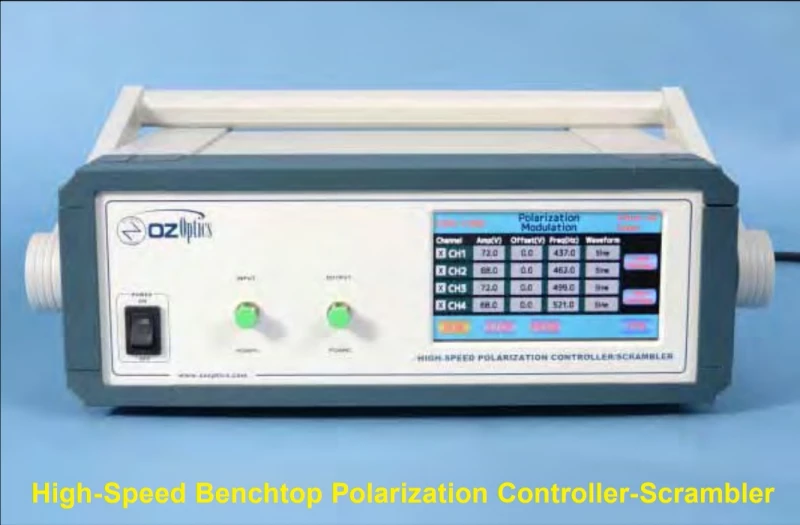
The High-Speed Benchtop Polarization Controller-Scrambler (HSPC-1000) is a state-of-the-art instrument designed for precise and dynamic control of the polarization state in fiber optic systems. Engineered for both laboratory and manufacturing environments, this device integrates an electric polarization controller and driver into a single, compact benchtop unit. Its robust design and intuitive LCD touch screen interface make it exceptionally user-friendly, allowing for rapid setup and seamless operation.
The HSPC-1000 stands out for its ability to generate both fixed and random polarization states, catering to a wide range of experimental and production needs. With four independent optical retardation elements, each controlled by internal piezoelectric drivers, users can achieve any desired state of polarization with high accuracy. The system supports user-selectable frequencies up to 1 kHz, offering flexibility for applications that require either steady-state or rapidly varying polarization conditions.
This polarization controller-scrambler is ideally suited for tasks such as polarization scrambling, measuring polarization dependent loss (PDL), and quality control in fiber optic component manufacturing. Its low insertion loss and minimal polarization dependent loss ensure that signal integrity is maintained, making it a reliable choice for sensitive optical measurements. The device accommodates a wide wavelength range (1260–1650 nm standard) and is compatible with standard 9/125 μm singlemode fibers, ensuring broad applicability across telecom and photonics research sectors.
Designed with durability in mind, the HSPC-1000 features a rugged casing and is built to withstand variable operating conditions, including a broad temperature and humidity range. Its universal power supply and USB connectivity further enhance its versatility, making it a valuable addition to any optical laboratory or production line where precise polarization control is essential.
High-Speed Benchtop Polarization Controller-Scrambler HSPC-1000
Specifications
| Operating Wavelength Range: | 1260 – 1650 nm |
|---|---|
| Insertion Loss: | 0.05 dB |
| High-Speed Benchtop Polarization Controller-Scrambler HSPC-1000: | 4 |
| Retardation Range: | 2π minimum |
| Backreflection: | >60 dB |
| Activation Loss: | ± 0.05 dB |
| Polarization Dependent: | <0.06 dB |
| Fiber Type: | 9/125 μm |
| Modes Of Operation: | Constant Voltage (DC), Sine or triangle waves at a user-selectable frequency and amplitude |
| Frequency Range (Sine Wave Output): | 0 to 1 kHz @ 140 V |
| Frequency Resolution: | 0.1 KHz |
| Output Voltage Range: | 0 to +140 V |
| Voltage Resolution: | 0.633 mV |
| Power Supply Input: | 120/240 VAC @ 50/60 Hz (Universal supply), 4 A |
| Power Supply Output: | 12 VDC, 15 A, 180 WATT (max.) |
| Communications Interface: | USB 2.0 Cable Type A to Type B |
| Humidity: | <90% RH, non-condensing, at 0 to 45 °C (32 to 113 °F) |
| Temperature Range: | Operating: -20 to 35 °C (-4 to 95 °F) at 140 V and 2 kHz, -20 to 45 °C (-4 to 113 °F) at 140 V and 1 kHz; Storage: -30 to 80 °C (-22 to 176 °F) |
| Dimensions (H X W X D): | 110 x 280 x 300 mm |
| Weight: | 5.5 kg |
Got questions about specs? Use the inquiry form to ask.
 Download Data Sheet

Features
- Intuitive LCD Touch Screen Interface: Effortlessly control and monitor device settings with a user-friendly touch display for streamlined operation.
- Integrated Electric Polarization Controller & Driver: Combines both controller and driver in a single compact benchtop unit, reducing setup complexity and footprint.
- Versatile Polarization State Generation: Supports both fixed and random (scrambled) polarization states, ideal for diverse research and manufacturing applications.
- User-Selectable Frequency Range: Adjust scrambling or modulation frequencies up to 1 kHz with fine 0.1 Hz resolution for precise control.
- Four Independent Channels: Features four optical retardation elements, each independently controlled, enabling generation of any desired polarization state.
- Wide Wavelength Compatibility: Standard operation from 1260–1650 nm; custom wavelength options available for specialized requirements.
- Low Insertion Loss: Typical insertion loss of only 0.05 dB (excluding connectors), ensuring minimal signal degradation.
- Exceptional Backreflection Performance: Greater than 60 dB backreflection (excluding connectors) for high-fidelity optical measurements.
- Ultra-Low Polarization Dependent Loss (PDL): Less than 0.06 dB PDL, making it suitable for sensitive optical testing and measurement tasks.
- Multiple Operation Modes: Supports constant voltage (DC), sine, and triangle waveforms with user-selectable amplitude and frequency.
- High Output Voltage Range: 0 to +140 V output with fine 0.633 mV resolution for both AC and DC modes.
- Robust and Rugged Design: Durable casing and construction for reliable benchtop use in laboratory and industrial environments.
- Universal Power Supply: Accepts 120/240 VAC input (50/60 Hz), making it suitable for global deployment.
- USB 2.0 Communication Interface: Enables easy integration with computers and automation systems for remote control and data logging.
- Wide Operating Temperature Range: Operates from -20 to 45 °C, with storage capability down to -30 °C and up to 80 °C for maximum versatility.
- Compact and Portable: Benchtop form factor with dimensions of 110 x 280 x 300 mm and a manageable weight of 5.5 kg (12.2 lb.).
Applications
- Polarization Scrambling in Fiber Optic Systems
Achieve rapid and effective polarization scrambling for fiber optic networks, minimizing polarization-dependent effects and enhancing system reliability. - Measuring Polarization Dependent Loss (PDL)
Precisely measure PDL in optical components and systems, ensuring accurate characterization and quality assurance in manufacturing and R&D environments. - Manufacturing and Quality Control of Optical Components
Integrate into production lines for automated testing and quality control of fiber optic devices, such as isolators, couplers, and multiplexers, to ensure consistent performance. - Studying Polarization Effects in Research
Facilitate advanced research into polarization effects in photonics, quantum optics, and fiber optic communications by providing controlled and repeatable polarization states. - Polarization Mode Dispersion (PMD) Testing
Use in PMD characterization setups to simulate varying polarization states and evaluate the impact on high-speed optical transmission systems. - Calibration of Polarimeters and Optical Instruments
Serve as a stable and adjustable polarization source for calibrating polarimeters, optical spectrum analyzers, and other polarization-sensitive instruments. - Development and Testing of Polarization Sensitive Devices
Essential for the development, alignment, and testing of devices such as polarization controllers, modulators, and sensors. - Telecommunications System Optimization
Optimize and troubleshoot polarization-related issues in fiber optic telecommunication systems, including DWDM and coherent transmission networks. - Educational Demonstrations and Laboratory Experiments
Ideal for university and training laboratories to demonstrate polarization principles and effects in guided optics. - Polarization State Generation for Quantum Key Distribution (QKD)
Generate precise and repeatable polarization states required for secure quantum communication protocols. - Testing of Fiber Optic Sensors
Evaluate the polarization sensitivity and performance of fiber optic sensors used in structural health monitoring, medical diagnostics, and environmental sensing.
Frequently Asked Questions
What is the OZ Optics HSPC-1000 High-Speed Benchtop Polarization Controller-Scrambler?
What are the main features of the HSPC-1000 polarization controller-scrambler?
How does the HSPC-1000 polarization controller-scrambler work?
What applications is the HSPC-1000 suitable for?
What is the wavelength range supported by the HSPC-1000?
How do I control and interface with the HSPC-1000?
What are the power and environmental requirements for the HSPC-1000?
Got more questions? Use the inquiry form to ask the supplier directly.
Similar Products

Your inquiry has been received.
Create an account by adding a password
Why create an account?
- Auto-complete inquiry forms
- View and manage all your past messages
- Save products to your favorites
- Close your account anytime — no hassle