


Description
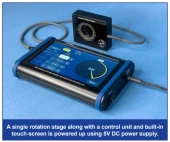
The high resolution motorized polarization controller from OZ Optics is engineered for precise, repeatable control of polarization states in both simple and complex optical systems. Designed as a compact, palm-sized platform, it integrates a control unit, processor, and intuitive touch screen in a single enclosure, allowing users to manage single or multiple motorized rotation stages from one central interface. This architecture makes it well-suited for laboratory setups, production test stations, and field environments where stable and automated polarization control is essential.
Unlike manual polarization controllers or fixed waveplate mounts, this motorized solution offers closed-loop rotation with a built-in encoder, enabling sub-degree resolution and excellent bidirectional and homing repeatability across a full 360° continuous travel range. Each stage can house waveplates, polarizers, polarizing beam splitters, or other polarization optics, making it adaptable to a wide range of experimental and industrial configurations. By synchronizing multiple stages via a single controller, users can perform complex, multi-parameter polarization manipulations sequentially or in parallel, which is particularly important for advanced measurements such as quantum state tomography or multi-channel polarization analysis.
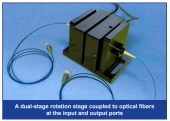
The system supports multiple optical interfaces to seamlessly integrate into free-space and fiber-based setups. Stages can be provided with fiber connector receptacles, pinholes for free-space input and output, or pigtailed with single-mode, polarization maintaining, or multimode fibers. This flexibility makes the controller suitable for tasks such as polarization alignment in coherent communication links, polarization mode dispersion studies, and the generation and stabilization of polarized fiber-optic sources. High power optics options and connectorized fibers can be configured for a wide range of operating wavelengths, enabling use with common laser lines and broadband sources in telecom, metrology, sensing, and research applications.
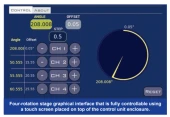
A key advantage of this platform is its user-friendly control environment. The integrated GUI on the touch screen offers straightforward access to motion parameters, rotation presets, and synchronization tools for multi-stage systems, effectively providing plug-and-play operation. For more complex workflows or automated test sequences, the controller can be driven from an external computer over USB, with software that can be customized on request and a Python library for easy integration into lab automation, instrument control frameworks, and quality-control systems. This level of software flexibility allows researchers and engineers to build repeatable polarization control routines that can be executed with minimal user intervention.
Mechanically, the rotation stage is built with a rugged housing and standard mounting provisions, featuring a ¼-20 UNC-2B tapped thread for straightforward integration with optical tables, posts, and breadboards. With compact dimensions of approximately 7.4 × 8.8 × 2.3 cm and a weight of about 230 g, it conserves space in dense optical layouts while maintaining mechanical stability. The controller and stages are specified for typical laboratory environmental conditions, operating reliably across a 15 to 40 °C temperature range and up to 80% relative humidity (non-condensing) at 31 °C, making them suitable for most indoor R&D and production settings at altitudes up to 2000 m.
In demanding applications where polarization stability, accuracy, and repeatability directly affect system performance—such as interferometric measurements, coherent detection schemes, polarization extinction ratio optimization, and polarization calibration—the high resolution motorized polarization controller offers a robust, upgrade-ready path beyond manual rotation mounts or improvised polarization solutions. By combining fine angular control, multi-stage synchronization, and flexible fiber or free-space interfaces in a single, compact platform, it provides a dependable backbone for modern photonic experiments and polarization-sensitive optical systems.
Precision Motorized Polarization Rotation Stage
Specifications
| Operating Wavelength Range: | 635 – 2050 nm |
|---|---|
| Resolution: | 0.0025 Degrees |
| Power Supply Voltage: | 5 V DC |
| Mounting Thread: | 1/4-20 UNC-2B TAP |
| Dimensions: | 7.4 x 8.8 x 2.3 cm |
| Weight: | 230 g |
| Operating Temperature Range: | 15 to 40 °C |
| Maximum Relative Humidity: | <80% at 31 °C (non-condensing) |
| Maximum Altitude: | 2000 m |
| Travel: | 360° continuous |
| Bidirectional Repeatability: | 0.05° |
| Homing Repeatability: | 0.1° |
Got questions about specs? Use the inquiry form to ask.
 Download Data Sheet

Features
- High‑Precision Polarization Control – Enables precise rotation of half‑wave plates, quarter‑wave plates, polarizers, polarizer prisms, and polarization beam splitters for accurate polarization state manipulation in single or multi‑stage optical systems.
- 360° Continuous Travel – Provides full 360° continuous rotation with fine angular control, ideal for applications that require complete polarization state coverage.
- Sub‑Degree Angular Resolution – Incorporates a high‑resolution motor/drive system with sub‑degree control, enabling fine tuning of the electric field orientation of the propagating wave.
- Built‑In Encoder for Closed‑Loop Operation – Integrated position encoder delivers closed‑loop feedback for improved accuracy, 0.05° bidirectional repeatability and 0.1° homing repeatability, enhancing stability and reproducibility.
- Multi‑Stage and Multi‑Path Capability – Allows single‑stage or multi‑stage configurations, with multiple optical paths controlled from one compact controller, supporting complex polarization control setups and synchronized operation.
- Compact Handheld Control Unit – Palm‑sized control unit with integrated processor and touch‑screen display provides a portable, space‑saving solution for both lab bench and field use.
- Intuitive Touch‑Screen GUI – Onboard graphical user interface offers plug‑and‑play operation, quick access to motion parameters, and easy sequencing of rotations without external software.
- USB Connectivity for PC Control – Can be fully controlled via a computer using a USB interface, enabling easy integration into automated test setups and remote polarization management.
- Python Library & Software API – Supplied with a Python library and software hooks to simplify scripting, automation, and integration into custom control environments or measurement platforms.
- Customizable Software and GUI – Control software and GUI can be modified on request to match specific workflows, test sequences, or OEM integration requirements.
- Interchangeable Optics & Holders – Modular design with interchangeable optics, holders, and receptacles allows quick switching between waveplates, polarizers, and other polarization optics.
- Flexible Fiber & Free‑Space Interfaces – Supports:
- Fiber‑connector receptacles (for connectorized components)
- Pinholes for free‑space beam applications
- Pigtailed modules with single‑mode, polarization‑maintaining (PM), or multimode fibers
- High‑Power Optics Options – Available with high‑power compatible optics and connectorized fibers for demanding laser applications over a wide wavelength range.
- Wide Wavelength Compatibility – Configurable with optics and fibers covering multiple telecom and specialty wavelength bands, supporting diverse laser sources and test regimes.
- Excellent Mechanical Stability – Rigid, compact mechanical design helps maintain polarization stability, minimizing drift and mechanical play even in multi‑stage assemblies.
- Compact Footprint for Easy Integration – Motorized rotation stage dimensions of approximately 7.4 × 8.8 × 2.3 cm (L × W × H) and a weight of 230 g facilitate integration into crowded optical tables, racks, or OEM instruments.
- Standard 1/4‑20 Mounting Interface – Equipped with a ¼‑20 UNC‑2B tap for straightforward mounting on standard optical posts, stages, and breadboards.
- Single or Dual‑Stage Configurations – Available as:
- Single rotation stage with built‑in control unit and touch‑screen
- Dual‑stage assemblies coupled to fibers at input and output ports for more advanced polarization schemes
- Simple Power Requirements – Operates from a 5 V DC power supply, simplifying power integration in lab and OEM systems.
Applications
- Automated polarization state control in fiber optic test systems
Ideal for characterizing polarization-dependent components such as isolators, circulators, couplers, WDMs, and fiber Bragg gratings by automatically sweeping and stabilizing polarization states for repeatable measurements. - Quantum optics and quantum communication experiments
Used for precise rotation of half-wave and quarter-wave plates in quantum key distribution (QKD), entanglement experiments, Bell inequality tests, and quantum state preparation where accurate polarization control and synchronization are critical. - Quantum state tomography and polarization-based qubit analysis
Enables automated measurement of Stokes parameters and density matrices by cycling through well-defined polarization projections, improving accuracy and speed in quantum state reconstruction. - Polarization calibration in optical measurement setups
Provides a stable reference for calibrating polarimeters, polarization analyzers, optical spectrum analyzers with polarization options, and coherent receivers, ensuring traceable and reproducible polarization measurements. - Polarization state analyzer and controller in fiber links
Compensates for time-varying polarization changes in deployed or laboratory fiber links, allowing active polarization tracking, alignment to desired states, and evaluation of polarization mode dispersion and PDL effects. - Generation and control of polarized fiber optic sources
Converts standard laser outputs into controlled polarization states (linear, circular, elliptical) and maintains them over time, supporting applications such as sensor interrogation, coherent detection, and spectroscopy. - Polarization extinction ratio (PER) optimization and PM fiber axis alignment
Optimizes the launch conditions into polarization-maintaining (PM) fibers by rotating waveplates and polarizers to align with slow or fast axes, maximizing PER and enabling axis conversion or cross-coupling characterization. - Laser-to-fiber coupling and alignment in free-space to fiber interfaces
Aligns the input polarization of a free-space laser to the PM or single-mode fiber axis, improving coupling efficiency, long-term stability, and repeatability in high-precision optical setups and interferometers. - Coherent detection and coherent communication systems
Adjusts the state of polarization at the receiver for optimal mixing with a local oscillator in coherent receivers, facilitating polarization-multiplexed link testing, impairment emulation, and DSP algorithm verification. - Optical interferometric systems and metrology
Controls polarization in Michelson, Mach–Zehnder, Sagnac, and fiber interferometers to manage interference visibility, suppress unwanted polarization modes, and investigate polarization-dependent phase shifts. - Polarization diversity and polarization multiplexing experiments
Automates rotation sequences for creating polarization-multiplexed channels, characterizing polarization-diversity receivers, and evaluating advanced modulation formats that rely on controlled polarization states. - Characterization of polarization-dependent loss (PDL) and polarization mode dispersion (PMD)
Sweeps polarization systematically to quantify PDL in components or subsystems and to study PMD effects, enabling accurate qualification of fiber links, amplifiers, and passive components. - Fiber optic sensing and distributed sensing systems
Manages and stabilizes polarization in interferometric and polarization-sensitive sensors, such as fiber gyroscopes, current sensors, and distributed acoustic or strain sensing systems that depend on polarization behavior. - Optical coherence tomography (OCT) and polarization-sensitive OCT
Adjusts and stabilizes the polarization state in OCT interferometers, particularly in PS-OCT systems, to enhance contrast and extract birefringence-related information from biological or industrial samples. - Laser material processing, microscopy, and imaging with controlled polarization
Tunes polarization to optimize interaction with anisotropic materials, thin films, and nanostructures in laser machining, confocal microscopy, and polarization-resolved imaging, improving contrast and process control.
Frequently Asked Questions
What is the OZ Optics high resolution motorized polarization controller and what does it do?
How does the motorized polarization controller work and how is it controlled?
What are the main applications of this high resolution motorized polarization controller?
What fiber types, optics, and wavelength ranges are supported?
What are the key performance and mechanical specifications?
What are the operating and environmental conditions for this polarization controller?
How can the software and GUI be customized and integrated into automated setups?
Got more questions? Use the inquiry form to ask the supplier directly.
Similar Products


Your inquiry has been received.
Create an account by adding a password
Why create an account?
- Auto-complete inquiry forms
- View and manage all your past messages
- Save products to your favorites
- Close your account anytime — no hassle