
Description
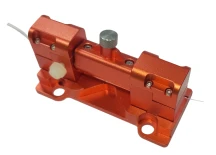
The All Fiber Polarization Controller from OZ Optics is a compact, stress-based polarization control solution designed for users who need precise, repeatable adjustment of polarization states in singlemode optical fiber. Unlike bulk‑optic polarization controllers that rely on external optics, this device works directly on the fiber itself. By applying a controlled, adjustable pressure to the fiber, it induces a well‑defined birefringence in the fiber core. This converts the fiber section into an effective fractional wave plate, enabling accurate transformation of any input polarization into virtually any desired output polarization state.
Operation is both intuitive and fast. The integrated clamp mechanism applies pressure to the fiber while allowing rotational adjustment, so the user can control both the magnitude and the orientation of the induced birefringence. By varying the applied pressure, the delay between the fast and slow polarization components can be finely tuned. Rotating the clamp changes the axis along which the stress is applied. Together, these controls make it possible to reach target polarization states in seconds, with extinction ratios typically exceeding 40 dB, which is comparable to or better than many alternative fiber squeezer‑type polarization controllers in advanced photonics labs and production environments.
Designed specifically for standard singlemode fiber, this polarization controller is inherently wavelength insensitive across a broad operating range from approximately 400 nm to 2200 nm. That means a single device can be deployed in diverse systems, from short‑wavelength bio‑imaging and OCT setups through telecom C‑band networks and up to eye‑safe infrared fiber laser applications. Because it uses controlled mechanical stress rather than inserted optical components, the controller introduces essentially no intrinsic insertion loss and no measurable backreflection, a key advantage for precision interferometry, ultra‑stable laser cavities, and systems sensitive to return loss. These performance attributes position it favorably alongside similar polarization controllers used in advanced R&D, test and measurement, and OEM system integration.
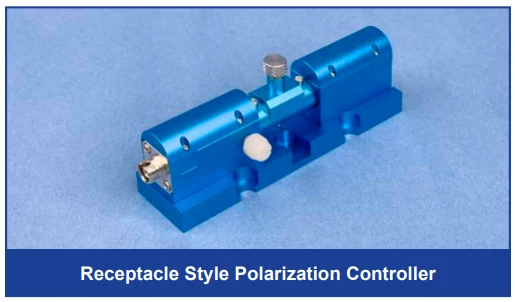
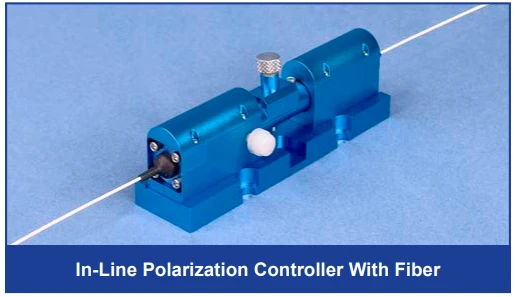
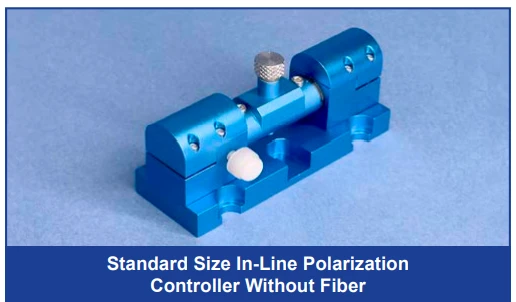
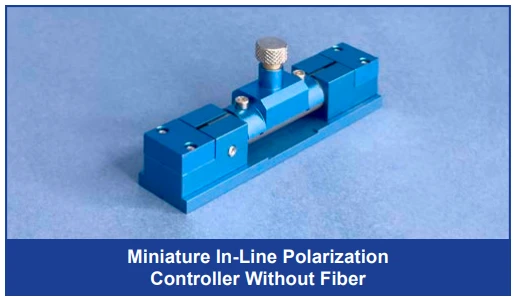
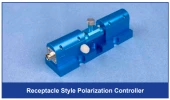
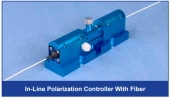
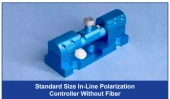
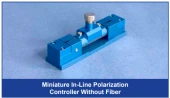
To meet a wide variety of integration requirements, the All Fiber Polarization Controller is available in several mechanical configurations. The in‑line polarization controller without fiber is designed for direct installation onto the user’s own 250 μm or 400 μm coated singlemode fiber, ideal for flexible research setups or field deployment where the fiber already exists in the system. A miniature in‑line version offers an even smaller footprint for dense optical layouts and space‑constrained instruments. For more turnkey integration, pigtailed polarization controllers are offered with customer‑specified fiber types, cable diameters, and connector options, simplifying drop‑in use within existing patch‑cord based infrastructures. Additionally, a receptacle‑style controller using a short section of internal fiber with connectorized receptacles allows plug‑and‑play polarization control between standard patch cords, often preferred in test benches and modular platforms.
By combining low loss, low backreflection, mechanical robustness, and a compact footprint, this all‑fiber polarization controller provides a practical alternative to free‑space polarization optics. Its stress‑induced birefringence approach is similar to widely used fiber squeezer controllers found in polarization‑sensitive measurement systems worldwide, but with an emphasis on ease of use and long‑term stability. Typical applications include optimized launching from singlemode into polarization maintaining fiber, fine‑tuning polarization dependent loss in component characterization, stabilizing polarization for fiber lasers, improving fringe visibility in fiber interferometers, and maximizing signal quality in OCT and other polarization‑sensitive imaging or sensing systems. For engineers and researchers seeking a reliable, cost‑effective way to manage polarization directly in fiber, this controller offers a robust and versatile solution.
All Fiber Polarization Controller
Specifications
| Operating Wavelength Range: | 400 – 2200 nm |
|---|---|
| Insertion Loss: | 0.5 dB |
| Supported Fiber Type: | Singlemode fiber |
| Unsupported Fiber Types: | Multimode and Polarization Maintaining (PM) fiber |
| Compatible Fiber Coating Diameters (in-line Without Fiber): | 250 µm and 400 µm |
| Output Polarization Extinction Ratio: | > 40 dB |
| Miniature In-line Controller Part Number: | FPC-200 |
| Standard In-line Controller Part Number: | FPC-100 |
Got questions about specs? Use the inquiry form to ask.
 Download Data Sheet

Features
- Broad Wavelength Compatibility (400–2200 nm) – Works across a very wide spectral range, from visible to near‑infrared, making it suitable for telecom, sensing, biomedical, and laboratory applications without requiring wavelength‑specific hardware.
- True All‑Fiber Design with No Intrinsic Loss – Applies controlled stress directly to standard singlemode fiber, introducing birefringence without inserting bulk optical components, thereby avoiding additional insertion loss from lenses, prisms, or couplers.
- Ultra‑Low Backreflection – Mechanical polarization control inside the fiber core minimizes Fresnel reflections and return loss issues, improving performance in interferometric setups, fiber lasers, and high‑sensitivity detection systems.
- Fast, Precise Polarization Control – Adjustable clamp pressure and rotational control act like a tunable fractional wave plate, enabling quick optimization of the state of polarization (SOP) with extinction ratios routinely exceeding 40 dB within seconds.
- Any Input to Any Output Polarization State – Converts arbitrary input polarization into any desired output state (linear, circular, or elliptical) by fine‑tuning applied stress and orientation, ideal for polarization‑sensitive experiments and device characterization.
- Wavelength‑Insensitive Operation – Stress‑induced birefringence in the fiber core provides a nearly wavelength‑independent response over the specified range, unlike conventional bulk wave plates that are designed for a narrow band.
- Compact, Benchtop‑Friendly Footprint – Available in standard and miniature inline housings designed for space‑constrained optical setups, portable systems, and OEM integration where board or rack space is limited.
- Multiple Mechanical Configurations – Offered as:
- In‑Line Polarization Controller Without Fiber – For user‑installed 250 µm or 400 µm coated singlemode fibers.
- Miniature In‑Line Version – Reduced form factor for dense optical layouts and compact instruments.
- Pigtailed Polarization Controller – Delivered with custom fiber type, cable diameter, and connectors for plug‑and‑play use.
- Receptacle‑Style Controller – Uses a short internal fiber terminated with female receptacles for convenient connectorized integration.
- Compatible with Standard Singlemode Fibers – Optimized for non‑PM singlemode fibers at common wavelengths (e.g., 780 nm, 850 nm, 1064 nm, 1310 nm, 1550 nm, 2 µm), matching typical telecom and laser sources used in R&D and production environments.
- Ideal Interface to PM Fiber – Enables precise alignment of polarization axis when launching light from singlemode into polarization‑maintaining (PM) fibers, improving coupling efficiency and stability in PM‑based systems.
- Low‑Cost Alternative to Bulk Polarization Optics – Provides high‑performance polarization control in fiber without the cost and alignment complexity of traditional bulk polarizers, wave plates, and polarization rotators.
- Easy, Tool‑Free Operation – User‑friendly clamp and rotation mechanisms allow rapid adjustment without complex alignment procedures, reducing setup time for frequent polarization optimization tasks.
- High Stability After Adjustment – Once the desired polarization is set, the mechanical clamp maintains stable birefringence over time, supporting longer measurement runs and continuous‑wave (CW) or pulsed operation.
- Optimized for Polarization‑Sensitive Systems – Excellent fit for:
- Fiber Lasers and Amplifiers – Control lasing polarization, manage feedback, and optimize gain media coupling.
- OCT (Optical Coherence Tomography) – Adjust probe and reference arm polarization for maximum fringe visibility and signal‑to‑noise ratio.
- Fiber Interferometers – Balance polarization states between arms to improve interference contrast.
- PDL Measurements – Cycle through polarization states to characterize polarization‑dependent loss in components.
- Polarization‑Sensitive Devices – Optimize input state for isolators, modulators, splitters, and sensors.
- Lab and Field Ready – Rugged mechanical construction and passive operation (no electronics or power required) make it suitable for both controlled laboratory environments and field‑deployed fiber systems.
Applications
All-fiber polarization controllers are precision instruments used to manipulate the state of polarization (SOP) in singlemode fiber. Thanks to their compact size, low insertion loss, negligible backreflection, and broad wavelength coverage (typically 400–2200 nm), they are widely used in laboratory, industrial, and field environments across photonics, telecommunications, sensing, and biomedical markets.
1. Fiber-Optic Communications and Telecom Networks
- Optimizing polarization in high‑speed fiber links: Used in R&D and system integration to adjust the SOP for 10G/40G/100G and coherent communication systems, ensuring optimal performance of polarization-sensitive receivers and coherent detection schemes.
- Polarization control for WDM and DWDM systems: Enables fine tuning of polarization when characterizing multiplexers, demultiplexers, ROADMs, and optical amplifiers to minimize polarization dependent penalties in dense wavelength division multiplexing links.
- Testing and alignment of polarization-sensitive modulators: Used to set and maintain the correct SOP at the input of LiNbO3 and integrated silicon photonic modulators, Mach-Zehnder modulators, phase modulators, and IQ modulators during device development and production test.
- Polarization state scrambling and stability tests: Manually or stepwise adjusted to emulate changing field conditions and evaluate system robustness to polarization variations in deployed networks.
2. Fiber Laser and Amplifier Systems
- Optimization of fiber laser cavities: Installed inside or outside singlemode fiber laser cavities (e.g., Yb- or Er-doped fiber lasers) to control intra‑cavity polarization, enhance mode-locking, adjust output pulse shape, and improve power stability.
- Controlling polarization before and after EDFAs and Raman amplifiers: Adjusts the input SOP to minimize gain fluctuations due to polarization dependence and to characterize the polarization dependent gain (PDG) of amplifiers.
- Nonlinear optics and supercontinuum generation: Used to set the SOP entering highly nonlinear fibers or photonic crystal fibers, optimizing nonlinear processes such as four-wave mixing, self-phase modulation, and supercontinuum generation.
- Mode-locking and pulse shaping experiments: Facilitates manual polarization control in mode-locked fiber lasers and ultrafast pulse experiments where intracavity polarization strongly affects pulse width, repetition rate, and output spectrum.
3. Fiber-Optic Sensing and Measurement
- Singlemode to PM fiber launching: Used to launch light from standard singlemode fiber into polarization maintaining (PM) fibers by aligning the SOP of the incoming light with the fast or slow axis of the PM fiber to achieve high polarization extinction ratios.
- Polarization dependent loss (PDL) and polarization mode dispersion (PMD) measurements: Provides controlled polarization states to quantify PDL in optical components and can assist in PMD testing by generating and analyzing different SOPs along the fiber path.
- Fiber interferometers and coherent detection: Enables precise SOP adjustment within Mach–Zehnder, Michelson, and Sagnac interferometers to maximize interference contrast and fringe visibility in metrology and coherent sensing setups.
- Reflectometry and optical time-domain measurements: Improves measurement repeatability in OTDR/OFDR and distributed sensing systems where polarization fluctuations can affect backscatter or reflection signatures.
- Fiber Bragg grating (FBG) and cavity sensor interrogation: Controls polarization in systems using FBGs, Fabry–Perot cavities, and ring resonators to decouple or characterize polarization effects and enhance sensor accuracy.
4. Testing of Polarization-Sensitive Components
- Characterization of optical isolators and circulators: Used to sweep and optimize the SOP when measuring insertion loss, isolation, and PDL in isolators and circulators designed for singlemode operation.
- Evaluation of couplers, splitters, and WDM devices: Ensures consistent polarization conditions when measuring performance of fiber couplers, splitters, and wavelength management components that may have polarization-dependent characteristics.
- Testing of polarizers, PBS, and polarization controllers: Forms part of test benches for verifying extinction ratio, polarization crosstalk, and functionality of polarizers, polarization beam splitters, and other polarization control products.
Frequently Asked Questions
What is an all fiber polarization controller and how does it work?
What types of optical fiber are compatible with OZ Optics all fiber polarization controllers?
What are the main versions of the OZ Optics all fiber polarization controller and how do they differ?
What are typical applications for an all fiber polarization controller in optical systems?
What performance advantages does this all fiber polarization controller offer over free-space and paddle-type controllers?
How do I install and use an in-line all fiber polarization controller without fiber?
Is the OZ Optics all fiber polarization controller suitable for broadband and tunable laser sources?
Got more questions? Use the inquiry form to ask the supplier directly.
Similar Products


Your inquiry has been received.
Create an account by adding a password
Why create an account?
- Auto-complete inquiry forms
- View and manage all your past messages
- Save products to your favorites
- Close your account anytime — no hassle