
Description
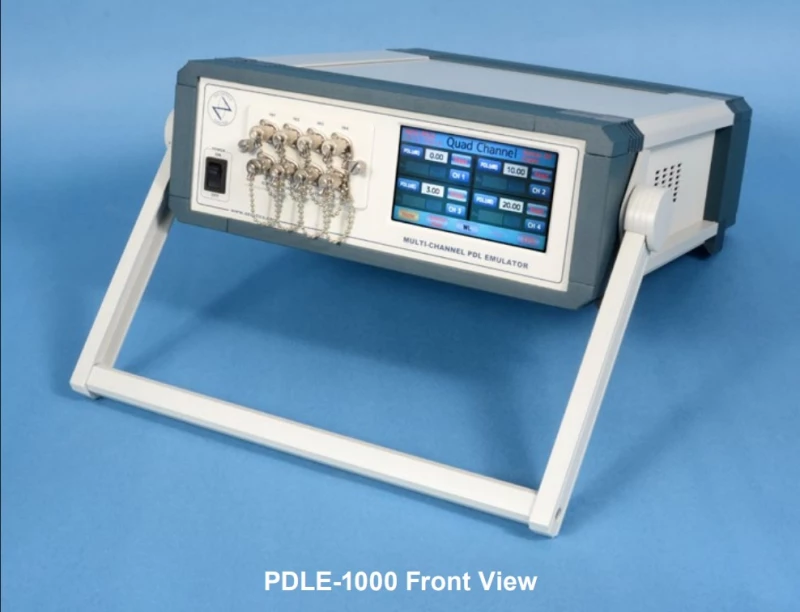
The Multi-Channel Benchtop Polarization Dependent Loss Emulator (PDLE) offered by OZ Optics is a rugged and low-cost turnkey solution with high resolution and high dynamic range. This benchtop unit features motor controlled PDLE units with low insertion loss, low back reflection, low polarization mode dispersion (PMD), and a flat wavelength response. It can be configured with up to 4 individual motor-driven PDLE units in a benchtop setup or up to 16 channels in a full rack-mount unit. The system includes a color touch screen on the front panel and a USB interface on the back panel for easy operation.
The PDLE is designed to emulate polarization dependent losses caused by passive/active optical devices in an optical link, such as attenuators, modulators, array waveguides, fiber Bragg gratings, switches, fused couplers, and more. It enables accurate physical emulation of PDL in an optical system, allowing for quantification of available PDL budget margins.
When combined with other OZ Optics products such as a motorized variable attenuator, an optical switch, a polarization dependent loss meter, a polarized stable source, or a polarization controller, the benchtop PDLE greatly assists in defining and quantifying polarization dependent losses and other fiber impairments in fiber-optic networks.
Multi-Channel Benchtop Polarization Dependent Loss Emulator
Specifications
| Operating Wavelength Range: | 1520 – 1620 nm |
|---|---|
| Insertion Loss: | 1 dB |
| Polarization Mode Dispersion: | 500 fs |
| Part Number: | PDLE-1000-CH-X-W-9/125-S-20 |
| Fiber Type: | 9/125 μm single-mode fiber |
| PDL Dynamic Range: | 0.1-20 dB |
| Optical Return Loss: | > 60 dB |
| Maximum Input Power: | 500 mW |
| Response Time: | 10 dB change in less than 1 second, 0.3 dB change in less than 0.1 second |
| Power Supply: | Universal 110/220 V AC, 50/60 Hz, 40 W |
| Computer Interface: | USB |
| Operating Temperature: | 14°F to 131°F (-10°C to 55°C) |
| Storage Temperature: | -22°F to 158°F (-30°C to 70°C) |
| Display: | Touch screen |
| Dimensions: | 280 x 300 x 100 mm |
| Weight: | 8.8 lb. + 0.55 lb./channel (4 kg + 0.25 kg/channel) |
Got questions about specs? Use the inquiry form to ask.
 Download Data Sheet

Features
- Multi-Channel Capability: Configure up to 4 independent motor-driven PDLE channels in a benchtop unit, or up to 16 channels in a full rack mount chassis for versatile testing and emulation needs.
- Wide Polarization Dependent Loss (PDL) Range: Precisely emulate and control PDL effects with a broad dynamic range (up to 20 dB), ideal for comprehensive optical network testing.
- High Resolution & Linearity: Achieve fine-tuned PDL adjustments with high resolution and excellent linearity, ensuring accurate and repeatable measurements.
- Low Insertion Loss & Backreflection: Minimize signal degradation with insertion loss < 0.8 dB and return loss < -60 dB, supporting high-performance optical systems.
- Low Polarization Mode Dispersion (PMD): Device PMD < 0.5 ps per channel, maintaining signal integrity for advanced fiber-optic applications.
- Flat Wavelength Response: Optimized for C&L bands (1520–1620 nm) with consistent performance across a wide wavelength range.
- Rugged, Compact Benchtop Design: Durable construction suitable for laboratory and industrial environments, with a small footprint for easy integration.
- Intuitive User Interface: Features a color touch screen front panel for easy setup and real-time control, enhancing user experience and workflow efficiency.
- Flexible Connectivity: Standard USB interface on the rear panel for seamless computer integration and remote operation.
- Wide Range of Fiber Receptacles: Supports various connector types (e.g., FC/APC) and 9/125 μm singlemode fiber, ensuring compatibility with diverse optical setups.
- Comprehensive Application Support: Ideal for PDL compensation, reference PDL source, test equipment calibration, quality control, and measurement in fiber-optic networks.
- Expandable & Modular: Easily scalable from benchtop to full rack mount units, supporting evolving laboratory and production requirements.
- Seamless Integration: Works in conjunction with other OZ Optics products such as motorized variable attenuators, optical switches, polarization controllers, and stable sources for advanced fiber impairment analysis.
Applications
- PDL Compensation in Optical Networks
Emulate and compensate for polarization dependent loss (PDL) in fiber-optic links to optimize network performance and reliability. - Reference PDL Source for Test and Measurement
Serve as a stable, repeatable reference PDL source for calibrating and verifying the accuracy of PDL meters and other test equipment. - Calibration of Optical Test Equipment
Enable precise calibration of optical spectrum analyzers, optical power meters, and polarization dependent loss meters. - Quality Control in Optical Component Manufacturing
Perform quality assurance and production testing of passive and active optical components such as attenuators, modulators, fiber Bragg gratings, switches, and couplers. - PDL Budget Margin Quantification
Quantify and validate PDL budget margins in complex optical systems to ensure robust system design and deployment. - Characterization of Passive/Active Optical Devices
Evaluate the PDL performance of devices like arrayed waveguide gratings (AWGs), multiplexers/demultiplexers, and optical amplifiers. - System-Level PDL Emulation for R&D
Physically emulate real-world PDL effects in laboratory environments for research and development of advanced fiber-optic systems. - Polarization Impairment Analysis
Analyze and troubleshoot polarization-related impairments in fiber-optic networks, including the impact of PDL on signal integrity. - Integration with Automated Test Systems
Seamlessly integrate with automated test setups via USB interface for high-throughput testing and data acquisition. - Educational and Training Demonstrations
Demonstrate PDL effects and compensation techniques in academic and training settings for students and professionals. - Development and Validation of Polarization Control Algorithms
Provide a controlled environment for developing and validating polarization control and compensation algorithms in optical communication systems. - Multi-Channel PDL Testing
Simultaneously test and emulate PDL across multiple channels (up to 16), ideal for DWDM and multi-channel optical systems. - Component and System-Level Stress Testing
Stress-test optical components and systems under varying PDL conditions to evaluate robustness and performance limits. - Wavelength-Dependent PDL Characterization
Characterize PDL behavior over a wide wavelength range, supporting C&L band testing for telecom and datacom applications.
Frequently Asked Questions
What is the OZ Optics Multi-Channel Benchtop Polarization Dependent Loss Emulator (PDLE)?
What are the main applications of the PDLE-1000?
How many channels can the PDLE-1000 support, and what are the configuration options?
What are the key features and performance specifications of the PDLE-1000?
How does the PDLE-1000 help in fiber-optic network testing and calibration?
What types of connectors and fibers are supported by the PDLE-1000?
Got more questions? Use the inquiry form to ask the supplier directly.
Similar Products

Your inquiry has been received.
Create an account by adding a password
Why create an account?
- Auto-complete inquiry forms
- View and manage all your past messages
- Save products to your favorites
- Close your account anytime — no hassle