
Description
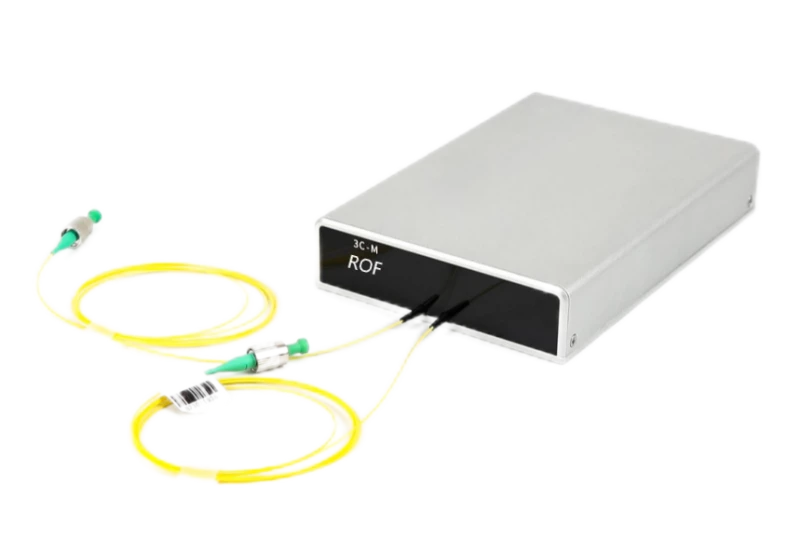
The ROF Polarization Controller is a compact, high‑performance solution designed for fast and precise manipulation of polarization states in optical fibers. Covering the full telecom band from 1260 nm to 1650 nm, it is engineered for demanding applications such as fiber laser systems, fiber optic sensing, high‑speed optical communications, and quantum‑secure links. With low insertion loss (≤0.7 dB), low polarization dependent loss (≤0.3 dB), and high return loss (>50 dB), this controller ensures stable, low‑noise operation in both laboratory and field environments where optical signal integrity is critical.
At its core, the device integrates a three‑axis piezoelectric (PZT) actuator combined with a built‑in high‑voltage amplification drive circuit. Unlike traditional bulk or free‑space solutions that require external high‑voltage drivers and complex alignment, this all‑fiber design delivers high response speed and real‑time polarization adjustment using only a low‑voltage 12 V supply. The controller can dynamically transform an input polarization state into any desired output state and maintain that state with excellent stability, making it suitable for automated or closed‑loop polarization control schemes.
The ROF Polarization Controller is optimized for seamless integration into modern fiber‑optic architectures. Its small footprint and FC/APC fiber connectors reduce back‑reflections and make it easy to insert into existing links without significant system redesign. A standard serial communication interface allows straightforward connection to a host computer or embedded controller, where simple SCADA or custom control software can manage polarization settings, sweeps, or perturbations. This makes the device ideal both for R&D environments and for OEM deployment in larger photonic subsystems.
In typical use, the controller serves as a versatile tool for fiber polarization control and polarization state perturbation, enabling stable operation of polarization‑sensitive components such as interferometers, coherent receivers, and nonlinear fiber devices. In fiber optic sensors, it helps optimize signal contrast and sensitivity by maintaining consistent polarization conditions along the sensing path. In fiber lasers, precise polarization management is essential for mode control, power stability, and noise reduction, all of which are supported by the controller’s high return loss and low loss characteristics. For polarization analyzers and polarization detectors, it can be used to generate controlled and repeatable polarization states for calibration and verification.
Designed to operate reliably over a wide environmental range, the ROF Polarization Controller supports operating temperatures from −10 °C to +50 °C and humidity from 20% to 85%, with even broader ranges specified for storage. This environmental robustness, combined with its dynamic real‑time adjustment capability, makes it an excellent choice for both benchtop experiments and long‑term deployed systems in telecommunications, sensing, and quantum information networks where high‑speed and highly stable polarization control is required.
High Speed Dynamic Fiber Polarization Controller 1260nm to 1650nm
Specifications
| Operating Wavelength Range: | 1260 – 1650 nm |
|---|---|
| Insertion Loss: | 0.7 dB |
| Polarization Mode Dispersion: | Not Specified |
| Resolution: | Not Specified |
| Working Wavelength: | 1260 nm - 1650 nm |
| Channel Value: | 3 cps |
| Insertion Loss: | ≤0.7 dB |
| Polarization Dependent Loss: | ≤0.3 dB |
| Supply Voltage: | 12 V |
| Return Loss: | >50 dB |
| Type Of Optical Fiber Connector: | FC/APC |
| Communication Interface: | Serial port |
| Working Temperature: | -10 °C ~ +50 °C |
| Storage Temperature: | -45 °C ~ +85 °C |
| Working Humidity: | 20% ~ 85% |
| Storage Humidity: | 10% ~ 90% |
Got questions about specs? Use the inquiry form to ask.
 Download Data Sheet

Features
- Ultra-Fast Dynamic Polarization Control – High response speed three‑axis PZT design enables real-time polarization state adjustment and scrambling, ideal for high‑speed optical communication and quantum key distribution (QKD) test setups.
- Wide Operating Wavelength Range (1260–1650 nm) – Supports O-, E-, S-, C-, L-bands, covering most telecom, fiber laser, and fiber sensing applications without the need for multiple controllers.
- Low Insertion Loss (≤ 0.7 dB) – All‑fiber structure and optimized optical design minimize signal attenuation, preserving optical power in long-haul links and precision laboratory systems.
- Very Low Polarization Dependent Loss (PDL ≤ 0.3 dB) – Ensures accurate polarization control without distorting power balance, critical for coherent detection, interferometric sensing, and polarization-sensitive measurements.
- High Return Loss (> 50 dB) – Excellent back‑reflection performance reduces system noise and instability, improving SNR in fiber lasers, optical amplifiers, and high‑precision test setups.
- Dynamic Real-Time Adjustment & Stabilization – Continuously transforms any input polarization state into any desired output state in real time and maintains stable polarization over time, even under environmental perturbations.
- Integrated High-Voltage Drive Electronics – Built‑in high‑voltage amplification circuitry eliminates the need for external HV drivers; operates from a simple 12 V supply for easy system integration.
- 3-Channel Control (3 cps) – Independent three‑axis piezo control allows full coverage of the Poincaré sphere, enabling arbitrary SOP (State of Polarization) generation for advanced modulation and scrambling schemes.
- Compact, All-Fiber Design – Small form factor and robust all‑fiber structure make it easy to integrate into rack systems, benchtop instruments, field test platforms, and OEM modules.
- Standard FC/APC Fiber Connectors – Angled physical contact connectors reduce back reflection and simplify plug‑and‑play use in telecom and lab environments.
- Serial Communication Interface – Simple serial port communication for remote control and monitoring, compatible with standard SCADA systems, custom control software, and automated test setups.
- SCADA-Compatible Control – Can be driven by common Supervisory Control and Data Acquisition software, streamlining integration into industrial sensing networks and centralized control platforms.
- Wide Environmental Operating Range – Reliable performance from ‑10 to +50 °C operating temperature and 20–85% RH working humidity, suitable for both laboratory and field applications.
- Rugged Storage Specifications – Withstands storage temperatures from ‑45 to +85 °C and 10–90% RH humidity, ensuring stability and long product life during transport and warehousing.
- Ideal for Fiber Lasers & Amplifiers – Maintains optimal polarization conditions in fiber laser cavities and EDFA/Raman amplifier systems, improving efficiency, stability, and output quality.
- Optimized for Fiber Sensing Systems – Enhances performance of interferometric, distributed (DTS/DAS/DFOS), and polarization‑sensitive fiber sensors by compensating polarization drift and maximizing measurement repeatability.
- Perfect for Coherent & High-Speed Communications – Suited to coherent receivers, polarization multiplexing, and PMD/PDL testing where fast, precise SOP control is crucial.
- Support for Quantum & Advanced Research – High‑fidelity polarization control makes it well suited for quantum secure communication experiments and advanced photonics R&D.
- Independently Owned IP & Mature Design – Based on proprietary technology, providing a stable, well‑engineered solution comparable to leading polarization controllers in telecom and photonics markets.
Applications
- Dynamic Fiber Polarization Control in Optical Communication Systems – Real-time state of polarization (SOP) adjustment in high‑speed DWDM, coherent, and metro/long‑haul links to optimize OSNR, reduce bit‑error‑rate, and stabilize transmission over 1260–1650 nm.
- Polarization State Perturbation for System Stress Testing – Programmable, high‑speed polarization scrambling and perturbation to emulate worst‑case fiber conditions in R&D labs, system qualification, and reliability tests for transceivers and optical modules.
- Coherent Receiver and DSP Algorithm Development – Controlled polarization rotation for validating coherent detection schemes, DSP algorithms, and MIMO equalization under changing SOP in coherent communication experiments.
- Fiber Laser Polarization Management – Stabilization and tuning of polarization in fiber laser cavities and outputs to control mode‑locking behavior, pulse shape, and polarization‑maintaining performance in industrial, medical, and scientific lasers.
- Polarization Control for Nonlinear Fiber Optics – Optimization of polarization‑sensitive nonlinear processes such as four‑wave mixing, supercontinuum generation, Raman/Brillouin scattering, and parametric amplification in specialty fiber setups.
- Fiber Optic Sensor Interrogation – Enhancement of sensitivity and repeatability in interferometric, polarimetric, and birefringent fiber sensors (FBG, Sagnac, Michelson, and Mach‑Zehnder configurations) by stabilizing and scanning SOP.
- Polarization Diversity and Polarization Multiplexing Systems – Active control of dual‑polarization channels in PDM coherent links to maximize channel isolation, reduce crosstalk, and improve throughput in advanced optical networks.
- Quantum Key Distribution (QKD) and Quantum Communication – Precise polarization alignment and compensation for polarization‑encoded qubits in fiber‑based QKD links, ensuring low QBER and stable quantum channel performance.
- Polarization‑Sensitive Component Characterization – Automated measurement of PDL, PER, and polarization response of optical components such as isolators, couplers, WDMs, filters, VOAs, and integrated photonic devices.
- Calibration of Polarimeters and Polarization Analyzers – Generation of known, repeatable polarization states over time to calibrate and verify polarimeters, polarization controllers, optical spectrum analyzers with polarization options, and polarization‑sensitive OTDRs.
- Test and Measurement in Photonics R&D Labs – General‑purpose SOP control for experiments involving interferometry, ellipsometry, and polarization‑dependent effects, enabling repeatable measurements and automated test sequences via serial interface.
- Integrated and Photonic Circuit Testing – Input polarization optimization for silicon photonics, InP, and PLC chips where device transfer function is polarization‑dependent, improving insertion‑loss and extinction‑ratio characterization.
- Polarization‑Controlled Fiber Sensing Networks – Active compensation for polarization fading in distributed fiber sensing systems such as DAS, DTS, and distributed interferometric sensors deployed in oil & gas, structural health monitoring, and perimeter security.
- Optical Coherence Tomography (OCT) and Biomedical Imaging – Tailoring and stabilizing polarization for polarization‑sensitive OCT (PS‑OCT) and other biomedical imaging modalities to improve tissue contrast and depth‑resolved birefringence measurements.
- Polarization Detector and Analyzer Front‑End – Use as a front‑end actuator in polarization detection systems where fast SOP control is needed to map, track, and lock onto unknown or time‑varying polarization states.
- Educational and Training Platforms in Fiber Optics – Demonstration of polarization concepts, Jones/Mueller calculus, and polarization‑dependent phenomena in university labs and training benches using a compact, easy‑to‑integrate controller.
- Environmental Drift Compensation in Deployed Links – Active polarization stabilization in field‑deployed fiber links affected by temperature, vibration, and mechanical stress, improving long‑term stability of measurement and communication systems.
- Adaptive Optics and Precision Metrology Systems – Fine control of laser polarization in high‑precision metrology, interferometry, and adaptive optics applications where polarization alignment directly affects measurement accuracy.
Frequently Asked Questions
What is the ROF Dynamic Fiber Polarization Controller and what does it do?
What are the key features and optical performance specifications of this polarization controller?
How is the ROF polarization controller controlled and integrated into a system?
What applications are best suited for this fiber polarization controller?
What are the electrical, environmental, and mechanical operating conditions?
How does the PZT three‑axis design affect polarization control performance?
What type of optical fiber and connectors are used, and can they be customized?
Got more questions? Use the inquiry form to ask the supplier directly.
Similar Products


Your inquiry has been received.
Create an account by adding a password
Why create an account?
- Auto-complete inquiry forms
- View and manage all your past messages
- Save products to your favorites
- Close your account anytime — no hassle