


Description
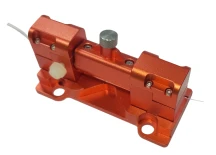
The Electrically Driven Polarization Controller-Scrambler from OZ Optics is a high-performance solution designed for precise manipulation of the state of polarization in singlemode optical fibers. Utilizing an innovative mechanical fiber squeezing technique, this device enables users to achieve continuous and endless polarization control with exceptional reliability and ease of use. The controller operates via three or four independent input voltages, each adjustable within a ±5 volt range, allowing for flexible and robust polarization management in a variety of demanding optical environments.
Engineered for rapid response, the controller boasts a response speed exceeding 100 Hz, making it highly effective at compensating for polarization changes induced by environmental fluctuations. This swift adaptability is particularly advantageous in applications such as polarization scrambling, where it can average out polarization dependent loss (PDL) effects or facilitate accurate polarization mode dispersion (PMD) and PDL measurements. The continuous fiber design ensures that insertion losses, return losses, and PDL are minimized, limited only by the inherent properties of the fiber itself. As a result, the device is ideally suited for test and measurement setups that demand high precision and minimal signal degradation. The OZ Optics polarization controller is available in both three-channel and four-channel configurations.
The three-channel model is optimized for general polarization scrambling and measurement tasks, while the four-channel version provides additional redundancy, enabling uninterrupted polarization control without the need for periodic resets. This flexibility makes the controller an excellent choice for integration into advanced optical systems such as interferometers, optical coherence tomography (OCT) systems, and various fiber optic sensors. A key advantage of this polarization controller is its straightforward operation. Unlike many competing products, it does not require specialized driver circuitry or high-voltage components, ensuring both safety and simplicity in deployment.
The device is compatible with a wide wavelength range (1250 to 1650 nm as standard), and offers low insertion loss (<0.4 dB without connectors), high backreflection (>70 dB excluding connectors), and minimal activation loss (±0.03 dB). These attributes, combined with its compact and robust design, make the Electrically Driven Polarization Controller-Scrambler from OZ Optics a preferred choice for researchers and engineers seeking reliable, high-speed polarization control in fiber optic applications.
Electrically Driven Polarization Controller-Scrambler EPC-300/400
Specifications
| Operating Wavelength Range: | 1260 – 1650 nm |
|---|---|
| Insertion Loss: | 0.05 dB |
| Polarization Mode Dispersion: | Not Specified |
| Resolution: | Not Specified |
| Number Of Control Channels: | 3 (EPC-300) and 4 (EPC-400) |
| Voltage Range: | ±5 V |
| 3dB Bandwidth: | 100 Hz |
| Electrical Interface: | DB-9 |
| Retardation Range: | 2 p Minimum |
| Backreflection: | >70 dB |
| Activation Loss: | ± 0.03 dB |
| Fiber Type: | Corning SMF-28 Standard — Other fiber types available on request |
| Operating Temperature: | -10 to +50 °C |
| Storage Temperature: | -40 to +80 °C |
| Dimensions: | 150x44x35 mm |
| Weight: | 400 g |
Got questions about specs? Use the inquiry form to ask.
 Download Data Sheet

Features
- Negligible Insertion Loss: Less than 0.4 dB (excluding connectors), ensuring minimal signal attenuation.
- Negligible Return Loss: Backreflection greater than 70 dB (excluding connectors) for superior signal integrity.
- Ultra-Low Polarization Dependent Loss (PDL): Maintains signal quality for high-precision applications.
- Fast Response Speed: Greater than 100 Hz 3dB bandwidth for rapid polarization adjustments.
- Continuous Polarization Control: Enables endless polarization state manipulation without resets (4-channel version).
- Low Voltage Operation: Safe and simple ±5V control range; no high-voltage circuitry required.
- Multiple Channel Configurations: Available in 3-channel (EPC-300) for scrambling and 4-channel (EPC-400) for continuous control.
- Wide Wavelength Range: Operates from 1250 nm to 1650 nm (other wavelengths available upon request).
- Low Power Consumption: Maximum 0.5 Watts per channel for energy-efficient operation.
- Flexible Electrical Interface: Standard DB-9 connector; other interfaces (e.g., 5-pin header, BNC) available on request.
- Compact and Robust Design: Mechanical fiber squeezing technique ensures durability and reliability.
- No Dedicated Driver Required: Simplifies integration and operation in various systems.
- Ideal for Test & Measurement: Perfect for polarization scrambling, stabilization, PMD/PDL mitigation, and advanced measurement systems.
- Compatible with Interferometers, Sensors, and OCT Systems: Versatile for a wide range of photonics and fiber optic applications.
Applications
- Polarization Scrambling: Ideal for rapidly varying the state of polarization in fiber optic systems to average out polarization-dependent effects, crucial for test and measurement setups and optical communication systems.
- Polarization Stabilization: Maintains a constant state of polarization in dynamic environments, ensuring stable system performance in applications such as coherent communication and quantum key distribution.
- Polarization Mode Dispersion (PMD) Mitigation: Reduces the impact of PMD in high-speed optical networks, improving signal integrity and transmission quality.
- Polarization Dependent Loss (PDL) Mitigation: Minimizes PDL effects in optical systems, enhancing measurement accuracy and system reliability.
- PDL and PMD Measurement Systems: Essential for characterizing and calibrating optical components and systems, enabling precise measurement of polarization-dependent parameters.
- Interferometers and Sensors: Enhances the performance of fiber optic interferometers and polarization-sensitive sensors by providing precise polarization control.
- Optical Coherence Tomography (OCT) Systems: Improves image quality and system stability in OCT applications by controlling and stabilizing the polarization state of the probing light.
- Fiber Optic Test and Measurement: Used in laboratory and production environments for testing the polarization response of optical fibers, components, and systems.
- Coherent Optical Communication: Enables advanced modulation formats and polarization multiplexing by providing dynamic polarization control in coherent receivers and transmitters.
- Quantum Optics and Quantum Communication: Facilitates experiments and systems that rely on precise polarization states, such as quantum key distribution and entanglement-based protocols.
- Polarization Multiplexing Systems: Supports the implementation and testing of polarization division multiplexing in high-capacity optical networks.
- Fiber Laser Systems: Assists in managing polarization effects in fiber lasers and amplifiers, improving output stability and performance.
- Polarization-Dependent Device Characterization: Used for evaluating the polarization sensitivity of optical devices such as isolators, circulators, and modulators.
- Research and Development: Provides a versatile tool for academic and industrial research in photonics, enabling the study and manipulation of polarization effects in various optical experiments.
Frequently Asked Questions
What is the OZ Optics Electrically Driven Polarization Controller-Scrambler?
How does the OZ Optics EPC achieve polarization control?
What are the main applications of the Electrically Driven Polarization Controller?
What are the insertion loss and return loss specifications for the EPC?
What is the response speed and recommended scrambling frequencies for the EPC?
What are the differences between the EPC-300 and EPC-400 models?
Is the OZ Optics EPC compatible with different wavelengths and electrical interfaces?
Got more questions? Use the inquiry form to ask the supplier directly.
Similar Products


Your inquiry has been received.
Create an account by adding a password
Why create an account?
- Auto-complete inquiry forms
- View and manage all your past messages
- Save products to your favorites
- Close your account anytime — no hassle