
Description
Introducing our state-of-the-art solarization-stable fibers, expertly designed to deliver exceptional performance in the critical UV-VIS range. These fibers are meticulously crafted with a high OH content, ensuring remarkable transmission capabilities between 190 nm and 250 nm. This makes them an ideal choice for applications requiring precise optical clarity and stability under challenging conditions.
Why Solarization-Stable Fibers Matter
Solarization is a degradation process that occurs in conventional UV optical fibers when prolonged ultraviolet exposure causes defect formation within the silica structure, resulting in increased optical absorption and reduced transmission efficiency. FiberTech Ultrasol fibers are specifically engineered to resist solarization effects in the critical 190–250 nm ultraviolet range through the use of high OH fused silica and optimized fiber manufacturing techniques. This enables stable long-term UV transmission performance in demanding photonics, spectroscopy, and analytical instrumentation applications where conventional UV fibers may experience premature degradation or failure.
Advantages of Multimode UV Fibers in Scientific and Industrial Systems
Multimode UV optical fibers are widely used in spectroscopy, analytical instrumentation, and industrial photonics systems because their larger core diameters support efficient optical coupling and high ultraviolet power throughput. Compared to single-mode UV fibers, multimode fibers provide improved alignment tolerance and enhanced light collection efficiency, making them ideal for deuterium lamp systems, fluorescence measurements, UV curing equipment, and broadband UV-VIS optical instrumentation.
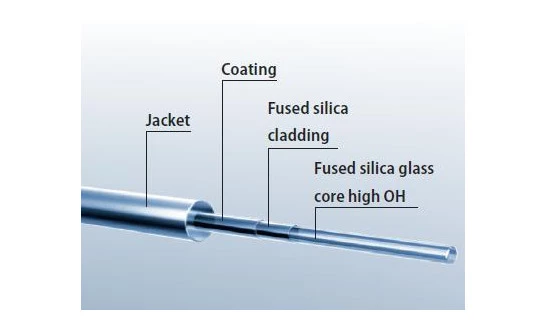
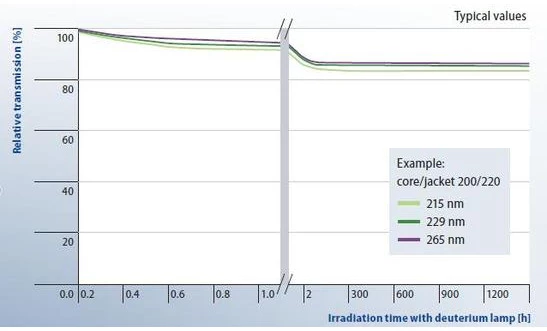
Our fibers are constructed with a fused silica glass core and a fused silica cladding, providing robust durability and reliable performance. The ultrasol® fibers are engineered to withstand the progressive absorption commonly seen in UV-VIS fibers below 240 nm, thereby preventing premature failure and extending their operational lifespan. This innovation is particularly beneficial for applications involving prolonged exposure to deuterium light sources, where maintaining optimal transmission is crucial.
For added versatility, these fibers are available with either single acrylate or polyimide coatings, each offering distinct advantages depending on your specific needs. The option to include coatings such as Nylon® or Tefzel® further enhances their adaptability, allowing them to meet a wide range of environmental and operational requirements. Additionally, these fibers can be configured as fiber bundles with single-fiber cores starting from 30 μm, offering even greater flexibility for complex optical systems.
Choose our solarization-stable fibers for your next project and experience the superior performance and reliability that only advanced optical technology can provide. Whether for research, industrial, or specialized applications, these fibers are engineered to deliver unparalleled results.
FiberTech Ultrasol Solarization-Stable UV Optical Fiber
Specifications
| Core Diameter: | 600 um |
|---|---|
| Wavelength Range: | 190 – 250 nm |
| Cable Length: | Not Specified |
| Fiber Core Material: | Silica |
| Fiber Length: | Custom |
| Fiber Type: | Solar Stable |
| Clad Diameter: | 660 um |
| Coating Diameter: | 740 um |
Got questions about specs? Use the inquiry form to ask.
 Download Data Sheet

Features
- High Transmission Efficiency: These fibers offer excellent transmission in the 190–250 nm range, making them ideal for UV-VIS applications.
- Solarization-Stable: Designed to withstand UV exposure, these fibers prevent progressive absorption and failure in critical ranges below 240 nm.
- Versatile Coating Options: Available with single acrylate or polyimide coatings, accommodating various environmental and application needs.
- Customizable Specifications: Options for further specifications, including CCDR, ensure tailored solutions for specific requirements.
- Durable Construction: Made with fused silica glass core and cladding, ensuring robustness and longevity.
- Available in Multiple Sizes: Core diameters range from 100 μm to 600 μm, with corresponding clad and coating diameters for diverse applications.
- Optional Materials: Coating materials such as Nylon® and Tefzel® are available for enhanced performance in specific conditions.
- Order Flexibility: Multiple order numbers and fiber codes allow easy selection and identification of the right fiber for your needs.
- Innovative Ultrasol® Technology: Features ultrasol® fibers for enhanced solarization stability, ensuring reliable performance in demanding environments.
- Bundle Configurations: Solarization-stable fibers are also available as fiber bundles, with single-fiber cores starting from 30 μm, offering additional configuration options.
Applications
Applications of Solarization-Stable UV Optical Fibers
FiberTech Ultrasol fibers are designed for demanding ultraviolet and UV-VIS photonics applications requiring stable long-term transmission in the deep UV spectral region. Their resistance to solarization-induced absorption makes them particularly suitable for spectroscopy, analytical instrumentation, UV laser delivery, semiconductor inspection, fluorescence systems, and scientific research environments operating below 250 nm.
- UV Spectroscopy Systems: Ensures stable transmission for precise measurements in the deep UV range.
- Photonics Instrumentation: Ideal for integrating into UV-based photonic devices and optical setups.
- UV Curing and Processing: Reliable for high-power UV delivery in industrial curing systems.
- Medical Diagnostics: Suitable for UV-based diagnostic and analytical equipment requiring solarization resistance.
- Fluorescence Analysis: Efficient light delivery and collection for fluorescence excitation and analytical measurement systems.
- Semiconductor Inspection: Reliable UV optical transmission for wafer inspection, lithography support, and semiconductor metrology applications.
- UV Laser Delivery: Transmission of ultraviolet laser energy in industrial, scientific, and photonics systems requiring stable UV performance.
- Biomedical Instrumentation: Optical signal delivery for medical diagnostics, biomedical optics research, and UV analytical instrumentation.
- Environmental Monitoring: Integration into UV sensing and analytical systems used for environmental measurement and monitoring applications.
- Analytical Chemistry Systems: Optical transmission for laboratory instrumentation used in absorption spectroscopy and chemical analysis.
- Deep UV Research: Support for scientific research systems operating in the ultraviolet spectral range below 250 nm.
- Photonics and Optical R&D: Suitable for experimental photonics setups, optical characterization systems, and advanced UV research platforms.
Frequently Asked Questions
What is the coating material used for the FiberTech Ultrasol Fibers?
Are the FiberTech Ultrasol Fibers available as fiber bundles?
What is the cause of progressive absorption of UV-VIS fibers?
What is the wavelength range for which the FiberTech Ultrasol Fibers can be used?
What is the core diameter of the FiberTech Ultrasol Fibers?
What is solarization in UV optical fibers?
Why are high OH fused silica fibers used for UV applications?
What applications require solarization-stable UV optical fibers?
Why are UV optical fibers used with deuterium lamps?
What is the advantage of multimode UV optical fibers?
What coating materials are commonly used for UV optical fibers?
Why is fused silica important in ultraviolet photonics systems?
Got more questions? Use the RFQ form to ask the supplier directly.
Similar Products
Need pricing for this product? Send a quick inquiry
Your inquiry has been received.
Create an account by adding a password
Why create an account?
- Auto-complete inquiry forms
- View and manage all your past messages
- Save products to your favorites
- Close your account anytime — no hassle