
Description
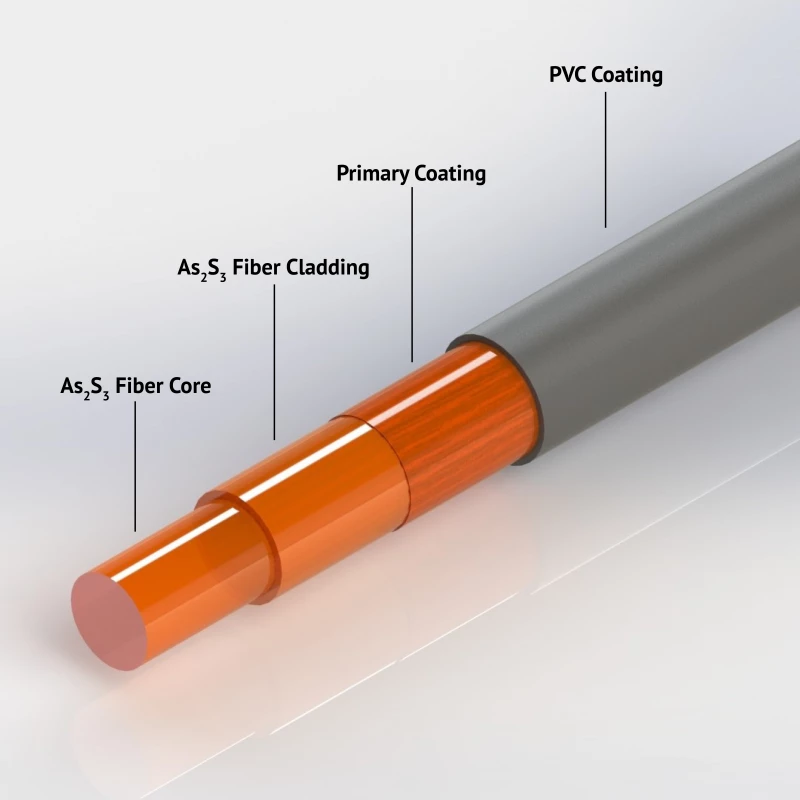
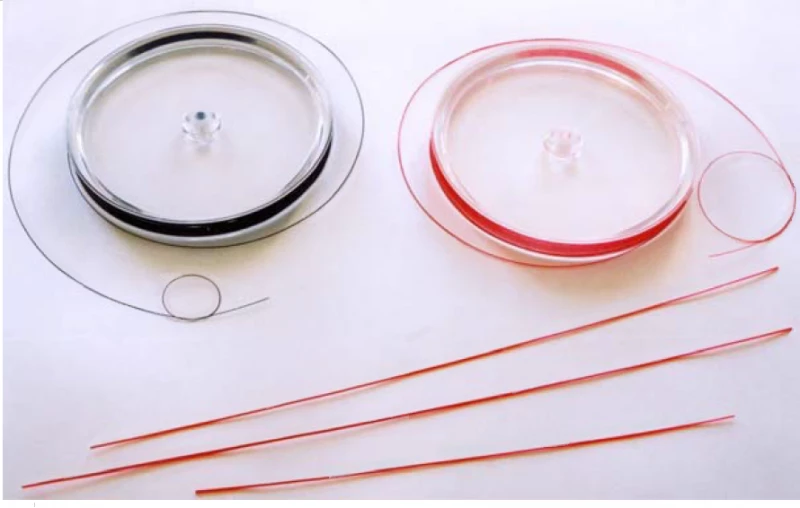
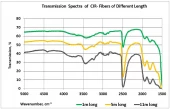
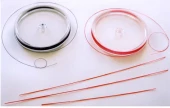
Chalcogenide As-S glass fiber is capable of transmitting IR radiation within the spectral range of 1.1 - 6.5μm. High-performance CIR (Core/Clad Infrared) fibers are manufactured through a drawing process, featuring core diameters ranging from 8µm to 500µm. These fibers exhibit exceptional mechanical strength and flexibility due to an advanced drawing technique and a double polymer jacket.
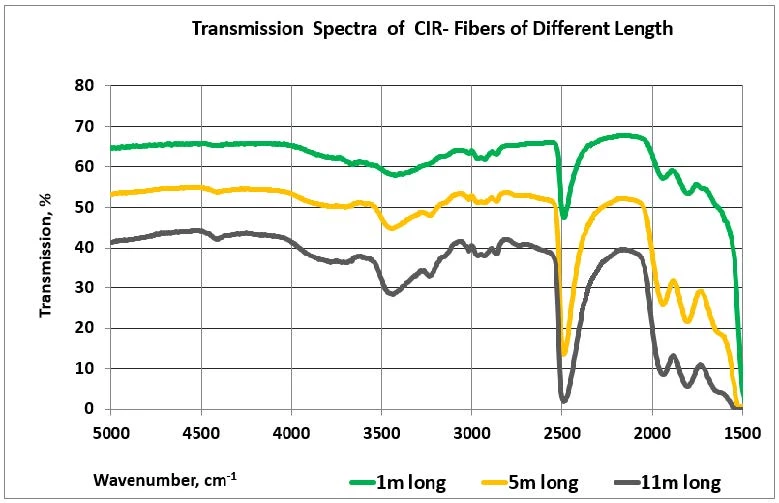
The CIR fibers are designed to minimize optical losses and exhibit minimal absorption peaks throughout the aforementioned spectral range. This characteristic enables the successful utilization of CIR-fiber across a wide range of applications.
Chalcogenide Mid-IR Fibers
Specifications
| Core Diameter: | 8 um |
|---|---|
| Wavelength Range: | 1100 – 6500 nm |
| Cable Length: | 0.1 m |
| Fiber Core Material: | Chalcogenide Glass |
| Available Core Diameters: | 8, 50, 250, 340, 500 μm |
| Core/Cladding Composition: | As2S3 |
| Spectral Range: | 1.1 - 6.5 μm |
| Fresnel Reflection Losses: | 31% |
| Protective Jacket: | Fluoro polymer + PVC |
Got questions about specs? Use the inquiry form to ask.
 Download Data Sheet

Features
- Core/Cladding Composition: As2S3
- Spectral Range: 1.1 - 6.5 μm
- Core Refractive Index: 2.42
- Fresnel Reflection Losses: 31%
- Attenuation at 3 - 4 µm & 4.5µm – 5µm: 0.2 - 0.4 dB/m
- Effective Numerical Aperture: See table above
- Glass Transition Temperature, Tg: 185 °C
- Operating Temperature: –273 to +90°C
- Core/Clad Diameter (standard): See datasheet
- Protective Jacket: Fluoro polymer + PVC
- Tensile Strength: > 70 MPa
- Minimum Bending Radius (fixed): 100 x [Fiber Diameter]
- Minimum Elastic Bending Radius: 200 x [Fiber Diameter]
Applications
- Mid IR spectroscopy
- Flexible IR pyrometry
- Flexible IR-Imaging systems
- Power delivery for Quantum Cascade Lasers
Frequently Asked Questions
What is the spectral range of the Chalcogenide Mid-IR Fibers?
What is the core/cladding composition of the fibers?
What is the minimum bending radius for the fibers?
What applications are the Chalcogenide Mid-IR Fibers suitable for?
What is the operating temperature range for the fibers?
Got more questions? Use the RFQ form to ask the supplier directly.
Similar Products
Need pricing for this product? Send a quick inquiry
Your inquiry has been received.
Create an account by adding a password
Why create an account?
- Auto-complete inquiry forms
- View and manage all your past messages
- Save products to your favorites
- Close your account anytime — no hassle