


Description
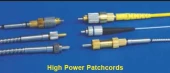
These high power / high temperature fiber optic patchcords are engineered specifically for delivering intense laser energy in the most demanding industrial, medical, and scientific environments. Building on a patented connector architecture (USA Patent #7431513), they combine specialized high power fiber, thermally optimized connector design, and carefully prepared fiber endfaces to ensure reliable power transmission where standard patchcords quickly fail. From UV at 200 nm through the near-infrared at 2000 nm, these assemblies are designed to support a wide range of wavelengths and core sizes for everything from precision micromachining to high energy laser surgery.
Conventional fiber connectors typically rely on epoxy right up to the ferrule tip, with the fiber polished flush to the ferrule. Under high laser power, this configuration becomes a thermal weak point. Heat generated at the fiber output causes the surrounding epoxy to degrade and outgas; those gases then deposit on the fiber facet, forming absorbing contamination that can rapidly lead to pitting, cracking, and ultimately catastrophic fiber failure. In contrast, these high power connectors employ a patented air-gap design in which the fiber protrudes 1.1 mm to 1.5 mm into free space. By eliminating epoxy from the emission zone and allowing heat to dissipate in an open region, the design dramatically reduces thermally induced damage and extends the service life of both the patchcord and the overall laser system.
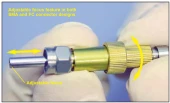
Patented Connector Technology for Maximum Power HandlingThe connector system is at the core of the patchcord’s performance, and these assemblies are available with industry-standard SMA905 and FC interfaces, including specialized very high power variants. The internal geometry is optimized for precise fiber-to-fiber alignment, ensuring stable coupling efficiency even at elevated temperatures and power densities. Adjustable focus options in both SMA and FC formats allow the user to fine-tune the working distance and spot size at the output, enabling better control of energy density on the workpiece, tissue, or optical component. For applications pushing into the kilowatt-class or operating continuously near damage thresholds, versions with integrated cooling fins and cladding mode stripping further increase the thermal headroom by removing stray light from the cladding and dissipating residual heat efficiently.
Compared with conventional high power patchcords commonly used in industrial marking or cutting lasers, these patented designs emphasize both longevity and stability under high thermal load. The ability to configure endcaps, endface treatments, and anti-reflection coatings on the same platform makes it possible to tailor each assembly to a specific laser type, whether it is a nanosecond pulsed source for marking, a CW fiber laser for welding, or an ultrafast system for nonlinear optics. Stainless steel armored cabling adds an additional layer of mechanical and thermal protection, helping to prevent kinks, crushing, or accidental contact with hot surfaces in production or clinical environments.
Engineered Fiber Endfaces for High Damage ThresholdThe preparation of the fiber endface is crucial for high power operation. Simple polished connectors, while easy and economical, can trap abrasive particles within the glass surface during finishing, creating microscopic absorption centers. Under high irradiance, these sites generate localized heating that rapidly escalates into burning and facet damage. To address this, these high power patchcords use carefully controlled endface finishing techniques specifically designed to minimize absorbing defects and improve the effective damage threshold. Depending on power level, wavelength, and budget, different finishing regimes and endcap options can be selected to balance performance with cost.
Fiber endcaps are available with tight thickness tolerances (±25 µm), providing a controlled expansion of the laser mode at the glass-air interface and reducing the optical intensity at the exit surface. This is particularly valuable for very high peak power or pulsed applications where facet damage is often the limiting factor. High power anti-reflection coatings can be applied to the endcap or fiber facet to suppress back reflections, improve transmission, and reduce standing-wave heating at the interface. By combining these optical surface treatments with the air-gap connector geometry, the patchcord delivers stable beam quality and output power over extended operating periods.
High Power High Temperature Fiber Optic Patchcords
Specifications
| Wavelength Range: | 200 – 2000 nm |
|---|---|
| Polarization Maintaining: | No |
| Maximum Operating Temperature: | 500 °C |
| Core Diameter Range: | 2 µm to 1500 µm |
| Fiber Types: | Multimode, singlemode, polarization maintaining |
| Connector Compatibility: | SMA905, FC |
| Fiber Extension (air-gap Design): | 1.1 mm to 1.5 mm |
| Fiber Endcap Thickness Tolerance: | ±25 µm |
Got questions about specs? Use the inquiry form to ask.
 Download Data Sheet

Features
- Engineered for Extreme Power Handling – Specialized high power fibers, patented connector geometry, and carefully prepared endfaces ensure reliable performance with high power continuous-wave and pulsed lasers.
- Operates up to 500 °C – Robust construction and advanced materials allow operation in harsh, high temperature environments up to 500 °C without degradation.
- Patented Air‑Gap Connector Design (USA Patent #7431513) – Unique ferrule geometry extends the fiber 1.1–1.5 mm into free space, creating an epoxy‑free region that minimizes thermal damage, eliminates burn‑back, and greatly increases connector lifetime.
- Precise Fiber‑to‑Fiber Coupling – Patented connector designs maintain tight concentricity and alignment for efficient power transfer and low insertion loss in demanding laser delivery systems.
- High Power Endface Options – Multiple fiber endface finishes (polished, angle‑polished, laser‑cleaved, or other high‑damage‑threshold terminations) are available to match power density, beam quality, and budget requirements.
- Wide Fiber Core Size Range – Standard and custom core diameters from 2 µm to 1500 µm support everything from precision single‑mode delivery to large‑core, very high power multimode transmission.
- Multimode, Singlemode & PM Options – Available with multimode, singlemode, and polarization maintaining (PM) fibers for materials processing, spectroscopy, non‑linear optics, and interferometric applications.
- Low and High Numerical Aperture (NA) Fibers – Choice of low‑NA for improved beam quality and long‑distance delivery, or high‑NA fibers for efficient coupling from high divergence laser sources.
- Broad Wavelength Coverage: 200–2000 nm – Fiber and coating options cover UV, visible, and IR ranges, ideal for applications such as laser marking, cutting, welding, medical lasers, LIDAR, and research lasers.
- High Power Anti‑Reflection (AR) Coatings – Optional AR coatings on fiber endfaces reduce Fresnel reflections, increase transmission efficiency, and raise the laser‑induced damage threshold.
- Fiber Endcaps with Tight Tolerances – Optional fiber endcaps with ±25 µm thickness tolerance reduce power density at the glass/air interface, improving damage resistance for very high power and short‑pulse systems.
- Stainless Steel Armored Cabling – Rugged stainless steel armor provides excellent mechanical protection, kink resistance, and user safety in industrial and medical environments.
- Very High Power Versions with Cooling Fins – Enhanced connectors with integrated cooling fins and thermally optimized bodies for applications requiring exceptional power handling and continuous operation.
- Cladding Mode Stripping for Maximum Power Safety – Available with integrated cladding mode strippers to safely remove stray cladding light, improve beam quality at the output, and prevent unwanted heating of downstream optics.
- Adjustable Focus SMA905 and FC Connectors – High power SMA 905 and FC connector designs with adjustable focus enable precise control of working distance and spot size at the output, ideal for laser machining and medical procedures.
- Compatibility with Industry‑Standard Interfaces – Fully compatible with common SMA905 and FC/PC style connectors and receptacles used in industrial, medical, and scientific laser systems.
- Optimized for Materials Processing – Designed for laser marking, cutting, welding, and drilling, ensuring stable transmission and minimal downtime in high duty‑cycle industrial environments.
- Suitable for Advanced Photonics Applications – Performance and options tailored for high power spectroscopy, non‑linear optics, LIDAR, and research labs requiring stable, repeatable beam delivery.
- Medical and Surgical Laser Ready – High reliability, robust jacketing, and high damage threshold make these patchcords well‑suited for laser surgery, including cosmetic, ophthalmic, and dermatological procedures (e.g., tattoo removal).
- Custom Configurations Available – Core size, NA, fiber type, armor, connector style, length, and coatings can be customized to match specific laser sources and system integration requirements.
Applications
High power, high temperature fiber optic patchcords with patented air-gap connector designs and stainless steel armored cabling are ideal for demanding industrial, medical, scientific, and defense systems. Their ability to handle temperatures up to 500°C and very high optical power levels makes them suitable for both continuous-wave and pulsed laser applications from 200 nm to 2000 nm.
- Laser Marking, Cutting, and Welding
Used to deliver high power laser energy from fixed laser sources to workpieces in laser marking, engraving, cutting, drilling, and welding systems. Ideal for fiber-coupled industrial lasers in automotive, aerospace, electronics, and metal fabrication, where high reliability under thermal and mechanical stress is critical. - Industrial Materials Processing
Suitable for laser-based materials processing such as surface hardening, cladding, brazing, additive manufacturing (3D metal printing), micro-machining, glass and ceramic processing, and polymer processing. The high temperature tolerance and armored construction enable integration into harsh factory-floor environments and robotic tooling. - High Power Spectroscopy
Enables transmission of high intensity light for techniques such as Raman spectroscopy, LIBS (Laser-Induced Breakdown Spectroscopy), fluorescence spectroscopy, and absorption spectroscopy. These patchcords are used in process analytical technology, inline quality control, and remote sampling where high photon flux and stable coupling are required. - Nonlinear Optics and Ultrafast Laser Delivery
Used to route high peak power femtosecond and picosecond pulses for nonlinear optics experiments and systems including harmonic generation, supercontinuum generation, parametric conversion, and nonlinear microscopy. The availability of singlemode and polarization maintaining fibers supports applications requiring precise mode quality and polarization control. - Medical and Cosmetic Laser Surgery
Robust delivery fibers for medical laser systems used in dermatology, cosmetic surgery, ophthalmology, dentistry, and general surgery. Typical procedures include skin resurfacing, hair removal, tattoo removal, vascular lesion treatment, scar revision, photocoagulation, and minimally invasive endoscopic laser surgery where high power and safety are paramount. - Ophthalmic and Eye Surgery Systems
Employed to transport precisely controlled laser energy to ophthalmic instruments for procedures such as retinal photocoagulation, laser iridotomy, trabeculoplasty, and refractive laser treatments. The stable high power coupling and low back-reflection are essential for protecting sensitive laser sources and ensuring treatment accuracy. - Tattoo and Pigmented Lesion Removal
Used in Q-switched and ultrafast laser systems for targeted removal of tattoos and pigmented lesions. The high power handling capability enables reliable fiber delivery of high peak power pulses at visible and near-infrared wavelengths without fiber tip degradation. - LIDAR (Light Detection and Ranging)
Suitable for high power transmit fibers in LIDAR systems, including industrial distance measurement, atmospheric sensing, environmental monitoring, and defense/aerospace LIDAR platforms. High power patchcords help maintain beam quality and withstand elevated pulse energies in both scanning and fixed-beam architectures. - Directed Energy and Defense Laser Systems
Applied in military and defense programs for high power laser routing, beam combining, target designation, rangefinding, countermeasures, and test stands. Stainless steel armored cables and high temperature performance provide robustness under shock, vibration, and harsh field conditions. - Oil & Gas Downhole Sensing and Harsh Environment Monitoring
Used in high temperature, high power interrogation of downhole sensors, fiber Bragg gratings, and distributed sensing systems where the fiber near high-intensity sources must tolerate elevated temperatures and mechanical stress. Ideal for refineries, drilling environments, and geothermal installations. - Distributed Temperature and Strain Sensing (DTS / DAS)
Integrated into high power optical time-domain reflectometry and Raman/Brillouin-based distributed sensing systems that require elevated launch powers for long-range or high-resolution measurements. The patchcords’ high power rating and endcap options help reduce nonlinear effects and prevent fiber-end damage.
Frequently Asked Questions
What are high power / high temperature fiber optic patchcords and how are they different from standard patch cables?
What power and temperature levels can these high power fiber patchcords typically handle?
Which fiber types, core sizes, and wavelengths are supported by these high power patchcords?
What connector options are available and are they compatible with standard SMA 905 and FC systems?
How does the special air-gap connector and fiber endface finish improve high power handling?
What high power applications are these fiber patchcords suitable for?
What options and best practices should I consider when specifying or using a high power patchcord?
Got more questions? Use the inquiry form to ask the supplier directly.
Similar Products
Your inquiry has been received.
Create an account by adding a password
Why create an account?
- Auto-complete inquiry forms
- View and manage all your past messages
- Save products to your favorites
- Close your account anytime — no hassle