


Description
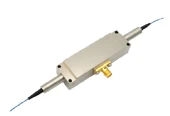
This fiber-coupled acousto-optic modulator (AOM) / frequency shifter is engineered for precise control of optical power and frequency in fully fiberized systems. Covering a broad operating wavelength range from 450 nm to 2060 nm and RF frequencies from 40 MHz to 200 MHz, it is suitable for demanding applications in fiber-optic communication, fiber sensing, quantum technology, and advanced scientific research. The device combines the advantages of conventional free-space AOMs—such as fast response and high extinction—with robust fiber coupling for easy integration into modern photonic setups.
Using precision fiber-coupling packaging and spatial acousto-optic modulation technology, this series is optimized for stable performance and excellent beam quality. A proprietary low-temperature crystal bonding process minimizes thermal stress, supporting long-term reliability even under elevated optical powers. Careful optimization of the optical path and acoustic field matching results in low insertion loss and high diffraction efficiency, making the modulator ideal for both amplitude modulation and frequency shifting of fiber lasers across the visible, near-infrared, and mid-infrared spectral regions.
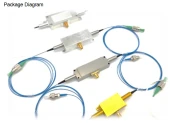
The device is available for both polarization-maintaining (PM) and single-mode (SM) fibers, enabling precise polarization control where required, such as in interferometric fiber sensors or quantum optics experiments, while also supporting more general-purpose SM fiber networks. Fast rise/fall times down to the tens of nanoseconds per millimeter range allow high-speed modulation of optical signals, which is critical for applications like pulse picking, time-domain multiplexing, and rapid signal gating. The high extinction ratio enables clean on/off contrast, reducing background light and improving signal-to-noise ratios in measurement and communication systems.
In fiber-optic communication, this fiber-coupled AOM can function as a compact, high-speed optical switch, intensity modulator, or frequency shifter around key telecom wavelengths such as 1550 nm. It supports dynamic channel control, optical path protection, and frequency offset locking in coherent systems. The capability to operate at various RF drive frequencies—40 MHz, 80 MHz, 100 MHz, 120 MHz, 150 MHz, and 200 MHz—enables flexible frequency-shift configurations for heterodyne detection, Brillouin-based systems, and advanced modulation formats.
For fiber-optic sensing, the combination of high stability, low insertion loss, and compatibility with rugged environments makes this modulator well suited for distributed sensing, interferometric measurement, and coherent OTDR/OFDR systems. The ability to impose well-controlled amplitude and frequency changes on probe beams allows precise interrogation of fiber Bragg gratings, acoustic sensors, and specialty fibers. Its compact, robust package is designed to withstand temperature variations and mechanical stress typical of field deployments, supporting reliable long-term operation in industrial and infrastructure monitoring applications.
In quantum technology and scientific research, this fiber-coupled AOM is particularly attractive for experiments requiring precise frequency offsets, rapid state preparation, or controlled light pulses delivered directly through fiber. Wavelength options such as 450 nm, 532 nm, 606 nm, 780 nm, 920 nm, 980 nm, 1550 nm, and 2060 nm cover many standard transitions used in atomic, molecular, and solid-state systems. The fast modulation response enables accurate timing control for quantum gates, optical pumping, and fluorescence excitation, while the high extinction ratio reduces leakage that could introduce decoherence or background noise.
The series supports rise/fall times as low as 10 ns/mm at 920 nm and 12–25 ns/mm at several popular wavelengths, with insertion losses typically in the 1.5–3 dB range for many configurations. This balance of speed and efficiency is comparable to high-end fiber-coupled AOMs used in cutting-edge laboratories and production test systems worldwide. Multiple wavelength and frequency combinations within the same product family simplify system design, allowing users to standardize on a single mechanical footprint while tailoring optical and RF parameters to specific application requirements.
Overall, this fiber-coupled acousto-optic modulator / frequency shifter delivers a compact, high-performance solution for precise optical modulation and frequency control in all-fiber architectures. Its broad spectral coverage, flexible RF options, fast temporal response, and robust packaging make it a strong choice for OEM integration and research-grade setups alike, from telecom and sensing platforms to next-generation quantum and photonic systems.
Fiber-Coupled Acousto-Optic Modulator
Specifications
| Center Wavelength: | 532 nm |
|---|---|
| Operational Wavelength Range: | 450 – 2060 nm |
| Acoustic Mode: | Transverse |
| Operating Frequency: | 100 MHz |
| Light Polarization: | Unspecified |
| Optical Power Density: | Not Specified |
| Deflection Angle: | Not Specified |
| Product Name: | Fiber-Coupled Acousto-Optic Modulator / Frequency Shifter |
| Wavelength Range: | 450–2060 nm |
| Frequency Range: | 40–200 MHz |
| Fiber Type: | PM/SM |
| Wavelength 450 Nm - Frequency: | 100 MHz |
| Wavelength 450 Nm - Rise/Fall Time: | 25 ns/mm |
| Wavelength 450 Nm - Insertion Loss: | 2.5 dB |
| Wavelength 532 Nm - Frequency: | 100 MHz |
| Wavelength 532 Nm - Rise/Fall Time: | 25 ns/mm |
| Wavelength 532 Nm - Insertion Loss: | 2.5 dB |
| Wavelength 606 Nm - Frequency: | 110 MHz |
| Wavelength 606 Nm - Rise/Fall Time: | 50 ns/mm |
| Wavelength 606 Nm - Insertion Loss: | 3 dB |
| Wavelength 780 Nm - Frequency: | 100 MHz |
| Wavelength 780 Nm - Rise/Fall Time: | 60 ns/mm |
| Wavelength 780 Nm - Insertion Loss: | 1.5 dB |
| Wavelength 920 Nm - Frequency: | 200 MHz |
| Wavelength 920 Nm - Rise/Fall Time: | 10 ns/mm |
| Wavelength 920 Nm - Insertion Loss: | 3 dB |
| Wavelength 980 Nm - Frequency: | 80 MHz |
| Wavelength 980 Nm - Rise/Fall Time: | 40 ns/mm |
| Wavelength 980 Nm - Insertion Loss: | 1.5 dB |
| Wavelength 1550 Nm - Frequency: | 40 MHz |
| Wavelength 1550 Nm - Rise/Fall Time (40 MHz): | 60 ns/mm |
| Wavelength 1550 Nm - Insertion Loss (40 MHz): | 3 dB |
| Wavelength 1550 Nm - Frequency (option): | 80 MHz |
| Wavelength 1550 Nm - Rise/Fall Time (80 MHz): | 60 ns/mm |
| Wavelength 1550 Nm - Insertion Loss (80 MHz): | 3 dB |
| Wavelength 1550 Nm - Frequency (option): | 100 MHz |
| Wavelength 1550 Nm - Rise/Fall Time (100 MHz): | 60 ns/mm |
| Wavelength 1550 Nm - Insertion Loss (100 MHz): | 3 dB |
| Wavelength 1550 Nm - Frequency (option): | 120 MHz |
| Wavelength 1550 Nm - Rise/Fall Time (120 MHz): | 60 ns/mm |
| Wavelength 1550 Nm - Insertion Loss (120 MHz): | 3 dB |
| Wavelength 1550 Nm - Frequency (option): | 150 MHz |
| Wavelength 1550 Nm - Rise/Fall Time (150 MHz): | 30 ns/mm |
| Wavelength 1550 Nm - Insertion Loss (150 MHz): | 4 dB |
| Wavelength 1550 Nm - Frequency (option): | 200 MHz |
| Wavelength 1550 Nm - Rise/Fall Time (200 MHz): | 12 ns/mm |
| Wavelength 1550 Nm - Insertion Loss (200 MHz): | 5 dB |
| Wavelength 2060 Nm - Frequency: | 200 MHz |
| Wavelength 2060 Nm - Rise/Fall Time: | 15 ns/mm |
| Wavelength 2060 Nm - Insertion Loss: | 3 dB |
Got questions about specs? Use the inquiry form to ask.
 Download Data Sheet

Features
- Wide Wavelength Coverage (450–2060 nm) – Supports visible to mid‑IR fiber lasers and systems, enabling use in telecom (1550 nm), quantum (780 nm, 920 nm), biomedical (532 nm, 606 nm), and industrial (980 nm, 2060 nm) applications.
- Broad RF Frequency Range (40–200 MHz) – Designed for efficient acousto‑optic modulation and frequency shifting, suitable for high‑speed intensity control, pulse picking, and precise frequency offsets.
- Fiber‑Coupled, All‑Fiber Integration – PM/SM fiber input and output provide straightforward integration into modern fiber‑optic architectures without free‑space alignment, minimizing system complexity and footprint.
- Fast Rise/Fall Time (Down to 10–15 ns/mm) – Enables high‑speed modulation, short pulse control, and rapid on/off switching for time‑critical applications such as quantum optics experiments and high‑bandwidth communication links.
- Low Insertion Loss (Typically 1.5–3 dB) – Optimized optical path and acoustic field matching reduce power loss, improving system efficiency and preserving signal quality in demanding fiber networks.
- High Extinction Ratio – Provides strong on/off contrast for precise intensity modulation, essential for accurate pulse shaping, optical gating, and noise‑sensitive sensing or quantum measurements.
- Polarization‑Maintaining (PM) and Single‑Mode (SM) Options – PM versions maintain polarization state for coherent and interferometric systems, while SM versions offer economical, low‑loss performance for general fiber systems.
- Compact, Rugged Package – Small form factor, robust mechanical design, and fiber‑pigtail construction allow easy mounting in crowded optical setups, OEM instruments, and field‑deployable equipment.
- Resistant to Harsh Environments – Designed to withstand temperature variations, vibration, and long‑term operation, suitable for industrial, telecom, and outdoor sensing installations.
- Advanced Low‑Temperature Crystal Bonding Process – Proprietary bonding and packaging technology enhances long‑term stability, minimizes thermal stress, and improves reliability under continuous operation.
- Optimized Acoustic and Optical Field Matching – High diffraction efficiency and stable modulation performance across the specified wavelength and frequency ranges, reducing RF power requirements and thermal load.
- Supports Intensity Modulation and Frequency Shifting – Functions both as a high‑speed amplitude modulator and as a frequency shifter, enabling flexible use in fiber‑optic communication, spectroscopy, and laser stabilization schemes.
- Ideal for Fiber‑Optic Sensing – High extinction ratio and fast modulation support coherent OTDR, interferometric sensors, and distributed sensing systems where timing and signal integrity are critical.
- Optimized for Quantum and Scientific Research – Suitable for atom cooling/trapping, quantum communication, and precision metrology that require stable, repeatable, and low‑noise optical modulation.
- Multiple 1550 nm Configurations – Various RF frequencies (40–200 MHz) and rise times allow tailoring to specific telecom, lidar, or coherent communication system requirements.
- OEM‑Ready and System‑Level Compatibility – Designed to integrate into existing laser platforms and measurement systems, with performance aligned to industry‑standard fiber‑coupled AOMs and frequency shifters.
Applications
- High-speed fiber-optic communication systems – Precise intensity and frequency modulation for DWDM, CWDM, coherent links, and high-capacity metro/long-haul networks.
- Fiber laser modulation and pulse shaping – On/off gating, Q-switching, pulse picking, and amplitude shaping for fiber lasers at 450–2060 nm.
- Frequency shifting for coherent detection – Heterodyne and homodyne detection schemes in coherent receivers and optical phase-locked loops.
- Optical time-division multiplexing (OTDM) – Fast rise/fall times enable time-slot routing and multiplexing in high-bit-rate fiber links.
- Optical power stabilization and feedback control – Active regulation of laser output power in fiber-based systems for improved long-term stability.
- Fiber-optic sensing (Φ-OTDR, BOTDA, BOTDR) – Intensity modulation and frequency shifting for distributed temperature, strain, and vibration sensing.
- Interrogation of FBG and interferometric sensors – Dynamic control of probe beams in FBG arrays, Mach–Zehnder, Michelson, and Sagnac fiber sensors.
- LiDAR and 3D ranging systems – Amplitude modulation and frequency shifting for FMCW LiDAR, time-of-flight ranging, and Doppler velocity measurements.
- Optical coherence tomography (OCT) – Intensity modulation and frequency shifting in fiber-based swept-source and spectral-domain OCT systems.
- Quantum communication in fiber networks – Fast modulation for quantum key distribution (QKD), entanglement distribution, and quantum repeaters at 780 nm and 1550 nm.
- Cold atom and ion trapping experiments – Frequency shifting for cooling beams, optical pumping, and Raman transitions at 532 nm, 606 nm, 780 nm, 920 nm, 980 nm, and 1550 nm.
- Quantum optics and single-photon experiments – Time-bin encoding, amplitude modulation, and path selection in fiber-based single-photon setups.
- Frequency shifting in quantum frequency conversion – Interface between visible/near-IR quantum sources and telecom-band photons using fiber-coupled architectures.
- Timing and synchronization in photonic quantum processors – Precise gating and routing of quantum signals in fiber networks for photonic computing platforms.
- Ultrafast optics and nonlinear fiber experiments – Pump–probe modulation, parametric amplification control, and supercontinuum generation management.
- Mode-locked and CW laser noise characterization – Intensity modulation for RIN measurements, transfer-function studies, and feedback stabilization.
- Fiber-based frequency comb control – Amplitude and frequency modulation of comb lines for locking, referencing, and metrology applications.
- Optical spectroscopy and pump–probe measurements – High-speed modulation of pump or probe beams for lock-in detection and dynamic spectroscopy.
- Heterodyne and Doppler spectroscopy – Controlled frequency offsets for velocity measurements and precision line-shape analysis.
- Atomic and molecular spectroscopy in fiber delivery – Stable, fiber-delivered, frequency-shifted beams for compact, vibration-tolerant spectroscopy setups.
- Laser scanning and beam switching in fiber systems – Rapid channel selection and beam routing between multiple fiber outputs in measurement or test setups.
- All-fiber optical switching and routing – Low-loss, high-extinction modulation for reconfigurable optical add-drop multiplexers and test networks.
- Optical test and measurement instruments – Integrated into intensity modulators, variable optical attenuators, and characterization benches for components and systems.
- Sensor simulation and calibration platforms – Generation of controlled optical signatures for calibrating fiber-optic sensors and interrogators.
- Harsh-environment fiber systems – Rugged, bonded-crystal design for aerospace, defense, and industrial monitoring where vibration and temperature cycling are critical.
- Defense and aerospace photonics – Frequency shifting and modulation for coherent imaging, laser radar, optical countermeasures, and secure optical links.
- Medical and bio-photonics systems – Fiber-delivered, intensity-controlled beams for diagnostic imaging, photoacoustic setups, and research-grade treatment systems.
- Optical metrology and interferometry – Phase-stable frequency offsets in fiber interferometers for precision displacement, index, and vibration measurements.
Frequently Asked Questions
What is a fiber‑coupled acousto‑optic modulator (AOM) and how is it used in fiber laser and communication systems?
Which wavelengths and RF center frequencies are available for this fiber‑coupled AOM / frequency shifter?
What are the typical performance specifications (rise time, insertion loss, and extinction ratio) of this fiber‑coupled AOM?
How do I select the right configuration (wavelength, frequency, PM/SM fiber) and place an order for this acousto‑optic modulator?
What type of RF driver do I need to operate this fiber‑coupled AOM or frequency shifter?
Can this fiber‑coupled acousto‑optic modulator be used in harsh or field environments, such as fiber‑optic sensing and quantum technology setups?
What are typical applications of this fiber‑coupled AOM / frequency shifter in quantum optics, fiber‑optic sensing, and research?
Got more questions? Use the inquiry form to ask the supplier directly.
Similar Products


Your inquiry has been received.
Create an account by adding a password
Why create an account?
- Auto-complete inquiry forms
- View and manage all your past messages
- Save products to your favorites
- Close your account anytime — no hassle