

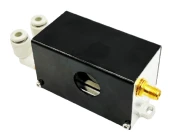
Description
Acousto-optic deflectors (AODs) are high-performance beam steering devices designed for applications that demand ultra-fast, precise, and reliable control of laser beams. By exploiting the interaction between light and acoustic waves in a crystal, these deflectors enable continuous variation of the output beam angle over a defined range, supporting both one-dimensional and two-dimensional scanning architectures. Compared with mechanical scanners such as galvanometer mirrors, AODs deliver much higher scanning speeds with no moving parts, making them ideal for high-throughput and long-lifetime operation in modern photonics systems.
These AODs are optimized for operation at 355 nm and 1064 nm, covering key industrial and scientific laser wavelengths. The product line includes configurations with different drive frequencies, optical apertures, and scan angles to support a wide variety of beam sizes and field-of-view requirements. For example, models with larger optical apertures are well suited for handling wider beams and higher powers, while higher-frequency versions provide larger angular deflection ranges for applications that require broad scanning coverage. All models are designed for use with linearly polarized light, ensuring stable and predictable diffraction behavior in demanding optical setups.
In operation, an acousto-optic deflector uses a radio-frequency (RF) signal to generate an ultrasonic wave inside a transparent crystal. As the frequency of this RF signal is tuned, the resulting acoustic grating period changes, causing the diffraction angle of the light to vary. Importantly, by maintaining a constant RF power while sweeping the frequency, the position of the diffracted beam can be scanned rapidly across the target plane while preserving nearly constant diffraction efficiency. This characteristic is crucial for applications requiring uniform illumination or exposure across the scan field, such as high-speed imaging and precision material processing.
The implemented scanning modes typically include continuous (raster or sawtooth) scanning for imaging and inspection tasks, as well as random-access scanning where the beam can jump rapidly between discrete positions with microsecond-scale response times. Compared with conventional mechanical scanners, AODs achieve ultra-high scanning speeds limited primarily by acoustic transit time in the crystal and RF driver performance. This makes them ideal for applications like laser beam multiplexing, dynamic spot positioning, and high-speed pattern generation, where rapid beam repositioning directly translates into higher throughput and shorter cycle times.
Thanks to their wide spectral operating range and carefully engineered interaction geometries, these acousto-optic deflectors provide high scanning resolution and excellent optical throughput. The high resolution arises from the large number of resolvable spots achievable across the scan angle, determined by the interaction length and acoustic bandwidth. At the same time, the devices are designed to minimize insertion loss and maintain strong first-order diffraction efficiency, preserving beam quality and power density at the workpiece or imaging plane. This balance of resolution, speed, and efficiency is particularly important in tightly focused laser systems, where any loss of power or beam distortion can compromise system performance.
With models covering wavelengths of 355 nm and 1064 nm and frequency options such as 100 MHz, 110 MHz, 170 MHz, and 200 MHz, system designers can select the optimum combination of aperture, scan angle, and drive conditions to match their specific application. Typical uses include precision laser processing (micromachining, drilling, marking, and patterning), optical inspection of semiconductor wafers and flat panel displays, and high-speed scanning-based imaging systems in industrial and scientific environments. The robust design and non-mechanical operation of these AODs help ensure long-term stability, low maintenance requirements, and consistent performance in continuous or high-duty-cycle operation.
Acousto-Optic Deflector for Ultra High Speed Scanning 355nm 1064nm Laser
Specifications
| Center Wavelength: | 1064 nm |
|---|---|
| Operational Wavelength Range: | 355 – 1064 nm |
| Acoustic Mode: | Unspecified |
| Operating Frequency: | 200 MHz |
| Light Polarization: | Unspecified |
| Deflection Angle: | 22.8 mrad |
| Available Wavelengths: | 355 nm, 1064 nm |
| Frequency: | 110 MHz |
| Optical Aperture: | 6 mm |
| Scan Angle: | 1.2 mrad |
| Polarization State: | Linear Polarization |
| Frequency: | 170 MHz |
| Optical Aperture: | 7 mm |
| Scan Angle: | 4.9 mrad |
| Polarization State: | Linear Polarization |
| Frequency: | 100 MHz |
| Optical Aperture: | 4 mm |
| Scan Angle: | 12.6 mrad |
| Polarization State: | Linear Polarization |
| Frequency: | 200 MHz |
| Optical Aperture: | 2 mm |
| Scan Angle: | 22.8 mrad |
| Polarization State: | Linear Polarization |
Got questions about specs? Use the inquiry form to ask.
 Download Data Sheet

Features
- Ultra-High Scanning Speed – Acousto-optic beam deflection enables line-by-line and point-by-point scanning at MHz-level update rates, far faster than galvanometer mirrors and many MEMS scanners, ideal for time‑critical laser processing and high-throughput imaging.
- Wide Spectral Range Coverage – Optimized for key industrial and scientific wavelengths at 355 nm (UV) and 1064 nm (NIR), covering common DPSS and fiber laser lines used in micromachining, inspection, and laser marking.
- High Scanning Resolution – Fine, frequency-controlled beam steering provides small angular step sizes and excellent positioning accuracy, enabling high pixel density, precise spot placement, and detailed image formation in scanning systems.
- High Optical Throughput – Engineered for strong diffraction efficiency and low insertion loss to maintain high optical power at the output, supporting demanding laser-processing and imaging applications where signal strength is critical.
- Multiple Optimized Models – Available configurations at 355 nm and 1064 nm with tailored frequency, aperture, and scan angle combinations to match different beam sizes, focal lengths, and field-of-view requirements.
- Large Optical Aperture Options – Apertures up to 7 mm support larger beam diameters, enabling tighter focusing, improved spot quality, and higher power handling for industrial laser systems.
- Wide Scan Angle Range – Angular deflection up to 22.8 mrad (model dependent) offers a broad usable field, suitable for wide-area scanning, large-format inspection, and extended FOV imaging.
- Stable Linear Polarization Operation – All listed configurations are designed for linear polarization, ensuring predictable diffraction efficiency and compatibility with polarized laser sources used in precision optics setups.
- Frequency-Tunable Beam Steering – Beam angle is continuously controlled via RF drive frequency (e.g., 100–200 MHz class), allowing programmable, repeatable deflection without moving mechanical parts, reducing wear and alignment drift.
- Supports Multiple Scanning Modes – Compatible with continuous scanning, random-access scanning, and step‑and‑hold operation, making it suitable for both raster imaging and arbitrary pattern generation.
- Fast Random-Access Addressing – Electronic beam steering allows jumping between points or regions of interest with microsecond-scale response, ideal for selective laser exposure, multi-spot addressing, and advanced microscopy techniques.
- Mechanical-Scan-Free Design – No moving mechanical parts in the deflection process improves reliability, reduces vibration sensitivity, minimizes maintenance, and enhances long-term stability compared with traditional scanning mirrors.
- Compact and Integrator-Friendly – Small footprint AOD modules are easy to integrate into OEM instruments, laser processing heads, and optical benches where space and alignment simplicity are important.
- Compatible with High-Power Lasers – Designed for industrial and scientific lasers at 355 nm and 1064 nm, with materials and crystal geometries commonly used in acousto-optic devices to support robust power handling (model and system dependent).
- Low Latency, High-Bandwidth Control – RF drive electronics enable rapid frequency updates and high bandwidth modulation, supporting real-time control loops, dynamic patterning, and synchronized scanning with imaging sensors.
- Ideal for Precision Laser Processing – Suitable for micro‑machining, drilling, scribing, and surface texturing where rapid, precise beam placement improves throughput and feature quality.
- Optimized for Optical Inspection Systems – Provides stable, repeatable scanning for surface inspection, defect detection, and metrology where consistent illumination and beam positioning are critical.
- High-Performance Scanning Imaging – Well suited for confocal, multi-photon, and other laser scanning imaging modalities that require fast line and frame rates with high spatial resolution.
- Consistent Diffraction Efficiency – By varying the RF frequency at constant power, the diffracted beam position changes while maintaining nearly constant diffraction efficiency across the scan range, ensuring uniform intensity over the field.
Applications
- Precision Laser Micromachining and Materials Processing
- High‑speed beam steering for micro‑drilling, cutting, scribing, and patterning of metals, semiconductors, ceramics, and polymers
- Dynamic spot positioning for laser texturing, surface functionalization, and thin‑film structuring
- Random‑access scanning for writing complex 2D patterns and QR codes in industrial marking and engraving
- Ultrafast beam deflection for precision semiconductor wafer trimming, link blowing, and repair processes
- Laser Scanning Microscopy and Imaging
- Fast line and frame scanning in confocal and multiphoton laser scanning microscopes
- Random‑access region‑of‑interest (ROI) scanning in neuroimaging and live‑cell fluorescence imaging
- High‑speed beam deflection for light‑sheet microscopy and volumetric imaging
- Fast beam positioning in optical coherence tomography (OCT) and scanning laser ophthalmoscopy
- Optical Inspection and Metrology
- High‑throughput laser scanning for automated optical inspection (AOI) of PCBs, micro‑LEDs, displays, and semiconductor wafers
- Precision beam steering in laser triangulation and 3D surface profilometry
- Non‑contact dimensional metrology and defect detection on high‑speed production lines
- Scanning for surface roughness analysis, film thickness mapping, and topology measurement
- Laser Projection, Printing, and Display Systems
- Beam deflection in high‑resolution laser projectors and heads‑up displays
- Random‑access beam placement for laser direct imaging (LDI) in PCB and maskless lithography
- High‑speed scanning for laser printing, marking, and coding in packaging and product identification
- Scanning in holographic and volumetric display prototypes
- Biomedical, Life Sciences, and Ophthalmic Applications
- Fast beam steering in laser‑based ophthalmic surgery and retinal imaging systems
- Optogenetics experiments requiring precise, random‑access stimulation of neurons
- High‑speed scanning in flow cytometry and fluorescence‑activated cell sorting (FACS)
- Laser scanning for phototherapy, photostimulation, and targeted biomedical treatments
- Lithography, Micro‑Fabrication, and 3D Structuring
- Beam deflection in direct‑write and maskless lithography for micro‑ and nano‑patterning
- High‑precision scanning for two‑photon polymerization and 3D micro‑printing
- Structuring of integrated photonics, waveguides, and micro‑optical elements
- Laser trimming and tuning of passive components and MEMS devices
- Communications, Signal Processing, and RF–Photonics
- Time‑ and wavelength‑dependent beam steering in optical signal processing setups
- Fast beam switching in optical cross‑connects and reconfigurable optical interconnects
- Use as a spatial disperser in RF–photonic systems and spectrum analyzers
- Beam steering for free‑space optical communication links and optical MIMO experiments
- Laser Radar (LIDAR), 3D Sensing, and Beam Steering
- High‑speed 1D or 2D scanning for short‑range and mid‑range LIDAR prototypes
- Beam steering in time‑of‑flight (ToF) and structured‑light 3D sensing systems
- Fine angular deflection for tracking, alignment, and pointing subsystems
- Laboratory LIDAR testbeds and research platforms requiring deterministic scan patterns
- Scientific Research and Ultrafast Laser Experiments
- Rapid beam positioning in pump‑probe setups and nonlinear optics experiments
- Scanning of focal spots in high‑intensity laser–matter interaction studies
- Beam steering in time‑resolved spectroscopy and fluorescence lifetime imaging (FLIM)
- Adaptive scanning for optical trapping, tweezers, and particle manipulation
- Defense, Security, and Remote Sensing
- Fast scanning for active laser rangefinding and target designation at 1064 nm
- Random‑access scanning for threat detection, perimeter monitoring, and surveillance illumination
- Beam steering in directed‑energy and countermeasure research platforms
- Scanning in optical target tracking, pointing, and stabilization systems
- Alignment, Calibration, and Test Systems
- Programmable scanning patterns for optical system alignment and calibration
- Beam steering in test benches for cameras, sensors, and imaging optics
- Automated scanning for MTF testing, resolution charts, and FOV characterization
- R&D laboratories requiring flexible beam position
Frequently Asked Questions
What is an acousto‑optic deflector (AOD) and how does it work?
What are typical applications of this acousto‑optic deflector?
How does the scan angle, aperture and RF frequency affect performance and beam deflection range?
What polarization and laser types are compatible with this AOD?
How fast can this acousto‑optic deflector scan, and what scanning modes are supported?
What should I consider when integrating this YOGEL acousto‑optic deflector into my laser system?
Got more questions? Use the inquiry form to ask the supplier directly.
Similar Products


Your inquiry has been received.
Create an account by adding a password
Why create an account?
- Auto-complete inquiry forms
- View and manage all your past messages
- Save products to your favorites
- Close your account anytime — no hassle