
Description
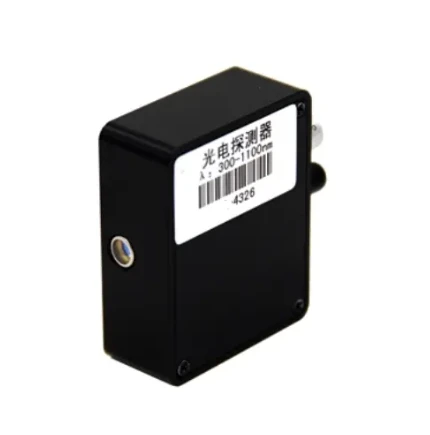
The ROF-APR Series APD Photodetector modules from Beijing Rofea Optoelectronics are engineered for applications that demand ultra‑high sensitivity and wide spectral coverage in a compact, ready‑to‑use package. These avalanche photodiode (APD) detection modules integrate a carefully selected APD, low‑noise transimpedance amplification, and bias circuitry into a single unit, offering reliable detection performance over wavelength ranges of 400–1000 nm and 800–1700 nm. With 3 dB bandwidths up to 1 GHz and multiple active area options, the series provides designers and researchers with a highly flexible platform for both free‑space and fiber‑based optical measurements.
In contrast to standard PIN photodiode receivers, APDs in the ROF-APR series operate with internal avalanche gain, significantly boosting responsivity and enabling detection of extremely weak optical signals down to the −30 to −40 dBm level and beyond, depending on the specific model. The integrated low‑noise electronics are optimized to preserve signal integrity even at high gain, making these modules well suited for demanding environments such as fiber optic sensing networks, interferometric setups, and precision metrology. Across the product family, the modules are designed to maintain stable performance over a wide operating temperature range from −10 °C to +60 °C and relative humidity up to 90%, improving reliability for both laboratory and field deployments.
The APR-1G, APR-500M, and APR-200M variants are tailored to different speed and sensitivity requirements. The APR-1G model offers a DC–1 GHz bandwidth and active areas of 50 µm or 200 µm, striking a balance between high‑speed response and low noise for telecom‑band and short‑wavelength experiments. The APR-500M provides DC–500 MHz bandwidth with 75 µm or 200 µm photosensitive diameters, giving users a mid‑range option for systems where moderate speed and enhanced collection efficiency are required. For applications where maximum sensitivity and larger spot sizes are critical, the APR-200M delivers DC–200 MHz bandwidth with 300 µm or 1.5 mm active areas, enabling efficient coupling from multimode fibers, bulk optics, or diffuse sources while still maintaining strong electrical gain.
The ROF-APR Series supports two main spectral windows using different APD designs: 800–1700 nm for near‑infrared systems such as fiber‑optic communications, distributed fiber sensing, and fiber‑optic gyroscopes; and 400–1000 nm for visible to near‑IR applications such as biomedical instrumentation, fluorescence detection, spectroscopy, and precision optical metrology. By covering both ranges with matched electrical characteristics and mechanical formats, the family allows engineers to standardize receiver architecture across multiple wavelengths. Each module is available with an SMA (female) RF output and offers options for fiber‑coupled or free‑space (spatially coupled) optical input, simplifying integration into existing setups, test benches, or OEM instruments.
From a system‑design point of view, these APD modules reduce the complexity associated with high‑voltage biasing and low‑noise amplification of discrete APDs. The operating voltage range of ±13.5 V to ±16.5 V is compatible with common laboratory and industrial power rails, minimizing the need for specialized supplies. Internally, the modules are configured to provide well‑controlled avalanche gain, expressed in V/W, ensuring a linear response over the specified input power range and protecting the device from over‑illumination up to 10 mW. This turnkey approach helps shorten development cycles for advanced sensing and detection platforms while improving repeatability and calibration stability among different units.
Typical application areas for the ROF-APR Series include fiber‑optic sensing (such as distributed temperature and strain measurement), fiber‑optic gyroscopes, optical time‑domain reflectometry, biomedical diagnostics, fluorescence and absorption spectroscopy, low‑light imaging support, and general‑purpose optical power monitoring in research labs. Their combination of high gain, low noise, and selectable bandwidth makes them particularly attractive where weak signals must be extracted from noise without sacrificing dynamic range. Multiple package sizes and photosensitive area options give users freedom in mechanical design and optical alignment, whether coupling from single‑mode fibers, multimode fibers, or collimated/free‑space beams.
Overall, the ROF-APR Series APD Photodetector modules provide a robust, versatile detection solution that brings together wide spectral coverage, configurable bandwidth, low noise performance, and convenient electrical and optical interfacing.
ROF APR Series Avalanche Photodetector APD Module 850-1650nm 1GHz
Specifications
| APD Type: | Silicon (Si) |
|---|---|
| Operational Wavelength (Typical): | Not Specified |
| Operational Wavelength Range: | 400 – 1000 nm |
| Peak Linear Responsivity (Rmax): | Not Specified |
| Peak Linear Quantum Efficiency: | Not Specified |
| Active Area: | 0.031 mm^2 |
| Dark Current: | Not Specified |
| Spectral Range: | 850–1650 nm, 400–1000 nm |
| Response Frequency: | up to 1 GHz |
| Input Optical Power, Max: | 10 mW |
| Operating Voltage: | ±13.5 to ±16.5 V (typ. ±15 V) |
| Operating Temperature Range: | -10 to 60 ºC |
| Storage Temperature Range: | -40 to 85 ºC |
| Humidity (non-condensing): | 5–90 %RH |
| Model: | APR-1G |
| Wavelength Range (APR-1G, Variant 1): | 800–1700 nm |
| 3 DB Bandwidth (APR-1G, Variant 1): | DC–1 GHz |
| Photosensitive Surface (APR-1G, Variant 1): | 50 µm |
| Gain (APR-1G, Variant 1): | 3×10^8 V/W |
| Sensitivity (APR-1G, Variant 1): | -33 dBm |
| Output Connector (APR-1G, Variant 1): | SMA(f) |
| Wavelength Range (APR-1G, Variant 2): | 400–1000 nm |
| Photosensitive Surface (APR-1G, Variant 2): | 200 µm |
| Gain (APR-1G, Variant 2): | 4×10^10 V/W |
| Sensitivity (APR-1G, Variant 2): | -36 dBm |
| Model: | APR-500M |
| Wavelength Range (APR-500M, Variant 1): | 800–1700 nm |
| 3 DB Bandwidth (APR-500M, Variant 1): | DC–500 MHz |
| Photosensitive Surface (APR-500M, Variant 1): | 75 µm |
| Gain (APR-500M, Variant 1): | 4×10^1.8 V/W |
| Sensitivity (APR-500M, Variant 1): | -35 dBm |
| Wavelength Range (APR-500M, Variant 2): | 400–1000 nm |
| Photosensitive Surface (APR-500M, Variant 2): | 200 µm |
| Gain (APR-500M, Variant 2): | 4×10^4.2 V/W |
| Sensitivity (APR-500M, Variant 2): | -38 dBm |
| Model: | APR-200M |
| Wavelength Range (APR-200M, Variant 1): | 800–1700 nm |
| 3 DB Bandwidth (APR-200M, Variant 1): | DC–200 MHz |
| Photosensitive Surface (APR-200M, Variant 1): | 300 µm |
| Gain (APR-200M, Variant 1): | 5×10^1.1 V/W |
| Sensitivity (APR-200M, Variant 1): | -42 dBm |
| Wavelength Range (APR-200M, Variant 2): | 400–1000 nm |
| Photosensitive Surface (APR-200M, Variant 2): | 1.5 mm |
| Gain (APR-200M, Variant 2): | 5×10^5.5 V/W |
| Sensitivity (APR-200M, Variant 2): | -45 dBm |
Got questions about specs? Use the inquiry form to ask.
 Download Data Sheet

Features
- Wide Spectral Response Range (400–1000 nm / 800–1700 nm) – Covers both visible and near‑infrared bands, ideal for fiber optic sensing, biomedical instrumentation, spectral analysis, and fiber optic gyroscope applications.
- High Sensitivity Avalanche Photodiode (APD) Detection – Integrated ROF‑APR series APD photodetector module with internal high‑gain low‑noise amplification enables detection of very weak optical signals down to ‑33 dBm to ‑45 dBm, depending on model and wavelength range.
- High Bandwidth Performance up to 1 GHz – Models available with DC–1 GHz, DC–500 MHz, and DC–200 MHz 3 dB bandwidths, supporting high‑speed optical communication, fast transient measurements, and time‑resolved optical sensing.
- Multiple Active Area Options – Choose from 50 µm, 75 µm, 200 µm, 300 µm and 1.5 mm photosensitive areas to optimize between coupling efficiency, alignment tolerance, and bandwidth for different optical setups.
- High Gain Transimpedance Amplifier – Built‑in high‑gain electronics (up to ~105 V/W depending on configuration) deliver strong electrical output signals, simplifying downstream signal processing and reducing external amplification requirements.
- Low‑Noise Performance for Weak Signal Detection – Carefully optimized APD bias and low‑noise front‑end electronics offer an excellent signal‑to‑noise ratio, improving measurement accuracy in low‑light and high‑dynamic‑range applications.
- Fiber or Free‑Space (Spatial) Coupling – Standard units provide high‑gain fiber‑coupled input, with optional spatially coupled input for free‑space beams, making integration flexible in both benchtop and OEM systems.
- Wide Operating Temperature Range – Reliable operation from ‑10 °C to +60 °C with storage from ‑40 °C to +85 °C, ensuring stable performance in laboratory, industrial, and field environments.
- Rugged Design with Wide Humidity Tolerance – Designed for operation in 5–90% RH environments, suitable for demanding sensing and monitoring systems where environmental stability is critical.
- Standard SMA Electrical Output Connector – Equipped with a 50 Ω SMA (female) output for easy connection to oscilloscopes, spectrum analyzers, data acquisition cards, and RF measurement equipment.
- Compact Integrated Module – APD sensor, bias circuitry, and high‑speed amplifier are integrated into a single compact module, reducing system footprint and simplifying optical receiver design.
- Dual Wavelength Versions per Model – Each APR series model offers both 400–1000 nm and 800–1700 nm variants, enabling a common platform for visible and telecom‑band applications.
- Flexible Packaging and Customization – Different housing sizes and mechanical interfaces are available, and custom packages and performance tuning can be provided to meet specific OEM or research requirements.
- Robust Electrical Operation – Operates from a single supply of approximately ±15 V (typical range ±13.5 V to ±16.5 V), compatible with common laboratory and system power rails.
- Ideal for Precision Optical Sensing – Optimized for applications such as fiber optic sensing, biomedical devices, fiber optic gyroscopes, laser monitoring, and spectral analysis where high sensitivity and reliability are essential.
Applications
Applications of ROF-APR Series APD Photodetectors
The ROF-APR series Avalanche Photodetector (APD) modules from Beijing Rofea Optoelectronics are high‑sensitivity, low‑noise photoelectric detection modules with a wide spectral response (400–1000 nm and 850–1650 nm) and bandwidths up to 1 GHz. Thanks to their high gain, low noise, and flexible packaging, they are ideal for a broad range of precision optical detection applications.
1. Optical Fiber Sensing and Structural Health Monitoring
- Distributed fiber optic sensing (DAS/DTS/DSS) for temperature, strain, and acoustic monitoring
- Structural health monitoring of bridges, tunnels, dams, pipelines, and critical civil infrastructure
- Oil and gas pipeline leak detection and intrusion monitoring
- Perimeter security and fence monitoring using coherent fiber sensing
- Railway track and train position monitoring via embedded fiber sensors
- Wind turbine blade and tower vibration/strain monitoring
2. Fiber Optic Gyroscopes (FOG) and Inertial Sensing
- Fiber optic gyroscopes for navigation in aerospace, marine, and defense systems
- Inertial Measurement Units (IMU) using interferometric fiber gyroscopes
- Rotation and angular velocity measurement in robotics and autonomous vehicles
- High‑stability reference gyros in positioning and guidance platforms
3. Optical Communication and Telecom Test
- High‑sensitivity optical receivers for single‑mode and multimode fiber links
- Test and measurement receivers in optical communication labs
- Optical power monitoring and automatic gain control feedback loops
- PON, CWDM, and DWDM channel monitoring and receiver development
- Free‑space optical communication and optical wireless links
4. Lidar, Laser Ranging, and Time‑Resolved Detection
- Short‑ and mid‑range lidar systems using near‑infrared detection
- Laser rangefinders and distance measurement instruments
- Time‑of‑flight (ToF) detection in 3D scanning and mapping systems
- Atmospheric and environmental lidar (aerosol, cloud, and pollution monitoring)
- Optical radar and target detection in defense and security applications
5. Biomedical and Life Science Instrumentation
- Biomedical diagnostic devices requiring ultra‑low‑light detection
- Fluorescence and chemiluminescence detection in life science analyzers
- Flow cytometry and cell counting systems
- Optical coherence tomography (OCT) and near‑infrared imaging
- Pulse oximetry and tissue spectroscopy in medical monitoring
- Point‑of‑care diagnostic instruments operating in the 400–1000 nm band
6. Spectroscopy and Spectral Analysis
- UV‑VIS‑NIR spectroscopy covering 400–1000 nm and 850–1650 nm ranges
- Absorption, reflection, and transmission spectroscopy for materials analysis
- Raman spectroscopy and low‑signal spectroscopic measurements
- Environmental spectral analysis for gas and pollutant detection
- Process spectroscopy and inline quality control in industrial production
7. Scientific Research and Laboratory Detection
- Low‑light level detection in physics and photonics research experiments
- Pulsed laser experiments and time‑resolved measurements up to 1 GHz
- Quantum optics and single‑photon level experiments (with appropriate front‑end)
- General purpose lab photodetector for R&D in universities and institutes
- Optical alignment, beam profiling, and reference detectors
8. Industrial Laser Monitoring and Process Control
- Laser power feedback and monitoring in fiber laser and solid‑state laser systems
- Alignment and stability monitoring for industrial laser processing
- Optical inspection and machine vision systems using NIR illumination
- Inline monitoring of welding, cutting, and additive manufacturing processes
9. Security, Surveillance, and Night‑Vision Systems
- Low‑light imaging modules using NIR illumination and APD detection
- Optical perimeter surveillance and intrusion detection
- Laser‑based security scanners and detection systems
- Covert optical communication and detection in security networks
10. Test, Measurement, and OEM Integration
- Reference APD modules in optical test equipment
- Built‑in detectors for optical power meters and optical sampling heads
- OEM integration into measurement instruments requiring:
- High gain and low noise
- Compact modules with different photosensitive areas (50 µm to 1.5 mm)
- Wide wavelength coverage (400–1000 nm and 800–1700 nm)
- Bandwidths from DC–200 MHz up to DC–1 GHz
Frequently Asked Questions
What is the ROF-APR series APD photodetector and what applications is it designed for?
What are the key optical and electrical performance specifications of the ROF-APR APD photodetector modules?
How do I choose between APR-1G, APR-500M, and APR-200M for my optical measurement or sensing application?
What wavelength ranges and photosensitive area sizes are available for ROF-APR APD detectors, and how do these affect performance?
What power supply and environmental conditions are required to operate the ROF-APR APD photodetector safely?
How do I connect optical signals to the ROF-APR series and what output interface is provided?
What is the sensitivity of the ROF-APR APD photodetector modules and how does it compare to standard PIN photodiodes?
Got more questions? Use the inquiry form to ask the supplier directly.
Similar Products


Your inquiry has been received.
Create an account by adding a password
Why create an account?
- Auto-complete inquiry forms
- View and manage all your past messages
- Save products to your favorites
- Close your account anytime — no hassle