


Description
HPLDD3040 High Power Laser Diode Driver – Precision Current Control up to 30 A / 1200 W
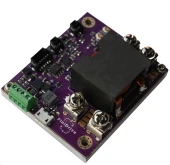
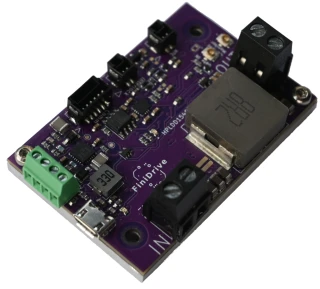
The HPLDD3040 is a compact, high-power laser diode driver engineered for applications that require precise current control, high electrical efficiency, and robust protection in a single integration-ready module. Unlike many generic current sources used for laser diodes, this driver is specifically designed for laser diode loads from low-power operation up to 1200 W, within its voltage, current, and thermal limits. With a wide 10-55 V DC input range and up to 40 V output voltage, it is suitable for driving single high-power diodes, diode bars, and multi-element stacks used in OEM systems, laboratory setups, materials processing, solid-state laser pumping, and demanding research applications.
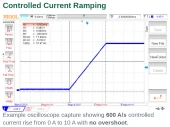
At the core of the HPLDD3040 is a precision current regulation stage that offers a programmable current range from 0 to 30 A with fine 2 mA setpoint resolution. This level of control supports both low-power characterization work and stable long-term operation at high power. Carefully controlled ramp-up and ramp-down behavior minimizes current transients that can otherwise shorten laser diode lifetime, an important benefit for OEM system builders and laboratories that frequently work with different diode modules. The driver achieves up to 97% conversion efficiency, depending on the operating point, reducing thermal load and simplifying cooling compared to less efficient linear solutions.
The HPLDD3040 is designed for flexible operation modes, supporting clean continuous-wave (CW) operation as well as QCW and digitally gated workflows. With an external 3.3 V logic gate input and internal, external, or combined gating options, users can synchronize laser output with external equipment such as scanners, choppers, measurement instruments, or machine control systems. An analog current monitor output, 0-15 V corresponding to 0-30 A, enables real-time monitoring, logging, and external supervisory control in more complex laser systems or experimental setups.
To protect expensive laser diodes and support safe operation, the HPLDD3040 integrates multiple hardware and firmware-based safety layers. These include a crowbar output protection stage, reverse current protection, and a hardware interlock loop tied directly to the crowbar and converter logic. Programmable overcurrent protection helps prevent accidental overdrive, while independent programmable overtemperature protection for both the driver and the laser diode allows the system to react to thermal issues before they become critical. In addition, load check and power-good status monitoring provide useful diagnostic information during setup and operation, especially in CW use after the output current has settled.
The driver is also equipped for monitoring and auxiliary integration tasks. It provides an NTC input for use with an external 10 kΩ temperature sensor, enabling straightforward temperature monitoring of the laser diode mount or heatsink. An AUX terminal exposes auxiliary rails of +5 V, +15 V, -15 V, and ground, which can be used for low-power peripheral electronics within their specified current capability, such as sensors, control logic, or signal conditioning stages.
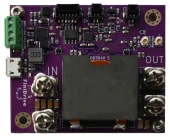
With a board footprint of only 50 x 60 mm and mounting hole spacing of 40 x 50 mm, the HPLDD3040 is significantly more compact than many comparable high-power laser drivers, making it easy to integrate into space-constrained instruments and embedded systems. Despite its small size, the driver incorporates dedicated communication and control interfaces that support a wide range of use cases. USB connectivity is available for quick laboratory setups, initial configuration, and diagnostics, while RS-232 is suited for direct integration into standalone machines and controllers. RS-485 adds support for multidrop installations where multiple addressed drivers must be controlled over a shared bus, a common requirement in multi-channel or modular laser platforms.
Configuration and control are further streamlined through a dedicated application for Windows and Linux, while automated integration can be implemented through the documented USB, RS-232, or RS-485 communication protocol. This combination of compact hardware, flexible interfaces, and protection-focused design makes the HPLDD3040 well suited for R&D labs, production test stands, and deployed OEM systems. Whether the goal is to safely characterize a new laser diode, build a reliable fiber-coupled source, or integrate a high-power pump module into a larger machine, the HPLDD3040 provides a tightly integrated solution that balances precision, power, and protection on a very compact board.
HPLDD3040 High Power Laser Diode Driver 1200 W 30 A 40 V
Specifications
| Drive Regime: | CW, Modulated |
|---|---|
| Output Current (max): | 30 A |
| Output Voltage (max): | 40 V |
| Current Monitor Output: | 0-15 V analog output for 0-30 A |
| Supported OS For Control App: | Windows / Linux |
| Communication Interfaces: | USB / RS-232 / RS-485 |
| Interlock Loop Maximum Resistance: | 355 Ω |
| Interlock Loop Minimum Current: | 4 mA |
| NTC Input: | External 10 kΩ NTC sensor input |
| AUX Terminal Voltages: | GND, +5 V, +15 V, -15 V |
| Mounting Hole Spacing: | 40 x 50 mm |
| Board Footprint: | 50 x 60 mm |
| External Gate Input: | 3.3 V logic input |
| Model: | HPLDD3040 |
| Efficiency: | Up to 97% (operating-point dependent) |
| Current Setpoint Resolution: | 2 mA |
| Current Setpoint Range: | 0-30 A |
| Output Power: | Up to 1200 W |
| Output Voltage: | 1-40 V (max. 73% of input voltage) |
| Input Voltage: | 10-55 VDC |
| Type: | High Power Laser Diode Driver |
Got questions about specs? Use the inquiry form to ask.
 Download Data Sheet

Features
- High‑Power Output: Up to 1200 W
Delivers up to 30 A and 40 V output, supporting single‑emitter, bar, and multi‑kilowatt laser diode stacks commonly used in industrial, medical, and research applications. - Wide Input Voltage Range: 10–55 VDC
Flexible input range simplifies integration with a broad variety of DC supplies and battery‑based systems, while the driver regulates output up to 73% of input voltage for optimal power conversion. - Exceptional Current Precision: 2 mA Resolution
Ultra-fine current control enables precise power tuning, safe diode characterization, and repeatable operating points for sensitive laser diodes. - High Electrical Efficiency: Up to 97%
Advanced power stage architecture provides up to 97% efficiency (operating‑point dependent), reducing heat dissipation, lowering cooling requirements, and improving overall system reliability. - Compact Footprint for OEM and Lab Use
Space‑saving board design of just 50 x 60 mm with 40 x 50 mm mounting hole spacing enables easy integration in compact laser systems, handheld instruments, and multi‑channel driver racks. - Controlled Current Ramp Up / Ramp Down speed
Programmable soft‑start and soft‑stop current profiles minimize current overshoot and inrush, reducing stress on sensitive laser diodes during power‑on, power‑off, and setpoint changes. - CW, QCW, and Gated Operation
Supports stable CW (continuous‑wave) operation as well as QCW / gated workflows, making it suitable for pulsed pumping, materials processing, and time‑resolved experiments. - Multiple Digital Interfaces: USB / RS‑232 / RS‑485
Built‑in USB for lab use and diagnostics, RS‑232 for direct host integration, and RS‑485 for multidrop and networked devices allow straightforward connection to controllers, PLCs, and embedded PCs. - Cross‑Platform Control Software
Supplied Windows and Linux application enables convenient configuration, monitoring, scripting, and logging without needing custom firmware or software development. - Layered Protection for Laser Diode Safety
Integrated crowbar output protection, reverse current protection, and interlock loop tied directly to crowbar and converter logic help protect expensive laser diodes against fault conditions and wiring errors. - Programmable Overcurrent and Temperature Protection
Features programmable and regulated overcurrent protection, driver overtemperature protection, and diode overtemperature protection to shut down or limit output before damage occurs. - External Gate Input for Fast Modulation
A 3.3 V logic external gate input supports rapid gating and modulation, enabling precise timing control for pulsed and synchronized laser applications. - Accurate Current Monitoring Output
Integrated 0–15 V analog monitor output for 0–30 A provides real‑time current feedback for oscilloscope monitoring, data acquisition, closed‑loop control, and system diagnostics. - Flexible Gating Modes: Internal, External, Combined
Configurable internal, external, or combined gating modes make it easy to adapt the driver to existing timing architectures and trigger schemes in complex optical setups. - Integrated AUX Power Rails
On‑board AUX terminal provides GND, +5 V, +15 V, and −15 V outputs to power sensors, control electronics, or small peripheral circuits without requiring extra power supplies. - External NTC Temperature Sensor Input
10 kΩ NTC input for external temperature sensing allows direct monitoring of laser diode or heat sink temperature for enhanced protection and closed‑loop thermal management. - Interlock Loop for System‑Level Safety
Dedicated interlock loop (minimum loop current 4 mA, maximum loop resistance 355 Ω) provides a hard safety chain for enclosure switches, key switches, and emergency stop circuits. - Load Check and Power‑Good Monitoring
Built‑in load check and power‑good status signals support automated system verification, ensuring proper connection and supply conditions before enabling laser output.
Applications
- High‑Power Laser Diode Driving in R&D Laboratories
Ideal as a primary current source for high-power laser diodes in DPSS, fiber, and direct diode laser systems requiring up to 30 A and 1200 W output power. The wide 10–55 V input and up to 40 V output voltage range make the HPLDD3040 suitable for driving single-emitter diodes, multi-emitter bars, and high-power fiber-coupled laser modules used in materials processing, medical, and industrial applications. - OEM Integration in Industrial Laser Systems
Designed for embedding into industrial laser engines for cutting, welding, drilling, and additive manufacturing. The wide 10–55 V input range, up to 40 V output, and 30 A programmable current make it suitable for high‑power diode stacks and fiber‑coupled industrial laser modules. - Laser Diode Burn‑In, Characterization, and Reliability Testing
Used in production test stands for L/I/V characterization, long‑term stability testing, and burn‑in of laser diodes and diode arrays. The fast gated operation and controlled current ramp up / ramp down minimize electrical and thermal shock during repetitive test cycles. - Pump Source Driver for Solid‑State and Fiber Lasers
Provides stable, low‑ripple current for diode bars and fiber‑coupled pump modules in DPSS and fiber laser systems. High electrical efficiency (up to 97%) reduces heat load in laser pump cabinets and improves overall system reliability. 2 mA current resolution setpoints allows extremely precise power control. - Material Processing, Marking, and Micromachining
Drives high‑brightness diodes used for precision marking, engraving, scribing, and micro‑drilling. QCW and gated operation support pulsed and burst regimes required for heat‑controlled machining and high‑contrast marking on metals, plastics, and semiconductors. - Illumination and Imaging Systems
Provides stable current for high‑power laser diode illuminators in machine vision, industrial inspection and 3D scanning. Programmable current waveforms and external gating allow synchronization with cameras, scanners, and timing electronics. - Spectroscopy, Metrology, and Sensing
Supports narrow‑linewidth and distributed feedback (DFB / DBR) laser diodes used in absorption spectroscopy, gas sensing, interferometry, and precision metrology. Fine current resolution enables accurate wavelength tuning and improved spectral stability. - Multi‑Channel and Multidrop Laser Driver Racks
RS‑485 support allows multidrop configurations with addressed devices, making it ideal for multi‑channel laser driver racks in production, test, or research environments. Multiple HPLDD3040 boards can be coordinated for complex multi‑wavelength or multi‑power‑level systems. - Educational and Training Laboratories
A practical platform for university and training labs teaching laser diode technology, optoelectronics, and control systems. USB connectivity and the Windows / Linux control application make it straightforward for students to configure, monitor, and log laser driver behavior. - Prototype Development and Custom Laser Modules
Well suited for rapid prototyping of custom laser heads, illumination modules, and integrated photonic systems. The AUX terminal (+5 V, ±15 V, GND), NTC input, and interlock loop streamline integration with temperature controllers, safety circuits, and system logic.
Frequently Asked Questions
What types of laser diodes can the HPLDD3040 high power laser diode driver operate?
How do I control and set the current on the HPLDD3040 laser diode driver?
What are the input power requirements and efficiency of the HPLDD3040?
How does QCW and gated operation work on the HPLDD3040?
What protection and safety features does the HPLDD3040 provide for my laser diode?
How can I integrate the HPLDD3040 into an OEM system or laboratory setup?
What are the thermal management and mounting considerations for the HPLDD3040?
Got more questions? Use the inquiry form to ask the supplier directly.
Similar Products



Your inquiry has been received.
Create an account by adding a password
Why create an account?
- Auto-complete inquiry forms
- View and manage all your past messages
- Save products to your favorites
- Close your account anytime — no hassle