
Description
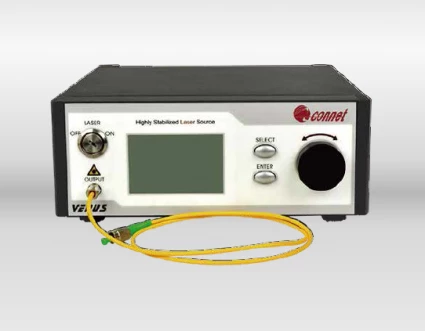
The VENUS Series C+L-band ASE (Amplified Spontaneous Emission) broadband light sources, models VASS-CL-B (single-mode) and VASP-CL-B (polarization-maintaining), are precision-engineered instruments designed for demanding fiber-optic test, measurement, and sensing applications. Based on an optimized erbium-doped fiber architecture, these sources deliver a wide optical spectrum spanning the full C and L bands (approximately 1528–1602 nm) with high output power levels up to 200 mW, making them suitable for both research laboratories and production environments that require stable, broadband illumination.
Unlike conventional narrowband laser sources, the VENUS C+L-band ASE design provides an inherently broadband, low-coherence output ideal for minimizing interference effects and standing waves in sensitive optical setups. The source exhibits excellent spectral flatness, with variation typically kept below 3.5–4 dB across the C+L bandwidth, and low spectral ripple. This uniform power distribution over the entire operating wavelength range helps ensure accurate, repeatable measurements for applications such as DWDM component characterization, spectral analysis, and broadband insertion loss testing.
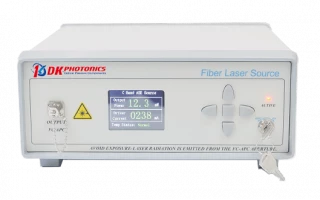
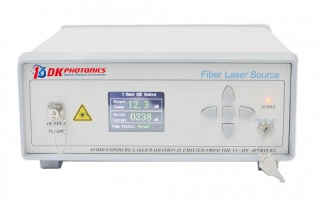
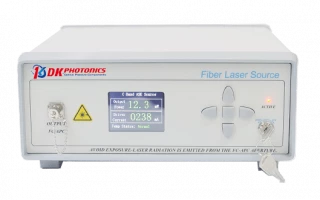
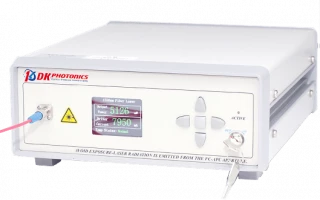
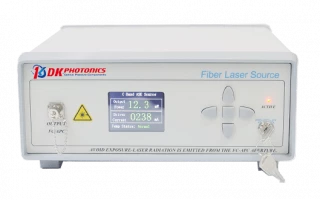
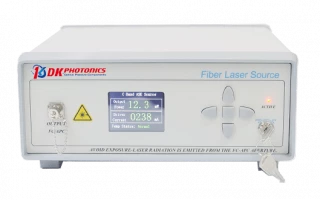
The benchtop configuration incorporates a highly integrated electronic and optical platform with a user-friendly high-definition LCD interface. Users can monitor operating current, voltage, and output power in real time, while the continuously tunable output power function allows fine adjustment to match specific experimental or production requirements. Coarse and fine power tuning modes support both quick setup and precise optimization. Designed for long-term operation, the VENUS series maintains high power stability over short (15-minute) and extended (8-hour) time scales after warm-up, even under varying ambient conditions, supporting rigorous, continuous testing cycles.
Both the VASS-CL-B and VASP-CL-B are available with a range of factory-configurable output powers, typically including 10 mW, 20 mW, 50 mW, 100 mW, and 200 mW. The standard single-mode version (VASS-CL-B) employs SMF 9/125 µm fiber, while the polarization-maintaining version (VASP-CL-B) uses PM1550 fiber with a typical polarization extinction ratio greater than 17 dB. This makes the PM model particularly well-suited for polarization-sensitive systems such as fiber gyroscopes, coherent detection setups, and certain types of interferometric sensing where stable polarization is critical.
The VENUS series is engineered for integration and flexibility. For stand-alone use, the benchtop unit offers a compact footprint of approximately 340 mm × 240 mm × 100 mm with standard FC/APC fiber connectors (other connector types can be specified). For OEMs and system builders, a compact module version is available, enabling straightforward incorporation into larger test racks, measurement systems, or field-deployable platforms. With a broad operating temperature range and low maximum power consumption, these sources are well suited for both laboratory environments and industrial test stations.
Typical application areas for the VASS-CL-B and VASP-CL-B include FBG (fiber Bragg grating) interrogation and sensing systems, where a broadband and spectrally flat source is needed to illuminate multiple gratings over long distances. They are also widely used in optical fiber gyroscope development, component and subsystem testing in C+L-band fiber communications, spectral analysis in research labs, and qualification of passive components such as multiplexers, filters, and couplers. The combination of high output power, excellent spectral flatness, and robust long-term stability makes the VENUS series a reliable backbone light source for advanced photonic testing scenarios.
VENUS SERIES C+L-band ASE Broadband Light Source
Specifications
| Bandwidth: | 74 nm |
|---|---|
| Center Wavelength: | 1602 nm |
| Output Power: | 200 mW |
| Polarization: | Linear |
| Series: | VENUS C+L-band ASE Broadband Light Source |
| Part Numbers: | VASS-CL-B (SM), VASP-CL-B (PM) |
| Output Power (typical Options): | 10 mW, 20 mW, 50 mW, 100 mW, 200 mW |
| Maximum Output Power: | 200 mW |
| Operating Wavelength Range: | 1528 nm – 1602 nm |
| Spectral Width (FWHM): | C+L band |
| Spectral Flatness (typical): | < 4 dB |
| Spectral Flatness (max.): | < 5 dB |
| Output Isolation (min.): | 30 dB |
| Operating Mode: | CW |
| Output Power Stability (15 Min, Typ.): | ±0.5% |
| Output Power Stability (15 Min, Max.): | ±1.0% |
| Output Power Stability (8 H, Typ.): | ±2.0% |
| Output Power Stability (8 H, Max.): | ±5.0% |
| Output Power Tunable Range: | 0–100% |
| Output Power Tunable Mode: | Coarse / Fine |
| Operating Voltage: | 100–240 VAC |
| Maximum Power Consumption: | 50 W |
| Operating Temperature Range: | 0 – +50 ℃ |
| Storage Temperature Range: | -40 – +85 ℃ |
| Output Fiber Type (SM Version): | SMF 9/125 µm, NA = 0.13 |
| Output Fiber Type (PM Version): | PM1550, NA = 0.13 |
| Polarization Extinction Ratio (PER, PM): | > 17 dB |
| Output Fiber Length: | > 1 m |
| Optical Connector: | FC/APC (other options available) |
| Dimension (benchtop): | 340(L) × 240(W) × 100(H) mm |
Got questions about specs? Use the inquiry form to ask.
 Download Data Sheet

Features
- Ultra-Broadband C+L Band Coverage (1528–1602 nm) – Single source delivers continuous, broadband ASE output across both C- and L-bands, ideal for DWDM component testing, optical sensing, and telecom system characterization.
- High Output Power up to 200 mW – Supports multiple power configurations (10, 20, 50, 100, 200 mW typical) for flexible use in R&D labs, production test benches, and system integration.
- Excellent Spectral Flatness & Low Ripple – Spectral flatness < 4 dB over the C+L band with low intensity ripple, providing highly uniform spectral power density for accurate spectrum analysis, FBG interrogation, and component calibration.
- High Stability Output – Output power stability as good as ±0.5% (15 min) and ±2.0% (8 h) (after warm-up at 25 °C), minimizing drift in long-duration tests and sensing applications.
- Er-Doped Fiber ASE Design – Optimized erbium-doped fiber architecture delivers low-coherence ASE light with excellent reliability, reduced speckle, and no mode-hopping, outperforming many laser diode–based broadband sources.
- SM and PM Output Options – Available as:
- VASS-CL-B: Single-mode (SMF 9/125 µm, NA=0.13)
- VASP-CL-B: Polarization-maintaining (PM1550, NA=0.13, PER > 17 dB)
- High Output Isolation ≥ 30 dB – Integrated optical isolation protects the internal source from back-reflections, improving lifetime and stability in complex optical setups.
- Continuously Tunable Output Power – Coarse/Fine power adjustment with continuous tunability over a wide range (up to 100% rated power) enables precise setting of launch power for device and system testing.
- Benchtop System with LCD Interface – High-definition front-panel LCD displays current, voltage, and output power in real time, simplifying operation and monitoring in laboratory and manufacturing environments.
- Optional Compact Module Package – In addition to benchtop units, compact module versions are available for OEM and system-level integration where space and power are constrained.
- Wide Operating Temperature Range – Designed for robust performance from -10 °C to +60 °C (typical industry range for similar modules) with storage down to -40 °C, suitable for demanding industrial and field applications.
- Low-Noise ASE Output – Broadband, low-coherence spectrum minimizes interference effects and speckle, ideal for fiber-optic gyroscopes, FBG sensor networks, and distributed fiber sensing systems.
- Telecom-Grade Reliability – Built with telecom-qualified components and proven EDF technology, offering long mean time between failures (MTBF) and stable performance for continuous 24/7 operation.
- Multiple Optical Connector Options – Standard FC/APC output to reduce back-reflection, with other connector types (e.g., FC/PC, SC/APC) available on request for easy integration into existing test setups.
- Compact Benchtop Footprint – Space-saving enclosure of approximately 340 (L) × 240 (W) × 100 (H) mm, optimized for crowded optical test benches and rack shelves.
- Universal AC Power Input – Operates from 100–240 VAC mains with low overall power consumption (≤ 74 W typical), compatible with global laboratory and production environments.
- Optimized for FBG & Fiber Sensing – Flat, broadband output is ideal for:
- FBG fiber sensing and interrogation systems
- Distributed temperature and strain sensing (DTS/DSS)
- Optical fiber gyroscopes and inertial systems
Applications
- Optical Component Characterization and Testing
- Broadband characterization of DWDM/CWDM multiplexers, demultiplexers, and filters.
- Insertion loss, return loss, and PDL testing of optical connectors, couplers, splitters, and isolators.
- S-parameter and spectral response measurements of integrated photonic devices and planar lightwave circuits (PLCs).
- Qualification of EDFAs, Raman amplifiers, and passive C+L-band components in R&D and production.
- Fiber Optic Gyroscope (FOG) and Inertial Sensing
- Low-coherence broadband light source for interferometric fiber optic gyroscopes to suppress coherent backscattering.
- Rotation sensing in navigation systems for aerospace, marine, and land vehicles.
- Development and calibration of next‑generation high‑precision FOG modules.
- FBG Fiber Sensing and Distributed Sensing Systems
- Interrogation of fiber Bragg gratings for temperature, strain, and pressure monitoring.
- Broadband illumination in quasi-distributed FBG sensing arrays across C+L bands.
- Structural health monitoring of bridges, tunnels, dams, wind turbines, and civil infrastructure.
- Oil and gas well monitoring, pipeline integrity sensing, and power cable temperature monitoring.
- Optical Communication System Development
- Testing and prototyping of C-band, L-band, and C+L-band transmission systems.
- Link characterization and equalization for DWDM networks and coherent communication systems.
- Optical layer testing in metro, long-haul, and submarine communication links.
- Noise loading, OSNR emulation, and receiver sensitivity validation.
- Telecom and Datacom Equipment Manufacturing Test
- Production line burn‑in and functional testing of transceivers, ROADMs, and WSS modules.
- Calibration of optical power meters, OTDRs, OSA-based test stations, and monitoring modules.
- Verification of programmable optical filters and variable optical attenuators (VOAs).
- Optical Spectrum Analysis and Metrology
- Broadband reference source for optical spectrum analyzers in C+L band.
- Calibration and linearity checks of wavelength-selective instruments and spectrometers.
- Characterization of spectral flatness, gain profiles, and passband shapes of fiber components.
- Research in Fiber Lasers and Nonlinear Optics
- Seed and pump source for studying nonlinear effects such as FWM, SPM, XPM, and Raman/Brillouin scattering.
- Broadband excitation in experiments on supercontinuum generation in highly nonlinear fibers.
- Gain and noise characterization of experimental EDF- and hybrid amplifiers.
- University and laboratory research in photonics, quantum optics, and optical signal processing.
- Optical Coherence Tomography (OCT) and Imaging
- Broadband low-coherence illumination for experimental C‑band/L‑band OCT systems.
- Development of interferometric and spectroscopic imaging techniques in the near‑infrared.
- Prototype biomedical and industrial imaging setups requiring low-coherence ASE sources.
- Optical Sensing in Harsh and Industrial Environments
- Broadband interrogation for perimeter security, acoustic and vibration sensing using distributed fiber sensors.
- Condition monitoring of rotating machinery, transformers, and generators via fiber sensing networks.
- Environmental and geophysical monitoring (earthquake, landslide, subsidence) using fiber sensing arrays.
- Test and Measurement Instrumentation Integration
- Integration as a stable internal light source in automated optical test platforms and rack‑mounted systems.
- Reference source in multi-channel testbeds for parallel component and module qualification.
- OEM light engine for spectrometers, tunable filter systems, and optical coherence analyzers.
- Laboratory Education and Photonics Training
- Demonstration of ASE generation, erbium-doped fiber behavior, and broadband emission in teaching labs.
- Hands‑on training for students in optical communications, sensing, and spectrum analysis.
- Use as a safe, stable, broadband source in university photonics and optical engineering courses.
- Calibration and Reference Source Applications
- Flat, broadband power reference for calibrating loss across C- and L-band components.
- Reference spectra for evaluating wavelength accuracy and dynamic range of OSAs.
Frequently Asked Questions
What is the Connet VENUS series C+L-band ASE broadband light source and how does it work?
What are the key specifications of the VENUS C+L-band ASE light source (wavelength range, power, and spectral flatness)?
What is the difference between the VASS-CL and VASP-CL models (SM vs PM output)?
What applications are the VENUS series C+L-band ASE sources designed for?
How stable is the output power of the VENUS ASE light source over time and temperature?
How do I select the correct VENUS ASE model and configure the ordering code?
What output interfaces, control features, and power requirements does the VENUS benchtop ASE source have?
Got more questions? Use the inquiry form to ask the supplier directly.
Similar Products
Your inquiry has been received.
Create an account by adding a password
Why create an account?
- Auto-complete inquiry forms
- View and manage all your past messages
- Save products to your favorites
- Close your account anytime — no hassle