

Description
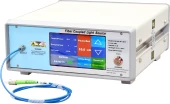
This 980 nm ASE (Amplified Spontaneous Emission) broadband light source is engineered for demanding fiber-optic test and measurement tasks that require a stable, low-polarization, and spectrally smooth optical signal. Covering a typical 20 dB bandwidth from 973 nm to 982 nm with a central wavelength near 980 nm, it provides a flat and reliable spectral output ideally suited for characterization of fiber lasers, fiber Bragg gratings, and a wide range of passive fiber-optic components. In contrast to narrow-line laser diodes, the ASE source delivers a broad spectrum with excellent power uniformity, minimizing interference effects and making it particularly valuable in laboratory and production environments where precision and repeatability are critical.
Designed as a compact benchtop unit, the source outputs ≥10 mW of optical power with a spectral power density of at least −20 dBm/nm. The built‑in optical isolator ensures output isolation greater than 35 dB, effectively protecting the internal gain medium from back reflections and maintaining consistent performance over extended operation. Short‑term power stability within ±0.02 dB (approximately ±0.5%) over 15 minutes and long‑term stability within ±0.05 dB (approximately ±1.2%) over 8 hours place this ASE source among the more precise and reliable instruments in its class, comparable to many lab‑grade 980 nm ASE modules found in advanced photonics laboratories and production test benches.
The output is delivered through Hi1060 single‑mode fiber terminated with an FC/APC connector, providing low back reflection and secure, repeatable connections to typical fiber‑optic test setups. The polarization state is fully depolarized (natural polarization), with a polarization extinction ratio of ≤0.2 dB and a degree of polarization ≤2.5%. This low and well‑controlled polarization minimizes polarization‑dependent loss and polarization‑dependent wavelength shifts when testing components such as WDMs, couplers, circulators, filters, and fiber Bragg gratings. As a result, measurement uncertainty due to polarization effects is significantly reduced, which is vital when comparing devices or calibrating high‑precision optical systems.
From a user perspective, the unit is designed for straightforward integration into both manual and automated setups. The benchtop chassis (255 mm W × 285 mm D × 115 mm H) is optimized for laboratory racks and optical tables, occupying minimal space while still providing clear front‑panel access. The source is operated and configured via a touchscreen interface, and it also supports RS232 serial communication through a DB9 connector for remote control and system integration. This makes it suitable for automated test platforms in fiber‑laser manufacturing, fiber‑optic component production lines, and research environments where scripting and remote operation are standard practice.
Powered from a universal AC input of 100–240 V with approximately 30 W consumption, the source is ready for deployment in laboratories and facilities worldwide without the need for external adapters or complex power conditioning. It operates reliably over a wide environmental range from −5 °C to +35 °C and humidity from 0% to 70%, matching or exceeding the environmental specifications of comparable 980 nm ASE instruments used in telecom, sensing, and academic research labs. These operating conditions, combined with the internal isolation and robust optical design, contribute to long service life and consistent performance, even under intensive daily use.
Typical application areas include fiber laser seeding and characterization around 980 nm, testing of pump laser components, calibration of optical grating interrogation systems, verification of broadband couplers and WDM devices, and general-purpose scientific research requiring a stable, unpolarized broadband source in the 973–982 nm region. Whether deployed as a standalone benchtop instrument or integrated into automated fiber‑optic test stations, this 980 nm ASE broadband light source offers a combination of spectral coverage, power stability, and polarization control that aligns well with the requirements of advanced photonics development and production testing.
980nm ASE Broadband Light Source
Specifications
| Bandwidth: | 20 nm |
|---|---|
| Center Wavelength: | 980 nm |
| Output Power: | 10 mW |
| Polarization: | Random |
| Wavelength Range (20 DB Bandwidth): | 973–982 nm (±2 nm tolerance) |
| Center Wavelength: | 980 nm |
| Optical Power: | ≥10 mW |
| Optical Power Spectral Density: | ≥ -20 dBm/nm |
| Output Isolation: | >35 dB (built-in isolator) |
| Short-term Stability (15 Min): | ≤±0.02 dB (≈±0.5%) |
| Long-term Stability (8 Hr): | ≤±0.05 dB (≈±1.2%) |
| Polarization State: | Fully depolarized (natural polarization) |
| Polarization Extinction Ratio (PER): | ≤0.2 dB |
| Degree Of Polarization (DOP): | ≤2.5% |
| Output Fiber Type: | Hi1060 |
| Fiber Connector: | FC/APC |
| Control Method: | Touchscreen / RS232 serial communication |
| Communication Interface: | DB9 female |
| Power Supply: | AC 100–240 V, 30 W |
| Package/Format: | B1 = Benchtop |
| Dimensions (B1): | 255(W) × 285(D) × 115(H) mm |
| Operating Temperature Range: | -5 to +35 °C |
| Operating Humidity Range: | 0–70% |
Got questions about specs? Use the inquiry form to ask.
 Download Data Sheet

Features
- Broad 973–982 nm Emission Bandwidth (20 dB) – Provides a wide and smooth spectrum around 980 nm, ideal for fiber laser seeding, component characterization, and general-purpose broadband illumination in the 1 µm region.
- High Optical Output Power ≥ 10 mW – Delivers sufficient power for accurate measurements and low-noise detection in fiber-optic testing, optical grating evaluation, and research setups.
- Excellent Power Spectral Density (≥ –20 dBm/nm) – Ensures a relatively flat and stable spectral profile over the specified band, improving measurement reliability in spectroscopy, loss testing, and calibration applications.
- Outstanding Short‑Term Stability (≤ ±0.02 dB / 15 min) – Minimizes output drift during critical measurement windows, helping maintain consistent test conditions and reducing re‑measurement time.
- Superior Long‑Term Stability (≤ ±0.05 dB / 8 hrs) – Guarantees highly repeatable performance over a full workday, supporting continuous operation in production lines and long-duration experiments.
- Fully Depolarized Output – Natural, random polarization state with Degree of Polarization ≤ 2.5%, making the source ideal for testing polarization‑sensitive components and reducing measurement uncertainty due to polarization effects.
- Very Low Polarization Extinction Ratio (≤ 0.2 dB) – Provides near-unpolarized light, improving accuracy in applications such as optical grating testing, fiber coupler characterization, and broadband loss measurements.
- Integrated High‑Isolation Output Stage (> 35 dB) – Built‑in optical isolator protects the internal ASE source from back‑reflections, enhancing device lifetime and stability when connected to complex fiber networks or reflective components.
- Hi‑1060 Single‑Mode Fiber Output – Standard SM fiber type for 980 nm operation (Hi1060), ensuring excellent beam quality and compatibility with common 980 nm fiber components, wavelength-division multiplexers, and pump combiners.
- Low‑Back‑Reflection FC/APC Connector – Angled physical contact interface minimizes return loss, protecting the source and improving measurement quality in high‑sensitivity setups.
- Benchtop Platform for Lab and Production Use – Rugged B1 benchtop housing (255 W × 285 D × 115 H mm) suited for R&D labs, system integration, and manufacturing environments.
- Intuitive Touchscreen Control – Front‑panel touchscreen allows fast and user‑friendly control of output power and operating parameters, reducing setup time and operator training needs.
- Remote Control via RS‑232 Interface – DB9 serial communication enables integration into automated test systems, remote monitoring, and PC‑based control software for high‑throughput testing.
- Universal AC Power Input (100–240 V) – 30 W power consumption with wide‑range input makes it suitable for global deployment without additional power adapters.
- Wide Operating Temperature Range (–5 °C to +35 °C) – Ensures reliable operation in varied lab and light industrial environments, maintaining performance over changing ambient conditions.
- Low Maintenance, Solid‑State ASE Design – No moving parts, high reliability, and long lifetime compared to traditional broadband lamps, lowering total cost of ownership.
- Optimized for Fiber Laser and Component Testing – Ideal for fiber laser development, optical grating testing, fiber‑optic component testing, and scientific research requiring a stable 980 nm broadband source.
- Custom Configurations Available – Tailored wavelength ranges, output power levels, and package options can be provided on request to match specific OEM or research requirements.
Applications
Typical Applications of 980 nm ASE Broadband Light Sources
- Fiber laser development and characterization
- Pumping and seeding experimental fiber laser cavities around 1 µm
- Gain characterization of ytterbium-doped and other rare-earth-doped fibers
- Measurement of fiber laser threshold, efficiency, and gain spectra
- Optical grating testing and metrology
- Spectral characterization of fiber Bragg gratings (FBGs) operating near 980 nm
- Reflection and transmission measurements of long-period gratings
- Verification of grating center wavelength, bandwidth, and insertion loss
- Fiber-optic component testing and QA
- Insertion loss and return loss measurements of 980 nm fiber components
- Testing of WDM couplers, splitters, circulators, and isolators at 980 nm
- Characterization of 980/1550 nm pump combiners for EDFAs and Raman amplifiers
- Verification of passive components’ spectral flatness and uniformity
- Optical amplifier research (EDFA / Raman)
- Benchmarking 980 nm pump modules and EDFAs
- Gain and noise figure measurement in pre-amplifier and booster stages
- Characterization of pump-signal interaction in distributed Raman amplifiers
- Wavelength-division multiplexing (WDM) system evaluation
- Characterization of CWDM/DWDM devices in the 980 nm band
- Testing narrowband and broadband optical filters and thin-film filters
- Verification of mux/demux performance under broadband illumination
- Optical sensing and instrumentation
- Interrogation of FBG-based temperature and strain sensors near 980 nm
- Development of broadband sensor interrogation units and spectral analyzers
- Low-coherence interferometry and optical coherence sensing in the 980 nm range
- Biomedical optics and spectroscopy (980 nm band)
- General-purpose broadband source for tissue optics research around 980 nm
- Excitation and calibration source in near-IR spectroscopy setups
- Evaluation of 980 nm window in biomedical imaging and diagnostics
- Optical coherence tomography (OCT) and low-coherence applications
- Source for prototype OCT systems operating near 980 nm
- Coherence length and axial resolution optimization experiments
- Component testing for interferometric and coherence-based sensors
- Polarization-insensitive test source
- Qualification of polarization-insensitive components with fully depolarized light
- Verification of PDL (polarization dependent loss) in fiber components
- System testing where stable, low-DOP broadband light is required
- Laboratory broadband reference source
- Stable reference source for spectrometers and optical spectrum analyzers (OSAs)
- General-purpose illumination source for R&D in the 973–982 nm band
- Calibration and verification of optical measurement benches and setups
- Educational and training laboratories
- University and research lab training in fiber optics, photonics, and laser technology
- Demonstrations of ASE, gain broadening, and noise processes in rare-earth-doped fibers
- Hands-on experiments with broadband sources, OSAs, and FBGs
- Custom and OEM integration
- Integration as a broadband seed source in custom fiber laser platforms
- OEM inclusion in test and measurement instruments for 980 nm components
- Adaptation for specialized sensing, metrology, or spectroscopy equipment
Frequently Asked Questions
What is the ASE 973–982 nm broadband light source and what are its key specifications?
What are typical applications of a 980 nm ASE broadband light source?
How does an ASE broadband light source differ from SLDs or tunable lasers for testing fiber components?
What does fully depolarized output and low degree of polarization (DOP ≤ 2.5%) mean in practice?
How stable is the 980 nm ASE source over time and what does the stability specification mean?
What fiber output, connector type, and output isolation does this ASE light source provide?
How do I control and integrate the 980 nm ASE source into my test setup, and what power and environmental conditions are required?
Got more questions? Use the inquiry form to ask the supplier directly.
Similar Products



Your inquiry has been received.
Create an account by adding a password
Why create an account?
- Auto-complete inquiry forms
- View and manage all your past messages
- Save products to your favorites
- Close your account anytime — no hassle