
Description
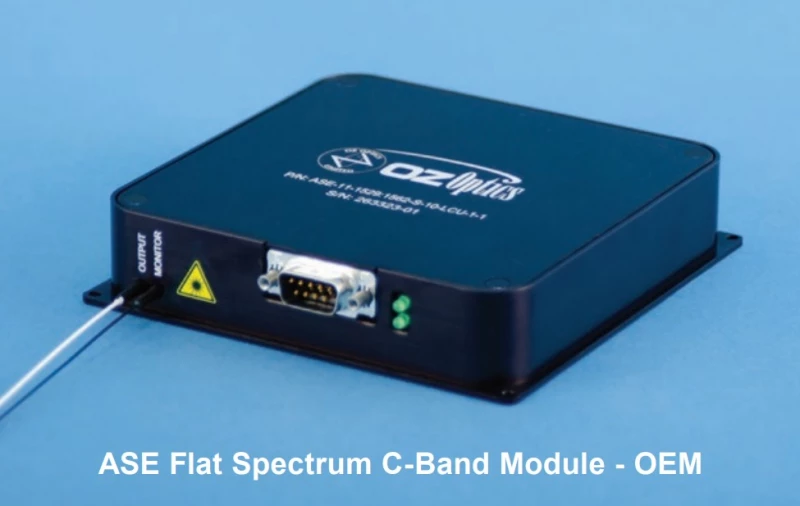
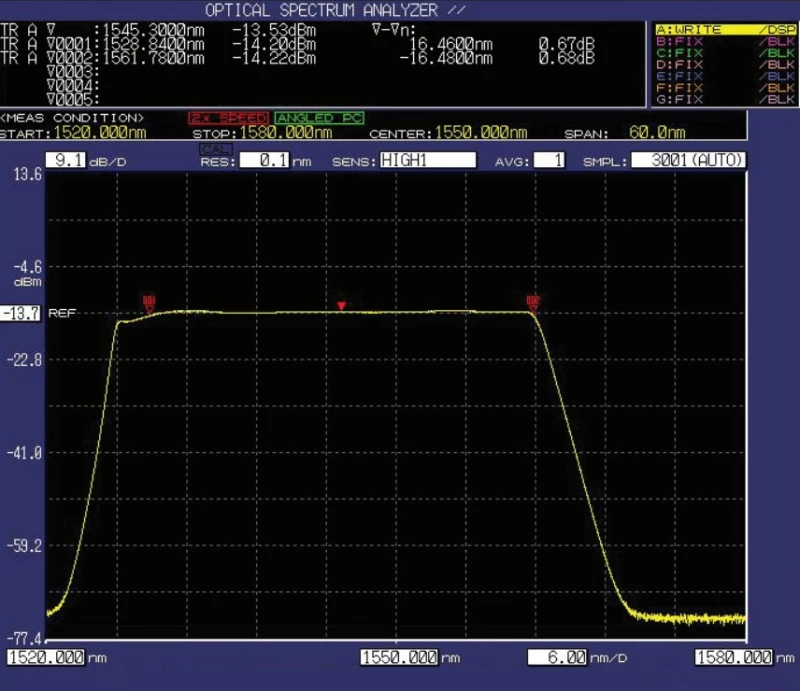
The ASE Flat Spectrum C-Band Module is a high-performance broadband light source designed for demanding optical testing and measurement applications. Utilizing amplified spontaneous emission (ASE) technology, this module delivers a flat, low-coherence output across the entire C-band (1529 nm to 1562 nm), making it exceptionally well-suited for optical signal-to-noise ratio (OSNR) measurements, component characterization, and system compliance testing. Its flat spectral bandwidth, with peak-to-peak ripple less than ±0.5 dB, ensures accurate and reliable results in both laboratory and manufacturing environments.
With a robust nominal output power of 13 dBm, the module provides ample optical power for a wide range of applications, including wavelength division multiplexing (WDM), optical fiber sensor interrogation, and biomedical imaging. The unpolarized output is delivered through a pigtailed 9/125 µm singlemode fiber, and the module supports a variety of standard and custom connector options to accommodate diverse integration requirements. The compact OEM packaging, measuring less than 20 x 20 x 5 cm, is engineered for easy integration into test systems and production lines.
Engineered for stability and reliability, the ASE Flat Spectrum C-Band Module features high output isolation (45 dB) and excellent return loss (55 dB), ensuring minimal back-reflection and interference. The built-in pump TEC and current driver maintain consistent performance across a wide operating temperature range (0°C to +40°C), while the module’s low power consumption and high stability (power stability of 0.02 dB) make it a cost-effective solution for continuous operation. Optional built-in attenuators are available for applications requiring precise power control.
This ASE source is ideal for R&D labs, telecom system compliance testing, optical component manufacturing, and advanced sensing systems. Its combination of high output power, flat spectral response, and compact, integrable design positions it as a versatile and reliable tool for professionals seeking precision and efficiency in optical testing and measurement.
ASE Flat Spectrum C-Band Module - OEM
Specifications
| Center Wavelength: | 1562 nm |
|---|---|
| Polarization: | Unpolarized |
| Total Output Power: | 13 dBm |
| Total Power Stability: | 0.02 dB |
| Spectrum Flatness: | < ±0.5 dB |
| Output Isolation: | 45 dB |
| Input Voltage: | 5-12 V |
| Driving Current: | < 400 mA |
| Dimensions: | < 20 x 20 x 5 cm |
| Return Loss: | 55 dB |
| Operating Temperature Range: | 0 to +40 °C |
| Storage Temperature Range: | -40 to +80 °C |
| Humidity Non-Condensing: | 0-85 % |
Got questions about specs? Use the inquiry form to ask.
 Download Data Sheet

Features
- High Output Power: Delivers up to 13 dBm total output power for demanding applications.
- Flat Spectral Bandwidth: Exceptional flatness with spectral ripple less than ±0.5 dB across the entire C-band (1529–1562 nm), ensuring reliable and accurate measurements.
- Wide C-Band Coverage: Supports a broad wavelength range from 1529 nm to 1562 nm, ideal for telecom and photonics applications.
- Superior Stability: Outstanding power stability with variations less than 0.02 dB, guaranteeing consistent performance.
- High Output Isolation: Provides 45 dB output isolation and 55 dB return loss for optimal signal integrity and minimal back-reflection.
- Unpolarized Output: Ensures compatibility with a wide range of optical systems and components.
- Integrated Pump TEC and Current Driver: Built-in thermal and current management for enhanced reliability and ease of integration.
- Optional Built-in Attenuator: Allows precise control of output power to suit various testing and measurement needs.
- OEM-Friendly Design: Compact, low-profile module (< 20 x 20 x 5 cm) with pigtailed 9/125 µm singlemode fiber and multiple connector options (including custom connectors).
- Wide Operating Range: Operates from 0°C to +40°C with storage capability from -40°C to +80°C and humidity tolerance up to 85% (non-condensing).
- Flexible Power Supply: Accepts input voltages from 5 to 12 V and operates with low driving current (< 400 mA).
- Cost-Effective Solution: High performance-to-cost ratio, making it ideal for both R&D and manufacturing environments.
- Customizable: Custom fiber lengths, jacket diameters, and connector types available to meet specific application requirements.
Applications
- OSNR (Optical Signal-to-Noise Ratio) Measurement: Ideal for precise OSNR analysis in optical networks and systems, ensuring optimal signal quality and performance.
- Optical Components Testing: Provides a stable, broadband light source for characterizing and testing optical components such as filters, multiplexers, demultiplexers, and amplifiers.
- Telecom System Compliance Testing: Enables comprehensive compliance and performance testing of telecom equipment and systems operating in the C-band.
- Optical Fiber Sensors and Sensing Systems: Used as a reference light source in distributed and point fiber optic sensing applications, including strain, temperature, and pressure measurements.
- Wavelength Division Multiplexing (WDM): Supports WDM system development, calibration, and troubleshooting by providing a flat, broadband spectrum across the C-band.
- Biomedical Imaging: Suitable for optical coherence tomography (OCT) and other biomedical imaging techniques requiring low-coherence, broadband illumination.
- Coherent Communication Systems: Facilitates the development and testing of advanced coherent optical communication systems by providing a stable, unpolarized broadband source.
- Research and Development (R&D): Essential tool for R&D labs working on photonics, optical networking, and fiber optic technologies.
- Metrology and Calibration: Used as a reference source for calibrating optical spectrum analyzers, power meters, and other photonic measurement instruments.
- Optical Network Monitoring: Enables real-time monitoring and diagnostics of optical networks for fault detection and performance optimization.
- Educational and Training Purposes: Valuable for academic institutions and training centers for hands-on learning in fiber optics and photonics.
- Interrogation of Fiber Bragg Gratings (FBG): Provides the broadband illumination necessary for FBG sensor interrogation and spectral analysis.
- Material Characterization: Used in laboratories for the spectral analysis and characterization of optical materials and coatings.
Frequently Asked Questions
What is the ASE Flat Spectrum C-Band Module and what are its main applications?
What is the output power and spectral flatness of the ASE Flat Spectrum C-Band Module?
What are the key features that differentiate this ASE C-Band Module from similar products?
How is the ASE Flat Spectrum C-Band Module typically used in OSNR measurement and optical testing?
What are the available connector and fiber options for this ASE module?
What are the power and environmental requirements for operating the ASE Flat Spectrum C-Band Module?
Can the ASE Flat Spectrum C-Band Module be customized for specific applications?
Got more questions? Use the inquiry form to ask the supplier directly.
Similar Products
Your inquiry has been received.
Create an account by adding a password
Why create an account?
- Auto-complete inquiry forms
- View and manage all your past messages
- Save products to your favorites
- Close your account anytime — no hassle