


Description
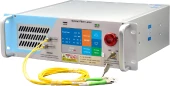
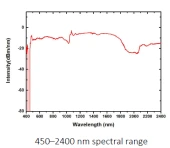
The Super Broadband Light Sources from Yogel are precision-engineered benchtop instruments designed for applications that demand an ultra-wide spectral range, high power, and exceptional stability. Covering up to 450–2400 nm at a 20 dB range, these sources provide a continuous and flat spectrum that spans the visible, NIR, and extended NIR regions. This makes them highly suitable for modern spectroscopy, optical characterization, and imaging tasks where a single, versatile source can replace multiple narrowband lamps or lasers.
Leveraging advanced supercontinuum generation and fiber-based technology, these broadband sources deliver average output powers of 100 mW, 200 mW, or 400 mW, depending on the selected configuration. The flatness and uniformity of the spectrum help minimize calibration complexity and improve signal-to-noise ratio in measurement systems. Compared with conventional halogen lamps or LED-based systems, these sources offer significantly broader coverage and higher spectral brightness, enabling more accurate measurements across a much larger wavelength window.
A key advantage of these Super Broadband Light Sources is their outstanding power stability. Short-term stability over 15 minutes is specified at ≤±0.02 dB (approximately ≤±0.5%), and long-term stability over 8 hours is ≤±0.05 dB (approximately ≤±1.2%). This level of performance is particularly important in precision spectral analysis, where even small fluctuations can degrade measurement repeatability, shift baselines, and introduce errors. Stable output also reduces the need for frequent reference measurements and recalibration, improving throughput in laboratory and production environments.
The output is delivered through a single-mode Hi-1060 fiber pigtail with random polarization, terminated with an FC/APC connector. This configuration is compatible with standard collimators and fiber-based optical setups found in spectroscopy, OCT, interferometry, and imaging systems. Random polarization helps avoid polarization-related artifacts in many test configurations, while single-mode delivery ensures good beam quality and spatial coherence suitable for precise coupling into instruments or fiber networks.
The platform is designed with user-friendly control and easy integration into automated test setups. A built-in touchscreen interface allows direct local control of operating parameters, while an RS232 serial interface (DB9 female connector) supports remote operation and system integration. The universal 100–240 VAC power supply and less than 150 W power consumption make it suitable for laboratories, OEM racks, and industrial workstations worldwide. With an operating temperature range of -5 to +35 °C and humidity tolerance from 0 to 70%, these units are engineered for reliable performance under typical lab and production conditions.
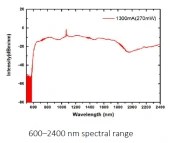
Typical applications for these ultra-broadband sources include spectral analysis, medical and biomedical imaging, optical inspection, material characterization, and development of photonic components. In spectral analysis, the extended 450–2400 nm or 600–2400 nm range enables simultaneous investigation of visible absorption features, NIR overtones, and deeper NIR-II and NIR-III bands often exploited in chemical sensing and process monitoring. In medical imaging and life sciences, access to NIR-II wavelengths supports higher-contrast, deeper-tissue imaging protocols. For optical inspection and component testing, the wideband output simplifies characterization of filters, waveguides, detectors, and other photonic devices over a very broad spectral window.
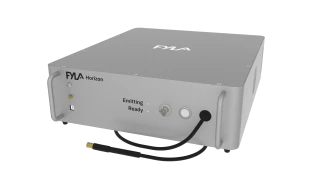
Housed in a compact benchtop (B3) chassis with dimensions of 376 mm (W) × 340 mm (D) × 112 mm (H), the Super Broadband Light Sources fit easily into crowded optical tables and test benches. Model configurations cover ultra-broadband ranges such as NIR-II (600–2400 nm) and NIR-III (450–2400 nm), allowing users to select the optimal wavelength coverage and power level for their specific application. This combination of broad spectral coverage, high and stable output power, and flexible control makes Yogel’s Super Broadband Light Sources a robust choice for researchers, system integrators, and manufacturers looking to upgrade or expand their optical testing and imaging capabilities.
450-2400nm Super Broadband Light Source
Specifications
| Bandwidth: | 20 nm |
|---|---|
| Output Power: | 100 mW |
| Polarization: | Random |
| Wavelength Range: | 600–2400 nm; 450–2400 nm @20 dB range |
| Optical Power: | 100 / 200 / 400 mW |
| Power Stability (15 Min): | ≤±0.02 dB (≤±0.5%) |
| Power Stability (8 Hr): | ≤±0.05 dB (≤±1.2%) |
| Polarization State: | Random polarization |
| Pigtail Type: | Single-mode fiber (Hi-1060) |
| Connector Type: | FC/APC |
| Control Method: | Touchscreen / RS232 serial communication |
| Communication Interface: | DB9 Female |
| Power Supply: | 100–240 VAC, <150 W |
| Dimensions: | 376 mm (W) × 340 mm (D) × 112 mm (H) |
| Operating Temperature Range: | -5 to +35 °C |
| Operating Humidity Range: | 0–70% |
| Package Type: | Benchtop (B3) |
| Model: | SC-LS |
| Operating Wavelength (options): | NIR-II = 600–2400 nm; NIR-III = 450–2400 nm |
| Average Optical Power (options): | 100 / 200 / 400 mW |
| Output Pigtail Type: | SM = Hi-1060 |
| Package: | B3 = Benchtop |
| Spectral Range Option: | 600–2400 nm; 450–2400 nm |
Got questions about specs? Use the inquiry form to ask.
 Download Data Sheet

Features
- Ultra‑Broadband Spectral Coverage (450–2400 nm) – Continuous wideband output covering VIS, NIR, and SWIR regions (NIR‑II: 600–2400 nm; NIR‑III: 450–2400 nm), ideal for spectroscopy, OCT, hyperspectral imaging, and fiber‑optic sensing.
- Flat, High‑Power Spectrum – Broad, spectrally flat emission with up to 400 mW total optical power provides high signal‑to‑noise ratio across the full band, enabling accurate spectral measurements and high‑contrast imaging.
- Exceptional Power Stability – Output stability of ≤ ±0.02 dB over 15 min (≈±0.5%) and ≤ ±0.05 dB over 8 h (≈±1.2%) minimizes drift, ensuring repeatable long‑term measurements for demanding lab and production environments.
- Random Polarization Output – Random polarization state reduces polarization‑dependent effects in optical components and measurement systems, improving overall measurement repeatability.
- Single‑Mode Fiber Delivery – Standard Hi‑1060 single‑mode fiber pigtail ensures high beam quality and excellent spatial coherence for interferometry, imaging, and precision optical testing.
- FC/APC Fiber Interface – Standard FC/APC connector compatible with common fiber collimators and patch cords, simplifying integration into existing optical benches and OEM setups.
- Multiple Power Levels Available – Configurable average output power of 100 mW, 200 mW, or 400 mW to match application requirements from low‑noise spectroscopy to high‑throughput imaging.
- Touchscreen & Remote Control – User‑friendly touchscreen control and RS‑232 (DB9) interface for remote operation, automation, and easy integration into test systems or production lines.
- Universal AC Power Input – Operates from a 100–240 VAC mains supply with power consumption <150 W, suitable for global deployment in laboratories and industrial facilities.
- Wide Operating Temperature Range – Reliable performance from -5°C to +35°C and 0–70% humidity, supporting stable operation in typical lab and light industrial environments.
- Benchtop Form Factor – Compact B3 benchtop package (approx. 376 × 340 × 112 mm) designed for easy placement on optical tables and racks, with convenient front‑panel access.
- Ideal for Spectroscopy & Optical Metrology – Ultra‑broadband, stable output is well‑suited for absorption and reflection spectroscopy, white‑light interferometry, ellipsometry, and material characterization.
- Optimized for Medical & Biomedical Imaging – Spectral coverage into the NIR‑II/SWIR windows supports deep‑tissue imaging, OCT, endoscopy illumination, and diagnostic instrumentation.
- High‑Quality Illumination for Inspection – Flat, broadband emission enables high‑precision optical inspection, machine vision, and quality control in semiconductor, photonics, and precision manufacturing.
- SC‑LS Configurable Models – SC‑LS series available with different wavelength options (450–2400 nm or 600–2400 nm), output powers, and SM fiber pigtail types to match diverse OEM and R&D requirements.
- Low Maintenance, Long‑Life Source – Robust supercontinuum‑based architecture designed for long service life and low downtime, reducing total cost of ownership compared with traditional lamp sources.
Applications
- Spectral Analysis and Spectroscopy
Ideal for broadband absorption, transmission, and reflection measurements across 450–2400 nm. Supports characterization of optical coatings, optical components, thin films, photonic devices, and materials research requiring a flat, high-power supercontinuum-like spectrum. - Optical Coherence Tomography (OCT)
Well suited as a light source for high-resolution OCT systems, including spectral-domain and swept-source OCT in the NIR and extended NIR (NIR-II and NIR-III) windows. Enables improved axial resolution and deep tissue penetration for biomedical and industrial imaging. - Medical and Biomedical Imaging
Provides stable, broadband illumination for medical imaging modalities such as endoscopy, microscopy, fluorescence imaging, photoacoustic imaging, and tissue spectroscopy. The wide spectral range allows multi-modal imaging and enhanced contrast in biological samples. - Fiber Optic Sensing and Structural Health Monitoring
Excellent for interrogation of FBG (Fiber Bragg Grating) sensors, long-period gratings, and distributed fiber sensors (DAS/DTS/DSS). Supports strain, temperature, pressure, and vibration monitoring in civil engineering, aerospace, energy, and transportation infrastructures. - Optical Component and System Testing
Used as a versatile test source for characterizing optical fibers, couplers, multiplexers/demultiplexers, filters, AWGs, WDM/CWDM/DWDM components, and integrated photonic circuits. The flat output spectrum simplifies insertion loss and spectral response measurements. - Telecommunications and Datacom Research
Supports testing and prototyping of broadband optical networks, passive optical components, and advanced modulation schemes. Suitable for evaluating optical amplifiers, wavelength selective switches, and other devices operating from the visible to the telecom C/L bands and beyond. - Optical Metrology and Calibration
Serves as a reference broadband source for calibrating spectrometers, optical spectrum analyzers (OSA), optical power meters, and monochromators. The high stability over 15 minutes and 8 hours ensures reliable metrology in laboratory and production environments. - Hyperspectral and Multispectral Imaging
Enables broadband illumination in hyperspectral cameras and imaging systems used for remote sensing, environmental monitoring, precision agriculture, cultural heritage inspection, and food quality control, especially in the 600–2400 nm and 450–2400 nm ranges. - Non-Destructive Testing (NDT) and Industrial Inspection
Provides uniform, high-power broadband light for detecting defects, cracks, delaminations, and inhomogeneities in metals, composites, ceramics, and semiconductor wafers. Supports inline process monitoring and automated optical inspection (AOI). - Materials Science and Chemistry
Suitable for broadband spectroscopy of polymers, nanomaterials, semiconductors, and chemical samples. Facilitates studies of bandgaps, absorption spectra, scattering behavior, and photonic band structures in research and quality control labs. - Microscopy and Optical Imaging Systems
Acts as a powerful illumination source for widefield and confocal microscopy, dark-field imaging, fluorescence excitation (with filters), and reflectance microscopy. The flat spectrum allows flexible wavelength selection for multi-channel imaging. - Environmental and Gas Sensing
Used in broadband spectroscopy systems for monitoring gases, liquids, and aerosols across a wide spectral range. Supports applications in air quality monitoring, combustion diagnostics, industrial emissions control, and environmental research. - Photonic Device Development and R&D
Ideal for characterizing waveguides, photonic crystals, integrated optics, MEMS devices, and silicon photonics components. The super-broadband output simplifies measurement of dispersion, loss spectra, and modal properties. - Optical Filter and Coating Characterization
Provides a convenient light source for measuring transmission/reflection spectra of interference filters, dichroic mirrors, beamsplitters, AR/HR coatings, and bandpass/edge filters from visible to mid-NIR wavelengths. - Education and Photonics Training Laboratories
A flexible broadband source for university and research labs teaching optics, photonics, and spectroscopy. Enables multiple experiments with a single platform, reducing the need for multiple narrowband lasers and lamps.
Frequently Asked Questions
What is the SC-LS ultra-broadband supercontinuum light source and what wavelength range does it cover?
What are the typical applications of this super broadband light source?
What output power levels and stability can I expect from the SC-LS broadband light source?
What fiber output, connector type, and polarization state does the light source use?
How do I control and integrate this broadband light source into my setup or automated system?
What are the mechanical dimensions and environmental operating conditions of the SC-LS light source?
How do I select the right SC-LS model for my application (NIR-II vs NIR-III and power options)?
Got more questions? Use the inquiry form to ask the supplier directly.
Similar Products



Your inquiry has been received.
Create an account by adding a password
Why create an account?
- Auto-complete inquiry forms
- View and manage all your past messages
- Save products to your favorites
- Close your account anytime — no hassle