


Description
The VENUS Series VLSM‑980‑B is a high‑power, 975 nm multi‑mode pump laser source engineered for demanding fiber laser and fiber amplifier applications. Designed as a benchtop, fully integrated system, it combines a single‑emitter, high‑brightness pump diode with precision thermal and drive electronics to deliver stable, repeatable optical power. The wavelength and output characteristics are optimized for pumping double‑clad fiber lasers and amplifiers, particularly in Yb‑doped systems operating around 1 µm, where 975 nm offers efficient absorption and low quantum defect.
A key feature of this source is its built‑in optical isolator, providing up to 30 dB isolation at the output. This effectively suppresses backward amplified spontaneous emission (ASE) and reflections from the fiber laser or amplifier under test, protecting the internal pump diode from damage and ensuring long‑term reliability. In contrast to many bare pump modules and lower‑end diode drivers, the VLSM‑980‑B integrates feedback protection and optimized drive circuitry, minimizing current and temperature fluctuations that can otherwise degrade diode lifetime and output stability.
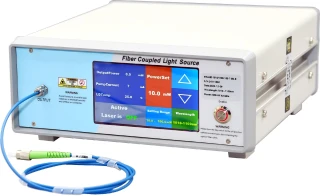
The VLSM‑980‑B offers typical output powers of 9 W and 25 W at 975 nm, with a narrow spectral width and optional wavelength stabilization for applications requiring precise pump wavelength control. A continuously adjustable output power range (with coarse and fine tuning modes) allows users to accurately set and ramp pump levels during system development or characterization. The high‑definition front‑panel LCD simultaneously displays current and voltage, giving immediate visual feedback on operating conditions and making it straightforward to reproduce experimental settings.
Integrated thermoelectric cooling (TEC) maintains the diode at a tightly controlled temperature, typically within ±0.1 °C, across an operating temperature range designed for lab and light industrial environments. This precise thermal management stabilizes both output power and wavelength, which is crucial for consistent coupling efficiency into double‑clad fibers and for maintaining optimal overlap with the absorption band of the gain fiber. Power stability is typically within ±0.5 % over 15 minutes and ±1 % over 8 hours after warm‑up at 25 °C, providing the temporal uniformity needed for long measurement runs and production testing.
The output is delivered through a high‑power multimode fiber (105/125 µm core/cladding with NA=0.15 or 0.22), terminated by an FC/APC connector for low back‑reflection and convenient integration into fiber‑based setups. Standard output fiber length is greater than 1 m, offering flexibility in benchtop layouts and system racks. The benchtop unit features a compact footprint of approximately 335 mm (L) × 280 mm (W) × 150 mm (H), making it suitable for crowded optical tables and test stations where space is at a premium.
In addition to 975 nm operation, related configurations of this platform can be specified at other key pump wavelengths such as 915 nm and 940 nm, supporting different absorption peaks or thermal management strategies for fiber lasers and amplifiers. The VENUS series is thus well suited not only as a primary pump source for double‑clad Yb‑doped fiber lasers, but also as a flexible building block for research on new gain fibers, high‑power amplifier chains, and wavelength‑specific pumping schemes.
Typical use cases for the VLSM‑980‑B include pumping of single‑mode or large‑mode‑area double‑clad fiber lasers, pre‑amplifiers and power amplifiers in MOPA architectures, spectral and temporal characterization of fiber devices, and general test and measurement tasks in advanced fiber photonics laboratories. Its combination of high output power, robust isolation, precise thermal and current control, and convenient benchtop operation makes it a reliable choice for both research environments and manufacturing test lines where high stability and high uptime are critical.
VENUS Series 975nm High Stability Multi-Mode Pump Laser Source
Specifications
| Bandwidth: | 7 nm |
|---|---|
| Center Wavelength: | 975 nm |
| Output Power: | 25000 mW |
| Polarization: | Random |
| Model: | VLSM-980-B |
| Series: | VENUS SERIES |
| Product Type: | 975 nm High Stability Multi-mode Pump Laser Source |
| Typical Output Power Options: | 9 W, 25 W |
| Output Power (min): | 9 W |
| Output Power (typ): | 25 W |
| Output Power Stability (15 Min, Typ): | ±0.1 % |
| Output Power Stability (15 Min, Max): | ±0.5 % |
| Output Power Stability (8 H, Typ): | ±1.0 % |
| Output Power Stability (8 H, Max): | ±2.0 % |
| Peak Operation Wavelength (min): | 970 nm |
| Peak Operation Wavelength (typ): | 975 nm |
| Peak Operation Wavelength (max): | 985 nm |
| Spectral Width FWHM (typ): | 5 nm |
| Spectral Width FWHM (max): | 7 nm |
| Output Isolation (typ): | 30 dB |
| Output Power Tunable Range: | 0–100 % |
| Output Power Tunable Mode: | Coarse/fine |
| TEC Stability (typ): | ±0.1 °C |
| TEC Stability (max): | ±0.2 °C |
| TEC Operating Range (min): | 25 °C |
| TEC Operating Range (max): | 35 °C |
| Operating Voltage (min): | 170 VAC |
| Operating Voltage (max): | 260 VAC |
| Power Consumption (typ): | 100 W |
| Power Consumption (max): | 220 W |
| Operating Temperature (min): | 0 °C |
| Operating Temperature (max): | 50 °C |
| Storage Temperature (min): | -40 °C |
| Storage Temperature (max): | 85 °C |
| Output Fiber Type: | 105/125 μm, NA=0.15 or 0.22 |
| Length Of Output Fiber: | > 1 m |
| Output Fiber Connector: | FC/APC (other options available) |
| Dimension: | 335(L) × 280(B) × 150(H) mm |
| Available Wavelengths (other Options): | 915 nm, 940 nm |
| Isolation Of Backward ASE: | 30 dB |
| Package Options: | B-Benchtop, M-Module |
| Feedback Protection Options: | 0-None, 1-Yes |
Got questions about specs? Use the inquiry form to ask.
 Download Data Sheet

Features
- High Output Power up to 25 W – Delivers robust multi‑mode 975 nm pumping power (typical 9 W and 25 W versions) for driving high‑power double‑clad fiber lasers and fiber amplifiers.
- Optimized 975 nm Pump Wavelength – Peak operation wavelength 970–985 nm (typ. 975 nm) for efficient pumping of Yb‑doped fibers and other 1 µm band fiber lasers.
- Wavelength-Stabilized Options – Optional wavelength‑stabilized configuration (narrow spectral width ~5–7 nm FWHM) ensures consistent pump performance and improved system stability.
- Built‑In 30 dB Optical Isolation – Integrated high‑isolation pump diode design provides ≥30 dB isolation against backward ASE, greatly reducing the risk of feedback‑induced damage to the pump laser diode.
- Excellent Output Power Stability – High stability output with typical short‑term power fluctuation ≤±0.1% (15 min) and long‑term stability ≤±1.0% to ±2.0% over 8 hours at 25 °C after warm‑up.
- Continuously Adjustable Output Power – Wide tuning range (0–100% rated power) with coarse/fine power control mode enables precise pump level adjustment for research, prototyping, and production testing.
- Integrated High‑Resolution LCD Display – Benchtop VENUS series units feature a clear LCD that simultaneously displays pump current and voltage for real‑time monitoring and easier operation.
- Advanced Feedback Protection – Optional feedback protection schemes tailored for different fiber laser and amplifier wavelengths improve device lifetime and safeguard against back‑reflections and ASE.
- High Reliability, Long‑Life Design – Single‑emitter pump diode architecture, precise TEC control, and optimized thermal management (TEC stability typically ±0.1 °C) ensure high reliability in 24/7 operation.
- Wide Operating Temperature Range – Designed for laboratory and light industrial environments with typical operating temperature from +10 °C to +35 °C (storage down to −40 °C), supporting stable performance in real‑world conditions.
- Efficient Thermal Control – Internal thermoelectric cooler (TEC) with tight temperature regulation enhances wavelength and power stability while minimizing drift due to ambient temperature changes.
- Flexible Pump Fiber Output – Uses standard high‑brightness pump fiber (105/125 µm, NA 0.15 or 0.22), enabling efficient coupling into double‑clad active fibers used in most high‑power fiber laser designs.
- FC/APC Pump Output Connector – Standard FC/APC output connector (other connector options available) offers low‑reflection, robust coupling and easy integration with existing fiber laser setups.
- Benchtop and Module Configurations – Available as a benchtop source (VLSM‑980‑B) for laboratory use with front‑panel control, and as a compact module (VLSM‑980‑M) for OEM and system integration.
- Compact Benchtop Footprint – Space‑efficient enclosure (approx. 335 mm (L) × 280 mm (W) × 150 mm (H)) saves valuable optical table or rack space while maintaining easy access to controls and connectors.
- Universal AC Power Input – Operates from standard AC mains (typ. 100–240 VAC) with power consumption tailored to output rating, simplifying deployment in global labs and production lines.
- Application‑Ready for Fiber Lasers & Amplifiers – Designed specifically as a stable multi‑mode pump source for double‑clad fiber lasers, high‑gain fiber amplifiers, and other 1 µm band systems.
- Ideal for Test, Measurement & Spectral Analysis – High stability and adjustable output make the VENUS series suitable for spectral analysis, test and measurement setups, and other precision laboratory experiments.
- Multiple Wavelength Options Available – In addition to 975 nm, alternative pump wavelengths (such as 915 nm and 940 nm) are available on request to match various rare‑earth‑doped fiber systems.
- Custom Pump Protection Solutions – Connet Laser can provide customized feedback isolation and protection configurations for different laser wavelengths and architectures, ensuring optimal system compatibility.
Applications
- Pumping for High‑Power Double‑Clad Fiber Lasers – Primary pump source at 975 nm for Yb‑doped double‑clad fiber lasers used in materials processing, industrial machining, and macro‑/micro‑fabrication.
- Fiber Amplifier Pumping (Yb‑ and Er/Yb‑Doped) – Stable multi‑mode pump for high‑gain Yb‑doped fiber amplifiers and Er/Yb co‑doped amplifiers in systems such as LIDAR, free‑space communication, and high‑power EDFAs.
- Seeded Fiber Laser and MOPA Systems – Pump stage for master‑oscillator power‑amplifier (MOPA) architectures requiring high‑brightness, high‑reliability pump sources with integrated feedback protection.
- High‑Power CW and Quasi‑CW Fiber Sources – Pumping of continuous‑wave and modulated high‑power fiber sources used in welding, cutting, marking, cleaning, cladding, and additive manufacturing.
- Nonlinear Frequency Conversion Pumping – Pump source for frequency‑doubled, frequency‑mixed, and supercontinuum fiber systems where stable, high‑power 975 nm radiation is required to drive nonlinear processes.
- LIDAR and Remote Sensing Fiber Transmitters – Backend pump for high‑energy fiber transmitters used in atmospheric sensing, wind LIDAR, range‑finding, and environmental monitoring.
- Optical Communications Test and Burn‑In – High‑power pump for stress testing, burn‑in, and reliability evaluation of passive and active fiber components (isolators, combiners, WDMs, couplers, connectors, and fiber terminations).
- Spectral Characterization and ASE/Noise Studies – Stable pump for studying amplified spontaneous emission (ASE), gain spectra, and noise characteristics of active fibers and fiber devices in R&D laboratories.
- Fiber Bragg Grating (FBG) Pumped Systems – Pumping of FBG‑stabilized Yb‑doped fiber lasers and narrow‑linewidth oscillators where high optical isolation and wavelength‑stabilized pump options are required.
- High‑Power Pump Combiners and Pump Modules – Source for qualifying pump/signal combiners, multi‑pump modules, and cladding‑pumped assemblies used in industrial fiber laser heads.
- Scientific Research in Nonlinear and Ultrafast Optics – General pump source in laboratories exploring nonlinear effects in fibers, fiber‑based supercontinuum, pulse amplification, and high‑energy ultrafast fiber systems.
- Optical Power Handling and Reliability Testing – High‑stability bench source for long‑term reliability tests, lifetime studies, and thermal management evaluation of high‑power fiber components and coatings.
- Spectroscopy and Pump–Probe Experiments – Pump beam for fiber‑based spectroscopy setups, pump–probe experiments, and broadband source pumping where a robust, user‑controlled high‑power pump is needed.
- Laser Safety and Protection Circuit Development – Reference high‑power diode‑based source with built‑in feedback protection for developing, calibrating, and validating laser safety interlocks and protection electronics.
- Educational and Training Laboratories – Demonstration source in university and technical‑institute labs for teaching high‑power fiber laser design, pump coupling, thermal effects, and fiber handling practices.
- OEM System Integration – Compact module version for integration into OEM fiber laser cabinets, medical laser platforms (where allowed by regulations), and custom photonics instruments requiring reliable 975 nm pumping.
- General Test and Measurement – Versatile laboratory workhorse for characterizing insertion loss, back‑reflection, power handling, and isolation of optical devices over extended periods with high stability.
Frequently Asked Questions
What is the Connet VENUS VLSM-980-B 975 nm high stability multi‑mode pump laser source used for?
What are the key technical specifications of the VENUS 975 nm multi‑mode pump laser source?
How does the VENUS pump laser protect against back‑reflections and ASE damage?
What fiber type and connector does the VENUS 975 nm pump laser use, and can they be customized?
How stable is the output power of the VENUS series, and what conditions are required to achieve the specified stability?
What is the difference between the benchtop and module versions of the VENUS multi‑mode pump laser?
What wavelength and power options are available for the VENUS multi‑mode pump laser, and how do I specify them when ordering?
Got more questions? Use the inquiry form to ask the supplier directly.
Similar Products



Your inquiry has been received.
Create an account by adding a password
Why create an account?
- Auto-complete inquiry forms
- View and manage all your past messages
- Save products to your favorites
- Close your account anytime — no hassle