


Description
The Connet VENUS Series C-Band Tunable Light Source is a high‑performance, laboratory‑grade CW laser designed for demanding applications in coherent communication, fiber‑optic sensing, and precision test and measurement. Built around a C‑band tunable semiconductor laser, it covers the full ITU C‑band from 1528.77 nm to 1567.13 nm (191.3 THz to 196.1 THz), supporting approximately 97 channels with a 50 GHz spacing. This wide tuning span and fine frequency granularity make it an excellent choice for evaluating DWDM components, simulating optical networks, and characterizing advanced photonic devices.
The source delivers narrow‑linewidth operation with a typical full width at half maximum (FWHM) of less than 1 MHz, ensuring high coherence and low phase noise. Such performance is particularly valuable in coherent transmission system development, interferometric sensing, and high‑resolution spectroscopy, where laser coherence directly impacts measurement precision and system sensitivity. Output is provided through polarization‑maintaining fiber with a high polarization extinction ratio, enabling stable polarization‑sensitive experiments and minimizing measurement uncertainty in polarization‑dependent setups.
A key strength of the VENUS C‑Band series is its long‑term output stability. The device integrates carefully engineered automatic power control (APC) and automatic temperature control (ATC) circuits combined with a dedicated high‑stability control architecture. As a result, single‑channel output power stability is maintained within ±0.5 dB over a wide operating temperature range, and long‑term power drift can be controlled to better than 0.1%. This level of stability is comparable to high‑end tunable laser sources used in telecom grade and metrology environments and is essential for repeatable experiments and long‑duration measurements.
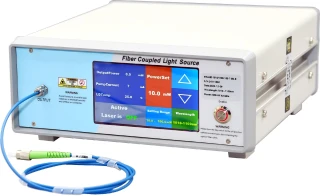
The benchtop version features a clear, high‑definition front‑panel LCD that displays real‑time operating status, including output power, drive current, operating voltage, temperature, wavelength (or frequency), and system state. Users can switch channels and adjust settings via an intuitive front‑panel control knob, making it easy to step through ITU‑grid wavelengths during component characterization or system alignment. For integration into automated setups, a module version and an RS‑232 communication interface option are available, allowing remote configuration and control from laboratory control software or production test platforms.
Designed with flexibility in mind, the system supports a tunable output power range of approximately 6 dBm to 10 dBm, with some configurations capable of exceeding 10 dBm. This power level is well suited to driving passive optical components, testing amplifiers, and serving as an input source for coherent receivers or optical modulators. The source also offers a side‑mode suppression ratio of 40 dB or better and low relative intensity noise, enhancing signal fidelity and measurement accuracy, especially in high‑dynamic‑range optical testing.
From a practical standpoint, the VENUS C‑Band Tunable Light Source is engineered for daily use in research laboratories and industrial environments. The benchtop model operates from a universal 100–240 VAC supply and includes comprehensive protection mechanisms for robust and safe operation. Fast warm‑up, typically within under a minute, allows users to reach stable operating conditions quickly, improving laboratory throughput. High output isolation, on the order of 45–55 dB, protects the internal laser from back‑reflections, which is particularly important when connecting to test setups containing reflective components or interferometric structures.
Compared with typical C‑band tunable lasers used in DWDM testing and coherent system development, the VENUS series balances narrow linewidth, high stability, and user‑friendly operation in a compact footprint. The module configuration is well suited for OEM integration or rack‑mount systems where space and remote control capabilities are critical, while the benchtop configuration serves as a convenient standalone instrument for R&D laboratories and university research facilities. Both share the same core optical performance, ensuring consistent behavior across different deployment scenarios.
Typical application areas include coherent communication system prototyping, where the narrow linewidth and fine frequency control allow accurate evaluation of advanced modulation formats and DSP algorithms. In interference and fiber‑optic sensing systems, the high coherence length and polarization‑maintaining output improve sensitivity and resolution in interferometric measurements. For general optical test and measurement tasks, the tunable C‑band coverage and ITU‑grid compatibility enable comprehensive characterization of filters, multiplexers,
Connet VENUS C Band Tunable Laser Light Source High Stability Benchtop
Specifications
| Bandwidth: | 40 nm |
|---|---|
| Center Wavelength: | 1528 nm |
| Output Power: | 10 mW |
| Polarization: | Random |
| Output Power Tunable Mode: | Coarse / Fine |
| Output Fiber Type (SM): | SMF 9/125um NA=0.13 |
| Output Fiber Type (PM): | PM1550 NA=0.13 |
| Polarization Extinction Ratio (PER): | dB > 17 (PM output fiber) |
| Output Fiber Length: | > 1 m |
| Optical Connector: | FC/APC (other options available) |
| Operating Voltage: | 100-240 V AC |
| Power Consumption: | 20 W |
| Operating Temperature: | 0 to + 50 ℃ |
| Storage Temperature: | -40 to +85 ℃ |
| Dimensions: | 340(L) x 240(W) x 100(H) mm |
Got questions about specs? Use the inquiry form to ask.
 Download Data Sheet

Features
- Wide C-Band Tunability (1528.77–1567.13 nm) – Covers the full C-band with >38 nm tuning range (191.3–196.1 THz), ideal for DWDM, coherent communication, and photonics R&D.
- Fine 50 GHz Channel Spacing with ~97 ITU Channels (C13–C61) – Precisely spaced channels simplify ITU grid experiments, DWDM component testing, and system prototyping.
- Narrow Linewidth Single-Frequency Output (<5 MHz, Typ. <1 MHz) – Ultra-narrow spectral width significantly reduces phase noise, enabling high-coherence applications such as interferometric sensing and coherent detection.
- Highly Stable Output Power (Better than 0.1%) – Long-term output power stability better than 1‰ (±0.5 dB per channel over −5 to +75 °C) ensured by high‑precision APC and ATC control circuits for repeatable, drift-free measurements.
- Fast Wavelength Switching (≤10 ms) – Rapid channel switching shortens test cycles in automated setups, swept-wavelength characterization, and network simulation environments.
- Low Noise and High Signal Purity – RIN down to −145 dB/Hz and SMSR ≥40 dB help minimize measurement uncertainty and crosstalk in dense channel configurations.
- Polarization-Maintaining Fiber Output – PM Panda 8/125 μm fiber with PER >20 dB and FC/APC connector ensures stable polarization state for coherent, interferometric, and polarization-sensitive experiments.
- Tunable Output Power (Up to ≥10 dBm) – Adjustable output from 6 to 10 dBm (with maximum power often exceeding 10 dBm) provides flexibility for device characterization, link testing, and nonlinear optics experiments.
- Intuitive Front-Panel Control with LCD Display – High-definition LCD shows output power, wavelength/frequency, operating current, voltage, temperature, and status; front-panel knob allows quick channel and wavelength selection.
- Remote Control Capability (RS‑232 Optional) – Optional RS‑232 interface enables computer control, scripting, and integration into automated test and measurement systems.
- High-Reliability Design with Built-In Protections – Wide-range 100–240 VAC input, internal protection circuitry, and robust thermal management enhance laser lifetime and system reliability in continuous laboratory operation.
- Fast Warm-Up Time (≤60 s) – Rapid startup (typically 30 s) supports time‑critical experiments and frequent power cycling without long stabilization delays.
- Benchtop and OEM Module Configurations – Available as a convenient plug-and-play benchtop unit (320 × 280 × 150 mm) or compact module (90 × 70 × 15 mm) for easy integration into racks, systems, and instruments.
- Optimized for Advanced Photonics Applications – Engineered for coherent communication systems, interference and fiber sensing, test and measurement setups, and general optical research labs.
- Field-Proven VENUS Series Platform – Based on Connet’s VENUS series C-band tunable semiconductor laser technology, widely used in optical communications and photonics research for its stability and performance.
Applications
- Coherent Optical Communication System Development – Ideal C-band tunable laser source for coherent transmission experiments, high‑capacity DWDM links, and advanced modulation format research (QPSK, QAM, OFDM) requiring narrow linewidth (<1 MHz) and high OSNR.
- DWDM System Design, Alignment, and Qualification – Used as a precisely tunable ITU‑grid source (50 GHz spacing, ~97 channels from C13–C61) for DWDM channel characterization, wavelength routing verification, and multiplexer/demultiplexer alignment and testing.
- Optical Component Characterization (Filters, AWGs, WSS, OADMs) – Suitable for testing transmission spectra, insertion loss, passband shape, and isolation of optical filters, arrayed waveguide gratings, wavelength‑selective switches, ROADMs, and other C‑band wavelength management components.
- Fiber Optic Interferometry and Coherent Sensing – Narrow linewidth and high stability enable deployment as a coherent source in Mach‑Zehnder, Michelson, Sagnac, and other fiber interferometers for phase‑sensitive sensing and metrology.
- Distributed Acoustic and Vibration Sensing (DAS/DVS) – Provides a low‑noise, coherent C‑band source suitable for phase‑sensitive OTDR‑based acoustic sensing along pipelines, perimeters, civil structures, and downhole environments.
- Fiber Bragg Grating (FBG) and WDM Sensor Interrogation – Used as a tunable probe laser for FBG, long‑period grating, and other wavelength‑encoded sensors in structural health monitoring, temperature and strain measurement, and distributed sensing systems.
- Optical Coherence Tomography (OCT) and Low‑Coherence Interferometry Research – Applicable as a stable C‑band source for swept‑wavelength and coherent imaging setups in laboratory OCT prototypes and biomedical optics research.
- Test and Measurement of EDFAs and Optical Amplifiers – Serves as a reference tunable signal for characterizing erbium‑doped fiber amplifiers and Raman amplifiers: gain spectrum measurement, noise figure evaluation, saturation behavior, and transient response testing.
- Optical Network Simulation, Emulation, and Lab Prototyping – Enables flexible generation of any C‑band ITU channel for prototyping next‑generation optical networks, flex‑grid systems, line systems, and transponder/ROADM testbeds.
- Laser Frequency and Wavelength Calibration – High wavelength/frequency accuracy (±1.5 to ±2.5 GHz) and fine ITU‑grid tunability make it suitable as a reference source for calibrating optical spectrum analyzers, wavemeters, and other metrology instruments.
- Polarization‑Maintaining System Testing – PM fiber output with high PER (>20 dB) supports characterization of polarization‑maintaining components, polarization controllers, PM couplers, and polarization‑sensitive devices and sensors.
- Nonlinear Fiber Optics and Photonics Experiments – Used as a seed in experiments involving four‑wave mixing, parametric amplification, supercontinuum generation, and other nonlinear effects in highly nonlinear fibers, integrated waveguides, and photonic crystal fibers.
- Integrated Photonic Circuit and Silicon Photonics Testing – Provides a tunable, narrow‑linewidth source for characterizing silicon photonics and InP photonic integrated circuits: ring resonators, MZ modulators, filters, switches, and other on‑chip optical functions.
- Optical Heterodyne and Homodyne Detection – Suitable as a local oscillator or signal laser in heterodyne/homodyne receivers and coherent detection setups due to its single‑frequency behavior, low RIN (≈‑145 dB/Hz), and fine frequency control.
- Quantum Optics and Quantum Communication Research – Stable C‑band single‑frequency laser source for quantum key distribution (QKD) testbeds, entanglement distribution experiments over fiber, and other quantum communication system prototyping.
- Phase‑Locked Laser and Frequency Comb Experiments (Seed Source) – Can act as a reference or seed laser for frequency‑locking experiments, optical phase‑locked loops, and for seeding frequency combs or OFDM multi‑carrier generators in the C‑band.
- Optical Sensor Network and IoT Infrastructure Testing – Facilitates the evaluation and calibration of fiber‑based sensor networks used in smart infrastructure, smart grids, transport monitoring, and environmental sensing operating in the C‑band.
- Educational and Research Laboratories – Robust, plug‑and‑play benchtop platform for universities, research institutes, and industrial labs teaching optical communications, photonics, and precision metrology, where reliable, long‑term stable C‑band sources are re
Frequently Asked Questions
What is the Connet VENUS series C-Band Tunable Light Source and what are its key specifications?
How stable is the output of the VENUS C-Band tunable laser compared to typical C-band tunable sources?
What applications is the Connet VENUS C-Band tunable light source suitable for?
How is the wavelength tuned and what is the tuning performance (channels, accuracy, speed)?
What is the difference between the benchtop (VLSP-C-B-TL) and module (VLSP-C-M-TL) versions?
How is the polarization handled and what type of output fiber is provided?
What are the power, temperature, and environmental operating conditions for the VENUS C-Band tunable source?
Got more questions? Use the inquiry form to ask the supplier directly.
Similar Products



Your inquiry has been received.
Create an account by adding a password
Why create an account?
- Auto-complete inquiry forms
- View and manage all your past messages
- Save products to your favorites
- Close your account anytime — no hassle