


Description
The VENUS series C+L band ASE broadband light sources from Connet are high‑performance benchtop systems designed for demanding applications in optical test and measurement, fiber sensing, and photonics research. Based on an optimized Erbium‑doped fiber laser architecture, these sources deliver a wide C+L band emission from 1528 nm to 1602 nm with high output power up to 200 mW. The system is engineered to provide extremely stable output over the full operating temperature range, making it suitable for both laboratory environments and production test lines where repeatability and reliability are critical.
Unlike simple LED or SLED-based solutions, the VENUS C+L band ASE source is optimized for spectral performance, offering a typical full-width at half maximum (FWHM) spectral width of about 74 nm. This broad and continuous spectrum is ideal for applications such as component characterization, spectral analysis, and fiber-optic gyroscope testing, where a smooth, low‑ripple spectral profile is essential. The source is available in both standard and flattened spectral flatness versions, with the flattened option achieving excellent uniformity across the band, with flatness as good as 2.5–3.5 dB, which compares favorably with many high-end ASE broadband sources used in metrology and DWDM component testing.
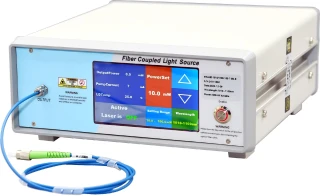
The benchtop unit incorporates a high-definition LCD interface that simultaneously displays key operating parameters such as current, voltage, and output power. This real-time visibility, combined with coarse and fine output power adjustment from 0–100%, allows users to precisely set and monitor the desired operating point. Output powers are configurable, with typical options of 10 mW, 20 mW, 50 mW, 100 mW, and 200 mW, making it straightforward to match the source to specific test setups, whether for low‑power component evaluation or high‑power system‑level testing. Power stability is tightly controlled, with short-term stability on the order of ±0.5% over 15 minutes and long-term stability typically around ±2% over 8 hours after warm‑up, positioning it in line with advanced ASE platforms used in precision fiber sensing and coherent detection research.
To support diverse deployment needs, the VENUS series is offered in both single-mode (VASS-CL) and polarization‑maintaining (VASP-CL) configurations. The PM version features a high polarization extinction ratio, making it suitable for polarization‑sensitive systems such as interferometric fiber sensors and optical gyroscopes. The output is delivered through SMF or PM1550 fiber with standard FC/APC connectors, and other connector options can be specified as required. With an output isolation of 30–35 dB, the source is well protected against back reflections, which enhances long-term stability and reliability in complex optical setups that may include circulators, couplers, and reflective components.
From a system integration perspective, Connet also provides a compact module package in addition to the benchtop format, enabling OEMs and system designers to embed the C+L band ASE source directly into larger platforms such as fiber sensing interrogators, optical coherence domain reflectometers, or automated test equipment. Operating from a universal 100–240 VAC input and consuming up to 20 W in the most demanding conditions, the unit is optimized for continuous operation in typical laboratory and factory environments, with an operating temperature range from 0 to +50 °C and extended storage from −40 to +85 °C. Taken together, the VENUS series C+L band ASE light source is a robust, spectrally broad, and highly stable solution that competes with leading global broadband sources, offering an excellent balance of power, flatness, and reliability for advanced optical research and industrial testing.
C-Band ASE Broadband Light Source
Specifications
| Bandwidth: | 33 nm |
|---|---|
| Center Wavelength: | 1550 nm |
| Output Power: | 200 mW |
| Polarization: | Random |
| Spectral Flatness (Standard): | 7 dB |
| Spectral Flatness (Gain Flatness): | 1-1.5 dB |
| Output Isolation: | 30-35 dB |
| Power Consumption: | 30 W |
| Output Fiber Length: | >1 m |
| Polarization Extinction Ratio (PER): | >17 dB |
| Output Fiber Type (PM): | PM1550 NA=0.13 |
| Output Fiber Type (Single Mode): | SMF 9/125um NA=0.13 |
| Stability Of Output Power: | ±0.5 % |
| Operating Temperature: | 0 to +50 ℃ |
| Storage Temperature: | -40 to +85 ℃ |
| Dimension: | 340(L)×240(W)×100(H) mm |
Got questions about specs? Use the inquiry form to ask.
 Download Data Sheet

Features
- Wide C+L Band Emission (1528–1602 nm) – Broadband ASE output covering both C-band and L-band enables use in DWDM component testing, fiber communication R&D, and spectrum analysis with a single source.
- High Output Power up to 200 mW – Adjustable output power from 10 mW to 200 mW (typical options: 10, 20, 50, 100, 200 mW) supports demanding applications such as optical fiber gyroscopes, sensor interrogation units, and high‑loss component characterization.
- Exceptional Spectral Flatness (< 3.5 dB)
- Flattened version: spectral flatness typically < 2.5 dB (max 3.5 dB) over the C+L band for highly uniform spectral power density.
- Standard version: typical flatness < 6 dB (max 7 dB), suitable for general broadband testing and spectroscopy.
- Ensures low power variation across channels in DWDM/Optical component analysis and fiber sensing systems.
- Low Ripple, Low Noise ASE Source – Optimized Er-doped fiber design delivers smooth spectral output with low ripple, improving measurement accuracy in optical spectrum analyzers and interferometric systems.
- High Output Stability
- Short-term stability (15 min): typically ±0.5%, max ±1.0%.
- Long-term stability (8 h): typically ±2.0%, max ±5.0%.
- Excellent stability over the full operating temperature range via closed-loop power control, ideal for long-duration tests and production environments.
- Continuously Tunable Output Power (0–100%)
- Full 0–100% output power adjustment range for flexible test conditions.
- Coarse/Fine adjustment modes allow both rapid setting and precise optimization of output levels.
- Single-Mode or Polarization-Maintaining Output
- SM version (VASS-CL-B): SMF 9/125 μm, NA=0.13 for standard telecom and general laboratory use.
- PM version (VASP-CL-B): PM1550 fiber, NA=0.13 with PER > 17 dB for polarization-sensitive measurements and coherent systems.
- High Output Isolation ≥ 30 dB – Built-in optical isolator (typ. 35 dB) effectively suppresses back-reflections from DUTs, protecting the internal EDFA and enhancing long-term reliability.
- High Reliability for 24/7 Operation
- Based on mature Erbium-doped fiber amplifier technology designed for continuous operation.
- Robust design suitable for both scientific research labs and production test lines.
- Benchtop Instrument with High-Definition LCD
- Real-time display of output power, current, and voltage for intuitive monitoring.
- Front-panel user interface for fast setup and easy operation in test benches.
- Optional Compact Module Version for Integration
- Available as a module package (M type) for OEM and system integration.
- Ideal for embedding in fiber sensing interrogators, gyroscope systems, and optical communication test platforms.
- Low Power Consumption & Wide AC Input
- Max power consumption: ≤ 20 W even at extreme temperatures.
- AC input: 100–240 VAC for worldwide compatibility in lab and factory environments.
- Wide Operating Temperature Range
- Operating: 0 to +50 °C – suitable for standard lab and industrial environments.
- Storage: –40 to +85 °C – supports secure transport and warehouse conditions.
- Compact, Robust Benchtop Footprint
- Dimensions: 340 (L) × 240 (W) × 100 (H) mm – fits easily on crowded optical benches or in racks.
- Sturdy housing designed for frequent use in measurement setups.
- Flexible Fiber and Connector Options
- Standard output fiber length ≥ 1 m for convenient routing on optical tables.
- Standard connector: FC/APC, with other connector types available on request for compatibility with existing test infrastructure.
- Optimized for Key Applications
- Component testing: broadband characterization of filters, multiplexers, AWGs, WDM components, and passive optical devices.
- Optical fiber sensing systems: FBG interrogation, distributed sensing (DAS/DTSS/DTGS), and structural health monitoring.
- Spectrum analysis: reference source for OSAs, spectral response measurements, and optical device R&D.
Applications
Applications of C+L Band ASE Broadband Light Source (Connet VENUS Series)
The Connet VENUS series C+L band ASE broadband light sources are high-power, low-ripple, and spectrally flat benchtop and module systems. Leveraging optimized Er-doped fiber technology, they provide a wide 1528–1602 nm emission band with up to 200 mW output, making them ideal for demanding laboratory, industrial, and system-integration environments.
- Optical Component Testing and Characterization
- Broadband source for testing insertion loss, return loss, and spectral response of WDM components, couplers, splitters, filters, and isolators.
- Qualification of C-band, L-band, and C+L band components such as AWGs, DWDM filters, FBGs, and ROADMs.
- Linear and nonlinear optical device evaluation under stable, flat spectrum illumination.
- Optical Fiber Sensing Systems (Distributed and Point Sensors)
- Interrogation light source for FBG (Fiber Bragg Grating) sensor arrays used in strain, temperature, pressure, and vibration monitoring.
- Suitable for distributed sensing techniques (e.g., OTDR- and OFDR-based systems) operating in the C+L band.
- Structural health monitoring in civil engineering (bridges, tunnels, dams, pipelines) and energy infrastructure.
- High-stability source for long-term field-deployed fiber sensor networks.
- Spectrum Analysis and Optical Testing Laboratories
- Broadband “white light” source for use with optical spectrum analyzers (OSAs) and tunable filters.
- Characterization of spectral responses, passbands, and insertion loss across the full C+L telecom windows.
- Reference source for calibrating and validating spectral test setups in R&D and metrology labs.
- Optical Fiber Gyroscopes (FOG) and Interferometric Systems
- Low-coherence ASE source ideal for fiber optic gyroscopes to reduce coherent backscattering and polarization-related errors.
- Used in Sagnac interferometers and other interferometric rotation and navigation sensors.
- Applicable in aerospace, defense, robotics, and inertial navigation platforms where high stability and reliability are critical.
- Optical Communications and Network Simulation
- Emulation and testing of DWDM and CWDM systems in the C and L bands.
- System margin testing, OSNR characterization, and filter shape verification for optical transport equipment.
- Channel loading source for simulating multi-channel traffic in coherent and IM/DD communication systems.
- Validation of EDFAs, Raman amplifiers, ROADMs, and other network elements under broadband input conditions.
- Passive Component Production and Manufacturing Test
- Inline test source for high-throughput manufacturing of PLC splitters, couplers, and filters.
- Quality control for C+L band devices, including mux/demux modules, WSS, and optical add-drop modules.
- Benchtop configuration for lab verification; module configuration for automated production lines and test stations.
- Photonic Integrated Circuit (PIC) and Silicon Photonics Characterization
- Broadband excitation for silicon photonics devices, InP-based integrated circuits, and hybrid photonic platforms.
- Measurement of waveguides, ring resonators, MZI filters, multiplexers, and integrated FBGs operating from 1528–1602 nm.
- Useful in university and industrial research cleanrooms for process development and device validation.
- Optical Coherence Tomography (OCT) and Low-Coherence Applications (C/L Band)
- Source option for specialized telecom-band OCT and low-coherence interferometry setups.
- Suitable for research-oriented OCT systems requiring a broadband, relatively flat spectrum in the 1.5–1.6 µm range.
- Evaluation of optical materials, waveguides, and coatings using low-coherence interferometry in the C+L band.
- Material and Device Spectroscopy in the 1.5–1.6 µm Region
- Absorption and reflection spectroscopy of optical materials, components, and coatings at telecom wavelengths.
- Characterization of rare-earth-doped fibers, nonlinear fibers, and specialty fibers (e.g., photonic crystal fibers).
- Research into wavelength-dependent properties of photonic devices and sensors in the C+L band.
- Polarization-Maintaining and Single-Mode Fiber System Integration
- Use as a stable ASE source with SMF or PM fiber for polarization-sensitive experiments.
Frequently Asked Questions
What is the VENUS series C+L Band ASE Broadband Light Source and what are its main applications?
What are the key optical performance specifications of this C+L band ASE source?
How stable is the output power and how is it controlled?
What package types, fiber types, and connectors are available for system integration?
How do I interpret and use the ordering code for the VENUS C+L Band ASE source?
Is the VENUS C+L band ASE source suitable for fiber sensing and DWDM/telecom component testing?
What power, environmental, and mechanical conditions are required for reliable operation?
Got more questions? Use the inquiry form to ask the supplier directly.
Similar Products



Your inquiry has been received.
Create an account by adding a password
Why create an account?
- Auto-complete inquiry forms
- View and manage all your past messages
- Save products to your favorites
- Close your account anytime — no hassle