


Description
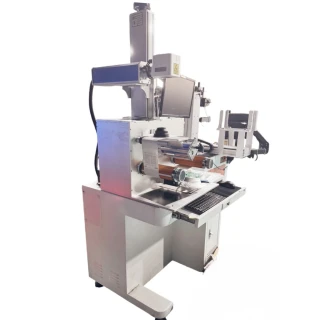
The VIPIN-4545AT-03 is a high-speed PCB laser marking machine (1064 nm fiber laser) designed for inline SMT production and industrial traceability. Optimized for metal and coated PCB surfaces, it delivers permanent, high-contrast marking of QR codes, barcodes, and serial data without consumables, significantly reducing operating costs and improving production efficiency.
Built around a high-speed galvanometer scanning system, the machine achieves marking speeds up to 7000 mm/s with repeatability of ±0.02 mm, ensuring consistent, high-resolution output in high-volume manufacturing environments. With typical marking times of ~6 seconds per PCB and throughput up to 360 units per hour, it is well suited for large-scale electronics production lines.
The 1064 nm fiber laser source is particularly effective for marking metals such as copper, aluminum, stainless steel, and plated surfaces, making it ideal for PCB components, shielding covers, and electronic assemblies. Compared to UV systems, fiber lasers offer higher speed, lower cost of ownership, and longer operational lifetimes (≥50,000 hours), making them the preferred solution for high-throughput industrial applications.
The system integrates seamlessly with SMT production lines and MES platforms, enabling automated traceability, real-time data management, and intelligent manufacturing workflows. Advanced support for QR codes, DataMatrix, and industrial barcode formats ensures compatibility with modern electronics traceability standards.
High-Speed PCB Laser Marking Machine (1064 nm Fiber Laser)
Specifications
| Work Area X: | 450 mm |
|---|---|
| Work Area Y: | 450 mm |
| Beam Delivery: | Galvo |
| Laser Source: | Fiber |
| Laser Output Power: | 20 W |
| Laser Wavelength: | 1064 nm (IR) |
| Marking Speed: | 7000 mm/sec |
| Voltage Requirement: | 220V - 50Hz |
| Materials: | Stainless Steel, Steel/Iron, Steel Alloy, Aluminum, Anodized Aluminum, Brass, Copper, Gold, Silver, Nickel, Titanium, Platinum, Glass, Plastic, Wood, Paper, Textile, Granite, Marble, Nylon, Acrylic, Plexiglass |
| Air Assist: | Included |
| Fume Extraction Unit: | Included |
| Safety Enclosure: | Included |
| Laser Type: | UV/CO2/GREEN/Fiber |
| Laser Power: | 5W/10W/5W/20W |
| Output Fluctuation Rate: | <3% |
| Laser Wavelength: | 355nm/10640nm/532nm/1064nm |
| Laser Cooling Method: | WaterCooling/Air Cooling/Air Cooling/Air Cooling |
| Minimum Point Diameter: | 0.13mm |
| Engraving Angle: | 0-360° |
| Repeat Accuracy: | ±0.02mm |
| XY Axis Movement Speed: | 0-500mm/s |
| QR Code Size (minimum): | 1.5mm×1.5mm |
Got questions about specs? Use the inquiry form to ask.
 Download Data Sheet

Features
- High‑Speed, High‑Throughput PCB Laser Marking – Optimized for SMT/PCB production lines with an average marking time of ~6 seconds per board, achieving up to 360 components per hour and an annual output of approximately 2.376 million boards per system. Ideal for medium‑to‑high volume electronics manufacturing.
- Powerful Cost Reduction vs. Labeling – Replaces traditional high‑temperature labels (e.g., 10×10 mm and 15×40 mm labels) and associated labor:
- Eliminates label consumables (no paper labels, no adhesives, no backing waste).
- Typical factories can avoid label expenses approaching ¥1,975k and manual labor costs around ¥540k over 5 years.
- Overall 5‑year cost for labels + labor (~¥2,515k) can be dramatically reduced by investing in just 4 sets of VIPin‑4545AT (~¥1.1 million).
- Permanent, Non‑Contact, High‑Contrast Marking – Laser marking is permanent and indelible, unlike stickers which can drop off, peel, or burn:
- No ink, no labels, no solvents – pure laser process.
- Marks will never disappear under normal PCB handling and reflow conditions.
- Ideal for harsh environments, high‑temperature applications, and long‑life electronics.
- Ultra‑Fine Marking for Miniaturized Codes – Engineered for small, dense PCBs and miniaturized identifiers:
- Minimum point diameter: 0.13 mm (130 µm) for crisp, fine lines.
- Line width accuracy: as small as 0.04 mm depending on laser source and material.
- Minimal QR code size: down to approximately 0.8 × 0.8 mm (laser dependent); system spec supports QR codes as small as 1.5 × 1.5 mm for reliable reading in production.
- Supports micro codes for dense layouts and tiny PCB real estate (e.g., 60× 2 × 2 mm or 60× 0.8 × 0.8 mm codes on a panel).
- Flexible Multi‑Laser Platform (UV / CO2 / Green / Fiber) – One platform compatible with several industrial laser types to match different PCB materials and surface finishes:
- UV Laser (5 W, 355 nm) – Ultra‑fine, high‑contrast marking for solder mask, white ink, green/black/blue/red oil, and sensitive substrates with minimal thermal damage.
- CO₂ Laser (10 W, 10,640 nm) – Excellent for marking organic coatings, resins, and certain label materials when used; ideal for contrast on some solder masks.
- Green Laser (5 W, 532 nm) – Optimized for materials that absorb better at visible wavelengths; strong contrast on special coatings and metals such as reinforcement steel sheets and shielding covers.
- Fiber Laser (20 W / 30 W, 1064 nm) – Suitable for marking metals, shields, hardware parts, and metal‑reinforced PCBs.
- Output fluctuation < 3% on all sources for stable, repeatable marking quality.
- Long Laser Lifespan & Low Maintenance – Designed for 24/7 industrial environments:
- CO₂ and Fiber Lasers: typical lifespan ≥ 50,000 hours.
- UV and Green Lasers: typical lifespan ≥ 15,000 hours.
- Industrial‑grade components (e.g., American Inno / Shenzhen RFH UV lasers, American Synrad CO₂, Maiman / GR green, German IPG / MAX fiber) ensure reliability, stable output, and low service cost.
- Precise Positioning & High Repeatability – Engineered for demanding electronics traceability:
- Engraving angle: 0–360° for flexible code orientation and layout.
- Repeat accuracy: ±0.02 mm for consistent code placement on small pads and crowded PCB areas.
- XY‑axis movement speed: up to 500 mm/s, balancing speed and precision for multi‑code or multi‑board panels.
- Versatile Online & Offline Configurations – Adapts to different PCB manufacturing workflows:
- Online automatic model: installed at the front of the SMT/PCB production line for continuous flow, in‑line marking.
- MES connectivity: supports integration into MES/ERP systems for intelligent traceability, real‑time data capture, and production analytics.
- Offline model for bare boards: ideal for standalone PCB fabrication lines before component mounting.
- Offline model for assembled boards: marks PCBs that already have components, with careful focus and fixture design.
Applications
Applications of VESHAY VIPin – 4545AT PCB Laser Marking Machine
The VESHAY VIPin – 4545AT PCB Laser Marking Machine is designed for high‑volume, high‑precision, non‑contact marking of PCBs and electronic components. It supports UV, CO2, Green, and Fiber laser sources, making it suitable for a wide variety of board materials, solder mask colors, and production environments. Below is an SEO‑optimized, clearly structured list of typical and advanced applications.
1. PCB Identification and Traceability Marking
- QR code and Data Matrix marking on bare PCBs for complete board traceability from fabrication to final assembly.
- Marking on PCBs with green, white, black, blue, and red solder mask (oil) with high contrast and excellent readability.
- Serial numbers, batch numbers, and lot codes for production tracking, recall management, and process control.
- Micro QR code and Micro Data Matrix codes for very small PCBs and dense layouts where space is highly constrained.
- Barcodes (CODE39, CODE128, ITF, NW‑7, JAN/EAN, UPC) on panels, single boards, and sub‑assemblies.
- Alphanumeric text marking (English upper‑ and lower‑case) for product names, model numbers, and internal coding.
2. High‑Temperature and Harsh‑Environment Marking
- Permanent replacement of high‑temperature labels used in SMT and reflow processes, eliminating label and adhesive failures.
- Laser marking on boards that pass through multiple reflow cycles without fading, peeling, or degradation.
- Marking on PCBs for automotive, aerospace, and industrial electronics where long‑term durability and environmental resistance are critical.
- Identification on boards exposed to conformal coating, cleaning, and chemical processes while maintaining code readability.
3. Online Automatic PCB Marking in SMT Production Lines
- In‑line PCB laser marking at the front end of SMT lines, synchronized with conveyors and loaders.
- Continuous online marking of single PCBs and panelized boards before solder paste printing or component placement.
- MES integration and intelligent traceability – automatic generation and upload of unique IDs, QR codes, and production data.
- Code verification and reading after marking using integrated or external vision systems for closed‑loop quality control.
- High throughput marking for mass production (millions of boards per year) while minimizing downtime and operator intervention.
4. Offline Marking for Assembled and Bare Boards
- Offline marking of populated PCBs (assembled boards with components) where in‑line integration is not possible or practical.
- Offline marking of bare boards before storage, kitting, or delivery to assembly subcontractors.
- Re‑marking or additional marking for rework, repair, and after‑sales service tracking.
- Small‑batch, prototype, and NPI (new product introduction) marking where flexible programming and quick changeover are needed.
5. High‑Resolution Micro Marking
- Micro‑scale QR codes and barcodes down to approximately 0.8 × 0.8 mm (depending on laser type) for compact electronics and wearables.
- Fine line marking down to tens of microns for dense PCB designs, fine‑pitch components, and miniaturized modules.
- High‑precision logos, symbols, and regulatory marks on limited surface areas without damaging copper, pads, or components.
- Marking of tiny fields on shielding cans and reinforcement plates while keeping edges clean and crisp.
6. Marking on Metal and Non‑Metal Electronic Components
- Marking on shielding covers, RF shields, and reinforcement steel sheets used on PCB assemblies.
- Identification on metal brackets, frames, and heat sinks associated with PCB assemblies.
- Marking on certain plastic parts, connectors, and housings used in electronic devices (depending on material and chosen laser source).
- Component‑level identification for modules, sub‑assemblies, and plug‑in boards for improved logistics and maintenance.
Frequently Asked Questions
What is the VESHAY VIPIN-4545AT PCB laser marking machine and what is it used for?
How does the VIPIN-4545AT PCB laser marking machine work and what laser types are available?
What is the minimum QR code size and marking precision of the VIPIN-4545AT?
How fast is PCB laser marking compared to using high‑temperature labels?
How does the total cost of laser marking compare to using high‑temperature PCB labels?
Can the VIPIN-4545AT be integrated into an SMT production line and connected to MES for traceability?
What are the main reliability and maintenance considerations for the VIPIN-4545AT PCB laser marker?
Got more questions? Use the inquiry form to ask the supplier directly.
Similar Products


Your inquiry has been received.
Create an account by adding a password
Why create an account?
- Auto-complete inquiry forms
- View and manage all your past messages
- Save products to your favorites
- Close your account anytime — no hassle