
Description
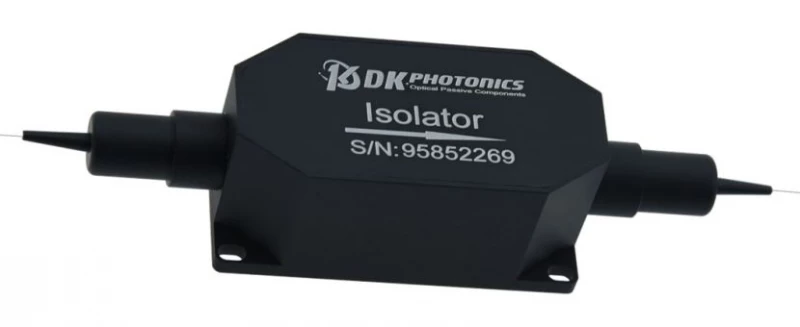
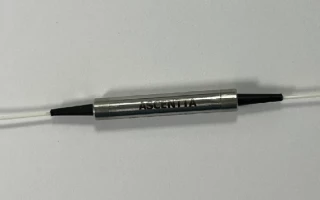
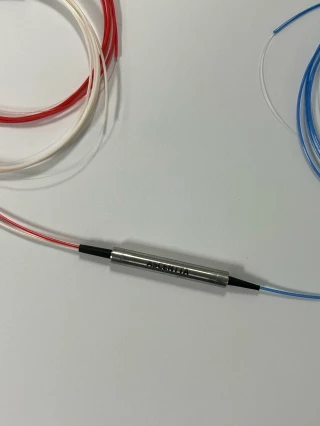
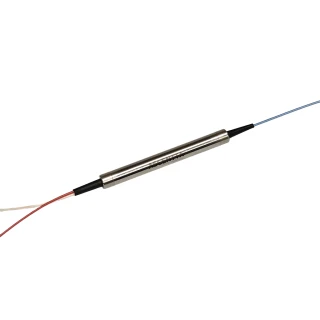
The 850nm TGG-based optical isolator is a high-performance fiber optic component designed to suppress back reflections and prevent destabilizing optical feedback in laser and photonic systems. Using Terbium Gallium Garnet (TGG) magneto-optic technology and the Faraday effect, the isolator enables unidirectional light propagation while maintaining low insertion loss and high isolation. These devices are widely used in fiber lasers, optical communication systems, biomedical instrumentation, spectroscopy, sensing, and precision photonics applications operating near the 850 nm wavelength range.
The TGG Based Optical Isolator is characterized with low insertion loss, high isolation, high return loss, excellent environmental stability and reliability. It has been widely used in lasers, transmitters and other fiber optics communication equipment to suppress back reflection and back scattering.
DK Photonics offers a large selection of polarization insensitive or polarization maintaining fiber-in to fiber-out isolators. These devices can handle powers rang from 300mW to 150W or other on request, and have center operating wavelengths ranging from 500nm to 2100nm.
If you do not see a standard isolator that meets your needs, we welcome the opportunity to review your desired specification and quote a custom isolator. Requests for custom fiber pigtails, different wavelengths and handling power of operation or other specific needs will be readily addressed.
Why Use Fiber Optical Isolators?
Optical isolators are critical components in fiber optic and laser systems because they prevent reflected light from traveling backward into sensitive optical sources. Unwanted back reflections can destabilize lasers, introduce noise, reduce signal quality, and damage optical components.
Key Benefits
Protect laser diodes and fiber lasers
Suppress back reflections and back scattering
Improve system stability
Reduce optical noise
Maintain signal integrity
Enhance measurement accuracy
Increase reliability in high-performance photonic systems
Optical isolators based on the Faraday effect are widely used across telecommunications, fiber lasers, sensing, and instrumentation applications.
What is TGG (Terbium Gallium Garnet)?
TGG (Terbium Gallium Garnet) is a magneto-optic crystal commonly used in high-performance optical isolators and Faraday rotators. TGG materials exhibit strong Faraday rotation, excellent optical transparency, high laser damage thresholds, and good thermal stability, making them ideal for optical isolation applications in visible and near-infrared laser systems.
TGG-based isolators are widely used for high-power laser and fiber optic applications because of their stability and reliable optical performance.
How Fiber Optical Isolators Work
Fiber optical isolators use the non-reciprocal Faraday effect to allow light to pass in only one direction. Internally, polarized light passes through a Faraday rotator that rotates the polarization state regardless of propagation direction. Combined with polarizers or birefringent elements, this design suppresses reverse-propagating light while maintaining forward transmission.
This non-reciprocal behavior helps prevent optical feedback into lasers and sensitive photonic components.
850nm TGG Based Optical Isolator
Specifications
| Type Of The Device: | Isolator |
|---|---|
| Operating Wavelength: | 850 nm |
| Max Power: | 10 W |
| Min Isolation: | 25 dB |
Got questions about specs? Use the inquiry form to ask.
 Download Data Sheet

Features
- Optimized for 850 nm Wavelength – TGG-based optical isolator precisely designed for a central wavelength of 850 nm with an operating bandwidth of ±10 nm, ideal for common 850 nm laser diode and VCSEL applications.
- High Isolation for Superior Back-Reflection Suppression – Provides a typical peak isolation of 30 dB and a minimum isolation of 25 dB in band (at 23°C), effectively blocking backward-propagating light to protect sensitive laser sources and stabilize system performance.
- Low Insertion Loss for Maximum Throughput – Features typical insertion loss of 1.0 dB and maximum 1.5 dB at 23°C, ensuring high optical power transmission and improved overall link budget in demanding fiber optic systems.
- Low Polarization Dependent Loss (PDL) – PDL as low as 0.15 dB (for SM fiber) delivers stable performance in systems where polarization effects can impact signal quality, making it suitable for precision test, measurement, and communication setups.
- High Return Loss – A minimum return loss of 45 dB reduces back-reflections into the source, improving laser stability and signal fidelity in high-performance optical networks and laser systems.
- TGG (Terbium Gallium Garnet) Faraday Rotator Technology – Utilizes high-quality TGG crystal for the Faraday rotator, providing high Verdet constant, low absorption, and excellent thermal and optical stability, outperforming many conventional isolator materials at 850 nm.
- High Power Handling Capability – Standard designs support power handling from hundreds of milliwatts up to multi‑watt levels, with custom versions available up to tens of watts or higher, enabling use in high‑power fiber lasers and optical amplifier systems.
- Polarization-Insensitive or PM Configurations – Available in polarization-insensitive or polarization-maintaining (PM) versions, allowing integration into both standard single-mode links and polarization-critical applications such as coherent detection or sensing.
- Fiber-In / Fiber-Out Design – Fully pigtailed, fiber-to-fiber isolator for simple in-line installation in fiber optic networks, laser setups, and instrumentation without the need for free-space alignment.
- Broad Fiber and Connector Options – Supports SM, PM, and specialty fibers (e.g., 780-HP and other common 850 nm fibers) with options for 0.9 mm loose tube, 2.0 mm or 3.0 mm jackets and standard connectors such as FC/PC, FC/APC, SC/PC, SC/APC, LC, or bare fiber on one or both ports.
- Excellent Environmental Stability and Reliability – Engineered for low thermal drift, long-term stability, and robust performance over a wide operating temperature range, suitable for laboratory, industrial, and field-deployed systems.
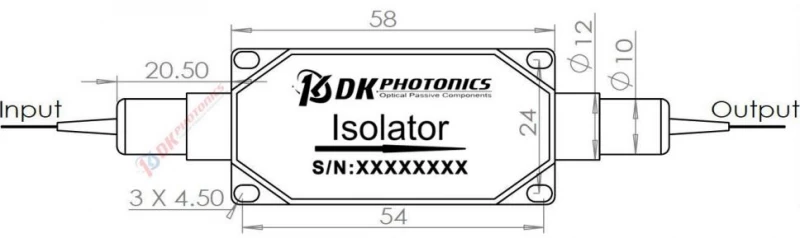
- Compact, Rugged Package – Small-form-factor hermetic or semi-hermetic package designed for easy integration into OEM modules, benchtop instruments, and fiber laser cavities. Package dimensions can be specified and confirmed for tight mechanical envelopes.
- Ideal for 850 nm Fiber Lasers and Amplifiers – Perfect for fiber optic amplifiers, fiber lasers, and VCSEL-based 850 nm transmitters, minimizing feedback-induced noise and mode hopping while enhancing power stability.
- Suitable for Test, Measurement, and Instrumentation – Stable, low-loss performance makes it well-suited for test and measurement setups, interferometers, optical coherence systems, OTDRs, and general photonics instrumentation operating around 850 nm.
- Cost-Effective Performance – Combines high isolation, low loss, and robust construction at a competitive cost, offering an excellent price-to-performance ratio for OEM and research users.
- Customizable Specifications – DK Photonics supports extensive customization, including special wavelengths (500–2100 nm range), higher power handling, custom fiber types, pigtail lengths, connector configurations, and packaging, enabling optimized solutions for unique applications.
- Global Support and Engineering Collaboration – Backed by DK Photonics’ experienced engineering team, enabling rapid prototyping, volume production, and application-specific design support for integrators and system des
Applications
Applications of 850nm TGG Based Optical Isolator
- 850 nm Fiber Lasers and Laser Diodes – Protection of 850 nm laser diodes and solid‑state/fiber lasers from back‑reflections in industrial, medical, and scientific systems.
- Fiber Optic Amplifiers (SOA/EDFA at 850 nm Band) – Isolation of gain stages to prevent parasitic lasing and oscillations in 850 nm optical amplifier modules.
- Optical Transmitters and Transceivers – Integration in 850 nm VCSEL‑based SFP, QSFP and custom transceivers to enhance stability and reduce RIN caused by back‑scattering.
- Short‑Reach Datacom and Local Area Networks – Use in multimode 850 nm links for data centers, enterprise networks, and high‑speed backplanes to improve signal integrity.
- Test and Measurement Equipment – Implementation in optical spectrum analyzers, power meters, tunable sources, and characterization benches operating around 850 nm to prevent feedback into sensitive sources.
- Optical Instrumentation and Metrology – Isolation in interferometers, optical coherence setups, and precision metrology tools where backward reflections degrade measurement accuracy.
- Optical Sensing and LiDAR at 850 nm – Back‑reflection suppression in 850 nm LiDAR transmitters, time‑of‑flight sensors, and free‑space sensing heads to protect emitters and improve range and SNR.
- Biomedical and Life‑Science Systems – Integration in 850 nm excitation or illumination paths in fluorescence imaging, flow cytometry, and spectroscopy systems to stabilize light sources.
- Free‑Space Optical Communication Links – Isolation of 850 nm transmitter modules in FSO terminals to prevent optical feedback from optics, windows, and atmospheric scattering.
- Research Lasers and Laboratory Setups – General‑purpose isolation for tunable or fixed‑wavelength 850 nm lab lasers used in physics, photonics, and materials research.
- Mode‑Locked and Ultra‑Fast Laser Systems – Protection of mode‑locked 850 nm oscillators and amplifiers from cavity destabilization induced by unwanted reflections.
- Optical Communication Modules and Sub‑Assemblies – Deployment in integrated transmitter/receiver optical sub‑assemblies (TOSAs/ROSAs) operating near 850 nm.
- Optical Interconnects in High‑Performance Computing – Use in high‑density, 850 nm fiber interconnects between servers, switches, and storage devices to minimize feedback and crosstalk.
- Optical Circulator and Isolator Networks – Combination with circulators, rotators, and other passive fiber components for complex routing, isolation, and protection schemes at 850 nm.
- Prototype and OEM Photonics Modules – Integration into OEM assemblies where compact, reliable, and cost‑effective 850 nm isolation is required for product‑level stability.
Frequently Asked Questions
What is the purpose of the TGG Based Optical Isolator?
What are the key features of the TGG Based Optical Isolator?
What power range can the TGG Based Optical Isolator handle?
What are the operating wavelengths of the TGG Based Optical Isolator?
Can I request a custom isolator if I don't see a standard one that meets my needs?
Got more questions? Use the inquiry form to ask the supplier directly.
Similar Products



Your inquiry has been received.
Create an account by adding a password
Why create an account?
- Auto-complete inquiry forms
- View and manage all your past messages
- Save products to your favorites
- Close your account anytime — no hassle