
Description
Advantages of Polyimide-Coated Optical Fibers
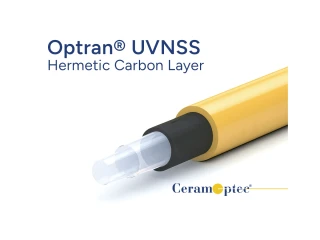
Polyimide-coated multimode optical fibers are designed for demanding industrial and scientific environments requiring enhanced thermal stability, compact fiber dimensions, and reliable long-term optical performance. Compared to standard acrylate coatings, polyimide coatings provide improved resistance to elevated temperatures, chemicals, and mechanical stress while maintaining a thinner coating profile. This makes polyimide-coated fibers particularly suitable for spectroscopy, sensing, aerospace, photonics research, semiconductor systems, and high-temperature instrumentation applications.
Compact Fiber Design for High-Density and High-Temperature Systems
Polyimide coatings enable reduced overall fiber dimensions compared to conventional acrylate-coated optical fibers, supporting integration into compact instrumentation and high-density photonics systems. Their enhanced thermal durability also allows reliable operation in elevated-temperature environments where standard polymer coatings may experience degradation or reduced long-term performance.
Enhanced Thermal Stability for Industrial Photonics Systems
Polyimide-coated multimode optical fibers are engineered for stable optical transmission in thermally demanding environments where conventional fiber coatings may not provide sufficient durability. Their improved heat resistance supports reliable operation in spectroscopy systems, industrial sensing platforms, semiconductor equipment, and aerospace photonics applications exposed to elevated temperatures and continuous thermal cycling.
Chemical and Mechanical Durability for Demanding Environments
The polyimide coating provides enhanced resistance to chemicals, abrasion, and mechanical stress compared to standard polymer coatings, supporting reliable long-term operation in industrial processing systems, laboratory instrumentation, and harsh-environment photonics applications.
FiberTech Polyimide Coated Multimode Optical Fiber 84810201N
Specifications
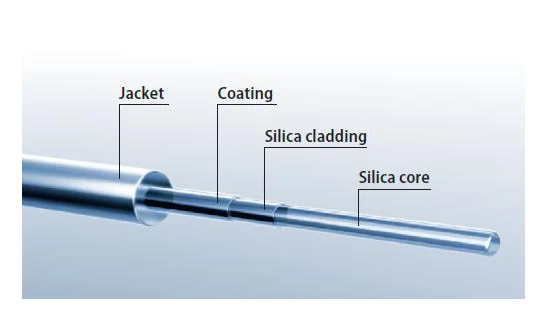
| Core Diameter: | 200 um |
|---|---|
| Wavelength Range: | 400 – 2400 nm |
| Cable Length: | Not Specified |
| Fiber Core Material: | Silica |
| Fiber Length: | Custom |
| Clad Diameter: | 240 um |
| Coating Diameter (polyimide): | 265 um |
| Jacket Diameter: | 600 um |
Got questions about specs? Use the inquiry form to ask.
 Download Data Sheet

Features
- Material Composition: The core of the glass fibers is made from pure fused silica glass with low OH content, providing a uniform refractive index across the entire diameter.
- Wavelength Range: Suitable for use in the VIS-IR range, from 400 nm to 2400 nm.
- Applications: Ideal for optical data transmission, sensor technology, spectroscopy, medical technology, and laser applications.
- Coating Options: Available with single acrylate, dual acrylate, or polyimide coatings.
- Numerical Aperture: 0.22, with options available from 0.1 to 0.4 upon request.
- Jacket Colors: Available in black, blue, transparent (Tefzel®), and black, blue, transparent, yellow, red, white (Nylon®).
- Bending Radius: Short-term: 100 x clad radius, Long-term: 600 x clad radius.
- Special Coatings: ORMOCER® coating available for continuous use at 200 °C.
- Product Codes: Each fiber variant comes with a specific order number and fiber code for easy identification.
Applications
- Optical Data Transmission: The multimode fibers are ideal for transmitting optical data efficiently across varying distances.
- Sensor Technology: These fibers can be used in various sensor applications, providing reliable and accurate data collection.
- Spectroscopy: Perfect for use in spectroscopic analysis due to their broad wavelength range from 400 nm to 2400 nm (VIS-IR).
- Medical Technology: Suitable for medical applications where precise and reliable fiber optics are required.
- Laser Applications: These fibers are designed to handle laser applications effectively.
- High-Temperature Sensing: Optical transmission for sensing systems operating in elevated-temperature industrial environments.
- Aerospace and Avionics: Rugged optical transmission for aerospace, avionics, and defense photonics systems.
- Semiconductor Equipment: Fiber integration into semiconductor inspection, metrology, and process control systems.
- Biomedical Instrumentation: Optical connectivity for biomedical diagnostics and photonics instrumentation.
- Laser Delivery Systems: Delivery of optical energy in industrial and scientific laser systems.
- Vacuum and Research Environments: Suitable for optical systems operating in laboratory and controlled-environment applications.
- Industrial Automation: Fiber routing and optical signal transmission in automation and control equipment.
- Photonics Research and Development: Ideal for experimental photonics systems and optical characterization platforms.
Frequently Asked Questions
What is the core material of the Polyimide Coated Multimode Fiber?
What are the applications of the multimode fibers?
What is the short-term bending radius for the fibers?
What is the temperature range for the fibers with acrylate coating?
What is the wavelength range of the fibers?
What is the advantage of polyimide-coated optical fibers?
Why are polyimide fibers used in high-temperature environments?
What applications use polyimide-coated multimode fibers?
Why are thin-coated optical fibers important?
Are polyimide-coated fibers suitable for harsh environments?
Got more questions? Use the inquiry form to ask the supplier directly.
Similar Products
Your inquiry has been received.
Create an account by adding a password
Why create an account?
- Auto-complete inquiry forms
- View and manage all your past messages
- Save products to your favorites
- Close your account anytime — no hassle