


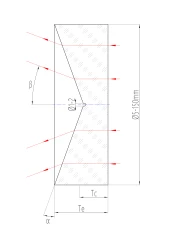
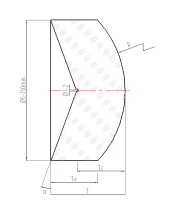
Description
Plano-concave axicon lenses are specialized conical optical elements used for laser beam shaping, annular beam generation, and Bessel-like beam formation in advanced photonics and laser processing systems. Unlike conventional spherical optics, plano-concave axicons transform incoming Gaussian beams into ring-shaped or extended-focus beam profiles with unique propagation characteristics.
These precision conical lenses are widely used in ultrafast laser processing, microscopy, optical coherence tomography (OCT), optical trapping, beam homogenization, and scientific imaging applications requiring controlled energy distribution and extended depth of focus.
Plano-concave axicon optics are particularly valuable in laser micromachining and beam transformation systems where elongated focal regions, annular illumination patterns, or non-diffracting beam behavior improve processing precision and optical performance.
Discover the precision and quality of the Axicon Lens crafted by China & South Optical Crystal (CSOC), a pioneering manufacturer in the optical industry and the first producer of optical glass products in Hong Kong. Established in 1972, CSOC marked a milestone in Hong Kong’s optical manufacturing history by becoming the first factory dedicated to the production of watch glasses, later expanding into a comprehensive manufacturer of high-precision optical components and sapphire products.
Through decades of continuous innovation and development, CSOC has expanded beyond Hong Kong and established advanced production facilities in Shenzhen and beyond.
Engineered with high precision, CSOC’s Axicon Lens features outstanding surface quality, excellent flatness, and precise angular control, delivering superior optical performance with minimal distortion. Advanced coating options including AR and BBAR coatings are available to enhance light transmission and reduce reflection, making the lens an ideal solution for professional optical systems requiring accuracy and stability.
How Plano-Concave Axicons Transform Laser Beams
Plano-concave axicons use a conical optical surface to redistribute incoming laser energy into annular or extended-focus beam profiles. By modifying the propagation geometry of the beam, these optics can generate ring-shaped illumination patterns and Bessel-like beams with reduced diffraction over longer distances.
This optical behavior enables improved depth of focus, more uniform energy distribution, and enhanced beam control in laser processing, microscopy, and imaging applications.
Advantages of Plano-Concave Axicon Optics
Plano-concave axicon optics provide several advantages in laser beam shaping and advanced photonics applications, including extended focal regions, annular beam generation, reduced diffraction, and improved beam uniformity.
These characteristics make them highly effective for ultrafast laser systems, laser drilling, optical alignment, and precision material processing applications requiring controlled energy distribution and stable beam propagation.
Plano-Concave Conical Lenses for Bessel Beam and Annular Beam Applications
Specifications
| Material: | BK7, FS, UVFS, Sapphire, B270 |
|---|---|
| Axicon Type: | Plano-Convex, Plano-Concave, Bi-Convex, Bi-Concave |
| Apex Rounding Diameter: | <1 mm |
| Diameter Tolerance: | mm+0.0/-0.15 |
| Clear Aperture: | >90% |
| Surface Quality (S-D): | 60-40 |
| Apex Angle Tolerance: | ±0.1°. Available down to +/-0.005° |
| Flatness: | λ/4 |
| Thickness Tolerance (mm): | ±0.1 |
| Protective Chamfers: | <0.25 mm x 45 deg |
| Coatings: | Available on request |
| Material: | Sapphire, BK7, B270, Quartz |
| Axicon Angle: | Max 179.5deg |
| Diameter: | 5-150mm |
Got questions about specs? Use the inquiry form to ask.
 Download Data Sheet

Features
Plano-Concave Axicons (Conical Lenses)
- Material:Sapphire, BK7, B270, Quartz
- Diameter: 5-150mm
- Axicon Angle: Max 179.5deg
- Apex Rounding Diameter: <1 mm
- Diameter Tolerance: mm+0.0/-0.15
- Clear Aperture: >90%
- Surface Quality (S-D):60-40
- Apex Angle Tolerance: ±0.1°. Available down to +/-0.005°
- Flatness: λ/4
- Thickness Tolerance (mm):±0.1
- Protective chamfers:<0.25 mm x 45 deg
- Coatings Available on request
Applications
Plano-concave axicon lenses are widely used in laser beam shaping, optical metrology, microscopy, ultrafast laser processing, OCT imaging, beam homogenization, and scientific research applications.
Their ability to generate annular and Bessel-like beam profiles makes them useful for laser drilling, laser micromachining, particle trapping, semiconductor processing, and imaging systems requiring extended depth of focus or ring-shaped illumination patterns.
- Laser Beam Shaping: Designed to convert Gaussian laser beams into non-diffractive ring-shaped beams, making it ideal for applications requiring precise and uniform energy distribution.
- Optical Metrology: Widely used in high-precision measurement and alignment systems where exceptional optical accuracy and stability are essential.
- Medical Imaging: Applied in advanced imaging technologies such as Optical Coherence Tomography (OCT), improving depth resolution and imaging performance in medical diagnostics.
- Microscopy: Enhances optical imaging capabilities in microscopy applications, providing improved visualization for biological research and materials science analysis.
- Optical Trapping: Utilized in optical tweezers systems for the precise manipulation of microscopic particles and biological specimens using focused light beams.
Frequently Asked Questions
What is a plano-concave lens?
How does a plano-concave axicon work?
What is the difference between a standard shaft cone and a concave shaft cone?
What is a plano-concave cylindrical lens used for?
Can a plano-concave axicon generate a Bessel beam?
Is a plano-concave axicon compatible with ultrafast lasers?
What materials and coatings are available for concave axicon optics?
Got more questions? Use the inquiry form to ask the supplier directly.
Similar Products

Your inquiry has been received.
Create an account by adding a password
Why create an account?
- Auto-complete inquiry forms
- View and manage all your past messages
- Save products to your favorites
- Close your account anytime — no hassle