
Description
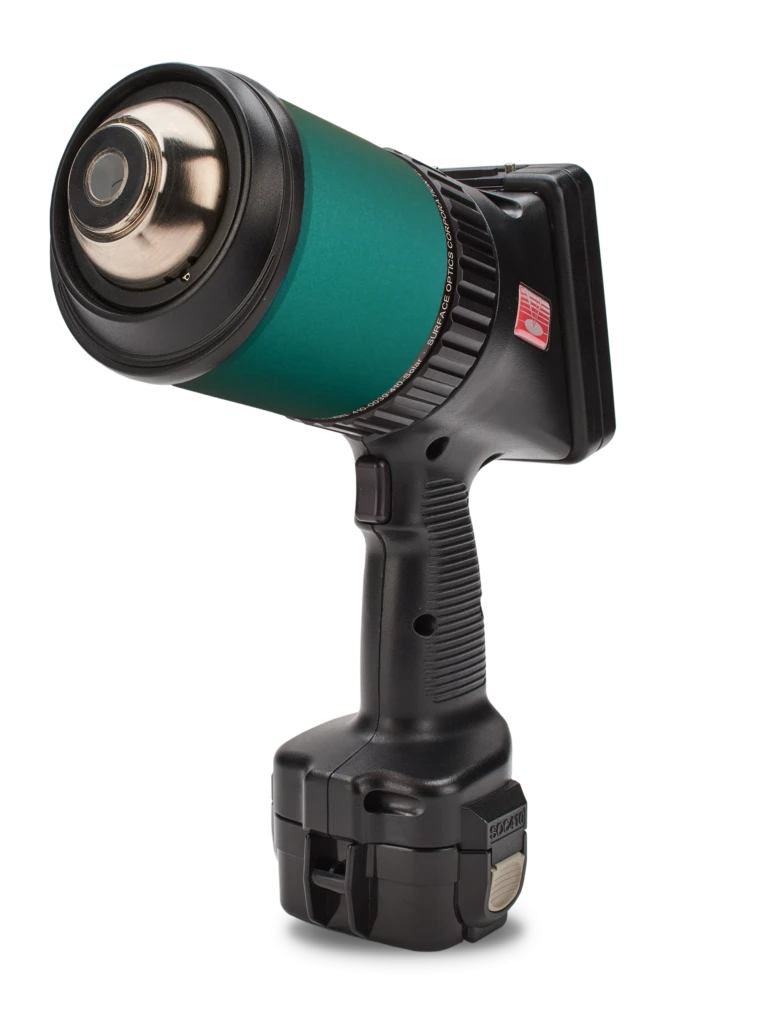
The 410-Solar-i Reflectometer conforms to ASTM E903 and C1549, the standard test methods for solar reflectance measurements. Measures total reflectance at near-normal incidence for seven spectral bands. Choose from eight solar irradiance functions, including air mass 0, 1, 1.5, and 2.0.
410-Solar-I Reflectometer
Specifications
| Wavelength Bands: | 335-380, 400-540 nm, 480-600 nm, 590-720 nm, 700-1100 nm, 1000-1700 nm, 1700-2500 |
|---|---|
| Angle Of Incidence (from Normal): | 20 deg |
| Accuracy: | 0.02 (abs. refl. units) |
| Repeatability: | 0.005 units |
| Beam Spot Size: | 12.7 mm |
| Measurement Time: | 7 sec |
| Measured Parameter:: | Directional hemispherical reflectance (DHR) |
| Measured Value:: | Absolute reflectance (0-1), Diffuse Reflectance |
| Calculated Value:: | Total Solar reflectance, Solar absorptance, specular reflectance |
| Wavelength Bands:: | 335-380, 400-540, 480-600, 590-720, 700-1100, 1000-1700, 1700-2500 (nm) |
| Angle Of Incidence:: | 20º from normal incidence |
| ASTM Standards:: | C1549 E1980 E903 |
| Calibration Coupon:: | Specular, Diffuse & Glazed Ceramic |
| Accuracy:: | +/- .02 |
| Repeatability:: | ±.005 units |
| Beam Spot Size:: | 0.25 inches to 0.50 inches |
| Measurement Time:: | 7 to 10 seconds |
| Sample Size & Geometry:: | Flat: ≥ 0.5 in. diameter Curved: 6 in. convex; 12 in. concave |
| Warm Up Time:: | 90 seconds |
| Time Between Measurements:: | 2 seconds |
| Sample Temperature:: | Ambient or heated/cooled to 0 - 100º C |
| Operating Temp:: | 0º to 40º C |
| Run Time:: | 2 hours on one battery |
Got questions about specs? Use the inquiry form to ask.
 Download Data Sheet

Features
- ASTM Compliant: Conforms to ASTM E408, E1980, and C1549 standards for emittance determination using a portable instrument.
- 7 Discrete Bands: Provides in-band reflectance data for seven discrete bands: 335-380, 400-540, 480-600, 590-720, 700-1100, 1000-1700, 1700-2500.
- Multiple Solar Irradiance Functions: New or custom functions can be added to the default options including AM 0, 1.5.
- Cleanable Calibration Coupon: Calibration coupon can be wiped clean.
- Immediate Data: Touch screen display for data review and management.
- 410-Solar Upgrades: Faster measure time, larger spot, single cleanable calibration coupon.
Applications
- Space Coatings Thermal Control: Optimize materials for spacecraft thermal management.
- Defense & Aerospace: Essential for IR signature reduction and heat transfer studies.
- LiDAR: Test Target Reflectance
- Cool Building Analysis: Evaluate reflective materials for energy-efficient construction.
- Radiative Heat Transfer: Absorptance for thermal modeling
Similar Products
Need pricing for this product? Send a quick inquiry
Thank You!
Your inquiry has been received.
Create an account by adding a password
Why create an account?
- Auto-complete inquiry forms
- View and manage all your past messages
- Save products to your favorites
- Close your account anytime — no hassle