


Description
The VASS-Yb-B and VASP-Yb-B light sources are members of the VENUS series of high‑stability 1.0 μm ASE (Amplified Spontaneous Emission) broadband sources based on an all‑fiber ytterbium‑doped architecture. Designed as robust, turn‑key benchtop instruments, these sources deliver a smooth, low‑coherence spectrum in the 1035–1080 nm range with optional output powers from 10 mW up to 100 mW. Compared with many conventional superluminescent diodes or discrete fiber ASE modules on the market, the VENUS series provides a more stable, thermally managed platform with higher output power options and excellent long‑term reliability, making it well suited for demanding laboratory and production environments.
At the core of these sources is a carefully optimized ytterbium‑doped fiber design that yields wide spectral bandwidth and excellent spectral flatness while suppressing unwanted lasing. The instruments are offered in two main configurations: the VASS‑Yb‑B with single‑mode fiber (SM) output and the VASP‑Yb‑B with polarization‑maintaining (PM) fiber output. The PM version offers a polarization extinction ratio greater than 17 dB, which is particularly important for polarization‑sensitive applications such as interferometric sensing, precision metrology, and coherent detection schemes. Both configurations use standard telecom‑style fiber types (SMF 6/125 μm and PM980) with a numerical aperture of 0.13, facilitating straightforward integration into existing fiber‑based test setups.
To support high‑precision measurement tasks, the VENUS series emphasizes power and spectral stability. After a typical 30‑minute warm‑up at 25 °C, the output power stability is specified at ±0.5% over 15 minutes and ±1.0% over 8 hours, meeting or exceeding the requirements of many optical characterization, calibration, and long‑duration experimental scenarios. The available spectral flatness options (standard flatness and gain‑flattened versions) allow users to choose the appropriate balance between power and uniformity across the emission bandwidth. This is particularly important in applications such as optical fiber sensing arrays, spectral response characterization of components, or broadband loss measurements, where non‑uniform spectral power can introduce measurement bias.
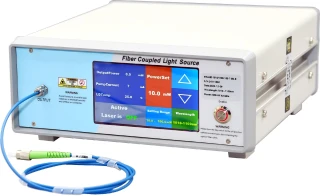
The instruments feature an integrated, high‑definition front‑panel display that simultaneously presents key operating parameters such as output power, drive current, and voltage. Output power can be continuously tuned over a broad range with both coarse and fine adjustment modes, enabling users to quickly set a desired operating level and then refine it for sensitive measurements. This tunability, combined with the inherent low coherence of ASE, makes the VENUS series ideal for minimizing coherent artifacts and interference fringes in systems such as optical coherence tomography, low‑coherence interferometry, and speckle‑reduction imaging.
From a usability standpoint, the VENUS series is designed for straightforward integration into labs and test benches. The benchtop units operate from a wide 100–240 VAC input and incorporate internal control, monitoring, and protection electronics, eliminating the need for external drivers or complex thermal management. Typical power consumption is kept moderate even when operating at the higher output power levels, which is advantageous for continuous use in test and measurement racks or field‑deployed diagnostic systems. The output is provided via standard FC/APC optical connectors (with other connector types available on request), and the default output fiber length of more than 1 meter simplifies connection to patch panels, couplers, or optical instruments.
In comparison with many other 1.0 μm ASE sources used in fiber sensing, component characterization, and OCT systems, the VASS-Yb-B and VASP-Yb-B models stand out by combining high power, low‑noise operation, and excellent thermal and power stability in a compact 340 × 240 × 100 mm benchtop package. These characteristics, together with the choice of single‑mode or polarization‑maintaining output and selectable spectral flatness, make the VENUS series a versatile platform for research laboratories, system integrators, and manufacturing test lines that require a reliable, broadband 1.0 μm ASE light source for precision optical measurements and advanced photonic experiments.
VENUS Series 1.0um ASE Broadband Light Source
Specifications
| Bandwidth: | 45 nm |
|---|---|
| Center Wavelength: | 1080 nm |
| Output Power: | 100 mW |
| Polarization: | Linear |
| Part Numbers: | VASS-Yb-B (SM), VASP-Yb-B (PM) |
| Operating Wavelength Range: | 1035–1080 nm |
| Typical Output Power Options: | 10 mW, 20 mW, 50 mW, 100 mW |
| Maximum Output Power: | 100 mW |
| Spectral Flatness (Standard): | ≤5 dB |
| Output Isolation: | ≥30 dB |
| Output Power Stability (15 Min): | ±0.5 % |
| Output Power Stability (8 H): | ±1.0 % |
| Output Power Tunable Range: | 0–100 % |
| Output Power Tunable Mode: | Coarse / Fine |
| Operating Voltage: | 100–240 VAC |
| Maximum Power Consumption: | 45 W |
| Operating Temperature: | 0–40 ℃ |
| Storage Temperature: | -40–85 ℃ |
| Output Fiber Type (SM): | SMF 6/125 µm, NA = 0.13 |
| Output Fiber Type (PM): | PM980, NA = 0.13 |
| Polarization Extinction Ratio (PM Output Fiber): | > 17 dB |
| Output Fiber Length: | > 1 m |
| Optical Connector: | FC/APC (other options available) |
| Dimensions: | 340(L) × 240(W) × 100(H) mm |
| Package Type: | Benchtop |
Got questions about specs? Use the inquiry form to ask.
 Download Data Sheet

Features
- Broadband 1.0 µm ASE Output – Ytterbium‑doped, all‑fiber architecture delivering a wide emission band from 1035–1080 nm, ideal for broadband test, measurement, and spectral analysis.
- Multiple Output Power Options – Factory‑configurable output power levels of 10 mW, 20 mW, 50 mW, and 100 mW (and other custom powers on request) to match diverse application and system requirements.
- High Output Stability – Excellent power stability after warm‑up with typical variations of ±0.5% over 15 minutes and ±1.0% over 8 hours, ensuring repeatable and reliable measurements in demanding R&D and production environments.
- Wide Spectral Bandwidth & Flatness – Optimized ASE design with broad FWHM bandwidth and selectable spectral flatness:
- Standard Flatness for general broadband applications and high total output power.
- Gain‑Flattened Spectrum for applications requiring tighter spectral uniformity across the band (e.g., precise spectral characterization, sensing arrays).
- Single‑Mode or Polarization‑Maintaining Output – Two distinct models for optimal system integration:
- VASS‑Yb‑B: Single‑mode output on SMF 6/125 µm, NA = 0.13 for low‑noise, high‑quality beams.
- VASP‑Yb‑B: PM output on PM980, NA = 0.13 with > 17 dB polarization extinction ratio for polarization‑sensitive applications such as interferometry and coherent detection.
- High Isolation and Low Feedback Sensitivity – Integrated optical isolation up to 35 dB minimizes back‑reflections from downstream components, enhancing long‑term stability and protecting the internal ASE source.
- Coarse / Fine Power Tuning – Integrated digital control with coarse and fine output power adjustment allows users to precisely set and optimize the ASE power for different experiments or test setups.
- Benchtop, Highly Integrated Design – Compact benchtop unit (approx. 340 mm × 240 mm × 100 mm) with all‑fiber internal design for improved robustness, minimal alignment requirements, and plug‑and‑play operation.
- High‑Definition LCD Interface – Front‑panel high‑definition LCD displays current, voltage, and output power simultaneously, enabling real‑time monitoring and intuitive control without external instruments.
- Universal AC Power Input – Wide‑range input of 100–240 VAC for global compatibility in laboratory and production environments; optimized internal electronics for low power consumption even at maximum output power.
- Rugged, All‑Fiber Construction – Er/Yb‑doped all‑fiber configuration (no free‑space optics in the signal path) provides high stability, long‑term reliability, and immunity to vibration and misalignment, outperforming many free‑space based broadband sources.
- Stable Performance over Wide Temperature Range – Designed to operate reliably over typical laboratory and light industrial ambient conditions, with controlled internal temperature for consistent spectral characteristics and power output.
- Standard and Custom Fiber Connectors – Delivered with FC/APC output as standard to minimize back‑reflection; other connector types (FC/PC, SC/APC, etc.) and pigtail options can be supplied on request for easy integration into existing fiber networks.
- Long Output Fiber Pigtail – Supplied with a standard 1 m output fiber (other lengths available on request), providing flexibility for rack, bench, or optical table setups without the need for additional patch cords.
- Optimized for Precision Test & Measurement – High stability, low coherence, and broad bandwidth make this source ideal for:
- Optical spectrum analysis and component characterization.
- Passive device testing (filters, couplers, WDM components, isolators, etc.).
- Optical time‑domain reflectometry (OTDR) calibration and verification.
- Wavelength‑dependent loss (WDL) and polarization‑dependent loss (PDL) measurements.
Applications
Applications of VENUS Series 1.0 µm High‑Stability ASE Broadband Light Sources (VASS‑Yb‑B SM / VASP‑Yb‑B PM)
The Connet VENUS series 1.0 µm ASE broadband light sources (models VASS‑Yb‑B for single‑mode output and VASP‑Yb‑B for polarization‑maintaining output) are high‑stability, Yb‑doped, all‑fiber sources designed for demanding laboratory, industrial, and field applications. Their wide 1035–1080 nm operating range, high output power (up to 100 mW), excellent power stability, and optional gain‑flattened spectrum make them suitable for a broad set of use cases across optics, photonics, and precision sensing.
- Optical Coherence Tomography (OCT) around 1.0 µm
Widely used as a broadband light source for:
– High‑resolution biomedical OCT imaging in tissue transparency windows near 1.0 µm
– Ophthalmic, dermatologic, and intravascular OCT systems requiring high axial resolution
– Industrial OCT for non‑destructive testing, thickness measurement, and internal defect inspection in glass, polymers, and ceramics - Fiber Optic Sensing and Structural Health Monitoring
Provides stable, broadband illumination for a variety of fiber‑based sensors:
– Fiber Bragg Grating (FBG) sensor interrogation near 1.0 µm for strain, temperature, pressure, and displacement monitoring
– Distributed sensing schemes (such as OFDR‑based strain/temperature profiling) that demand low‑coherence, wideband sources
– Polarization‑sensitive sensing with the PM model (VASP‑Yb‑B) for improved measurement fidelity in birefringent or polarization‑dependent sensors
– Long‑term structural health monitoring of bridges, tunnels, wind turbines, pipelines, aircraft, and civil infrastructure - Test and Measurement in Yb‑band Fiber Optics
Serves as a precision tool for characterization and metrology in the 1.0 µm window:
– Spectral response testing of Yb‑doped fibers, fiber components, and integrated devices
– Insertion loss, return loss, and polarization‑dependent loss (PDL) measurements of couplers, isolators, WDMs, and filters around 1030–1080 nm
– Calibration and verification of optical instruments (OSA, power meters, tunable filters) in the near‑infrared Yb band
– Evaluation and burn‑in of high‑power Yb‑doped fiber amplifier and laser components using a broadband seed source - Spectrum Analysis and Optical Component Characterization
High‑flatness, broadband ASE output is ideal for:
– Characterizing spectral transmission, reflection, and group delay of bandpass filters, etalons, and interference coatings at ~1.0 µm
– Testing gratings, thin film filters, and photonic crystal structures over tens of nanometers in a single sweep
– Benchmarking performance and bandwidth of wavelength‑selective switches and spectrally tunable devices
– Measuring spectral ripple and dispersion of fiber coils, interferometers, and fiber‑based delay lines - Interferometry and Low‑Coherence Metrology
Acts as a low‑coherence, stable source for precision measurement systems:
– White‑light / low‑coherence interferometry for absolute distance and thickness measurements
– Optical path length and refractive index metrology in glasses, crystals, and polymers
– Precision surface profiling, flatness, and film‑stack characterization with reduced coherent artifacts compared to laser sources
– Interferometric vibration and displacement sensors operating in the 1.0 µm band - Coherent and Polarization‑Sensitive System Development
Especially with the PM model (VASP‑Yb‑B), the VENUS series enables:
– Development and testing of polarization‑maintaining fiber components and modules at 1.0 µm
– Alignment and characterization of polarization‑sensitive devices (polarizers, PBS, PM couplers, PM circulators)
– Research on polarization effects, birefringence, and polarization mode dispersion (PMD) in specialty fibers
– Use as a reference or noise source in coherent detection and homodyne/heterodyne test benches - Laser and Amplifier Research in the Ytterbium Band
A convenient broadband seed and diagnostic source for Yb‑based systems:
– R&D of Yb‑doped fiber lasers, supercontinuum sources, and chirped‑pulse amplification (CPA) front ends
– Gain characterization, ASE noise measurements, and optimization of Yb‑doped amplifier chains
– Verification of saturation behavior, gain bandwidth, and spectral shaping schemes in the 1.0 µm region
– Prototyping of high‑power industrial and scientific Yb laser systems using a stable, well‑controlled broadband source
Frequently Asked Questions
What is the Connet VENUS 1.0 µm high‑stability ASE broadband light source and what are its key features?
What are the typical applications of the VENUS 1.0 µm ASE light source?
What is the difference between the VASS‑Yb‑B and VASP‑Yb‑B models and how do I choose the right one?
What output power and spectral flatness options are available and how are they specified when ordering?
How stable is the output power of the VENUS 1.0 µm ASE source over time and temperature?
What are the electrical, mechanical, and fiber interface specifications of the VENUS 1.0 µm ASE source?
Is the VENUS 1.0 µm ASE light source suitable for system integration and OEM use?
Got more questions? Use the inquiry form to ask the supplier directly.
Similar Products



Your inquiry has been received.
Create an account by adding a password
Why create an account?
- Auto-complete inquiry forms
- View and manage all your past messages
- Save products to your favorites
- Close your account anytime — no hassle