
Description
The Laser to Fiber Coupler with Receptacle (Non-Contact Style) is an advanced optical coupling solution designed for high-performance applications across a broad spectrum of industries. Unlike traditional contact-style couplers, this non-contact design introduces an air gap between the fiber and the lens, offering enhanced flexibility and adaptability. This configuration allows users to select from a wide range of lens types—including GRIN, achromats, aspheres, fused silica, plano-convex, and biconvex lenses—enabling precise control over focal length and beam characteristics. The adjustable distance between the fiber and lens makes it possible to compensate for changes in source wavelength or to intentionally defocus the laser beam, which is particularly beneficial in high-power laser to multimode fiber applications to prevent arcing.
Engineered for robust performance, this coupler can handle continuous wave (CW) input powers up to 100W, and even higher energies from pulsed laser sources. It is ideally suited for demanding scenarios where input energy exceeds 400mW, multiple wavelengths need to be coupled into a single fiber, or when dealing with beams that have large diameters or significant divergence angles. The non-contact design also delivers superior polarization maintaining capabilities, making it an excellent choice for applications where polarization integrity is critical, such as interferometric sensors, spectroscopy, and fluorescence measurements. The coupler is compatible with a variety of connector receptacle versions, including specialized options for improved repeatability and reduced backreflection. Standard connectors typically achieve backreflection levels of -14dB, while angled connectors can reduce this to as low as -60dB. For applications requiring optimal repeatability and minimal variation in endface geometry, the angled flat (AFC) connector is recommended, featuring a beveled fiber endface with a flat ferrule tip.
Additionally, for users employing SMA connectors, the use of Zirconia ferrules and sleeves is advised for core diameters of 100 microns or less, ensuring precise alignment and consistent performance. With its wide wavelength compatibility (180–2000nm), high coupling efficiency, and exceptional power handling, the Laser to Fiber Coupler with Receptacle (Non-Contact Style) is a versatile and cost-effective solution for laser shows, medical and pharmaceutical sensing, OEM laser systems, and more. Its innovative design and adaptability make it a preferred choice for professionals seeking reliable, high-performance fiber optic coupling in both research and industrial environments.
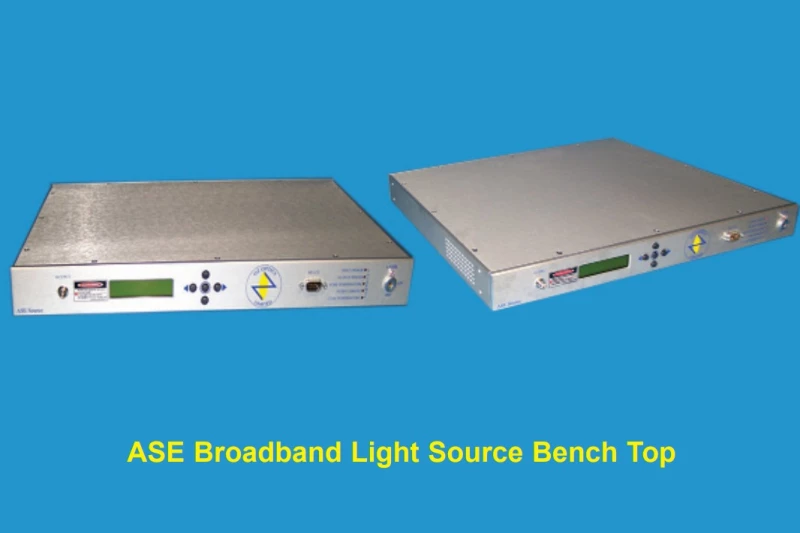
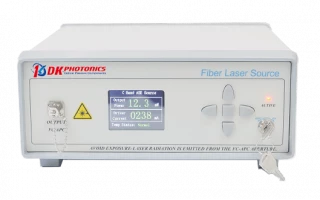
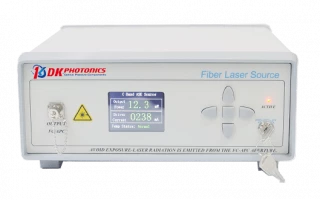
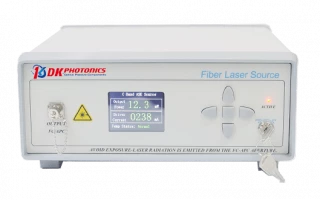
ASE Broadband Light Source - Bench Top
Specifications
| Bandwidth: | 40 nm |
|---|---|
| Center Wavelength: | 1547 nm |
| Output Power: | 500 mW |
| Polarization: | Random |
| Total Output Power: | 13 dBm |
| Otal Power Stability: | 0.02 dB |
| Spectrum Flatness: | 1.0 to 2.0 dB |
| Output Polarization: | Unpolarized |
| Output Isolation: | 45 dB |
| Return Loss: | 55 dB |
| Humidity: | 0 to 95 % |
| Operating Temperature Range: | 0 to +40 °C |
| Storage Temperature Range: | -40 to +80 °C |
Got questions about specs? Use the inquiry form to ask.
 Download Data Sheet

Features
- Low Cost, High Performance: Delivers exceptional value with robust performance for a wide range of laser-to-fiber coupling applications.
- High Power Handling: Supports input powers up to 100W CW (continuous wave) with fused silica or sapphire lenses, and up to 10W CW with aspheric lenses—ideal for high-power laser systems and pulsed sources.
- Wide Range of Lenses: Compatible with GRIN, achromat, aspheric, fused silica, plano-convex, and biconvex lenses, offering flexibility for diverse optical setups and focal length requirements.
- Excellent Polarization Maintaining Capabilities: Superior polarization extinction ratios (typically >20dB, with 25dB and 30dB versions available) ensure optimal performance in polarization-sensitive applications.
- Multiple Connector Receptacle Options: Available in various connector types, including standard and angled flat (AFC) connectors for enhanced repeatability and reduced backreflection.
- Wide Wavelength Range: Supports wavelengths from 180 nm to 2000 nm, making it suitable for UV, visible, and IR applications.
- Adjustable Air Gap Design: Non-contact style with adjustable distance between fiber and lens allows for compensation of wavelength changes and intentional defocusing to prevent arcing in high-power applications.
- High Coupling Efficiency: Achieves typically >60% coupling into singlemode or polarization maintaining fibers, and >80% into multimode fibers for efficient light transmission.
- Low Backreflection: Standard connectors provide -14dB backreflection; angled connectors can achieve <-60dB, minimizing signal loss and feedback.
- OEM and Custom Solutions: Designed for integration into OEM laser systems, with customizable options for lens type, connector, and wavelength range.
- Reliable and Repeatable Connections: Angled flat (AFC) connectors and Zirconia ferrule options for SMA connectors ensure high repeatability and stability, especially for small core diameters.
- Versatile Applications: Ideal for laser shows, spectroscopy, interferometric sensors, fluorescence measurements, medical/pharmaceutical/chemical sensors, and more.
Applications
- Laser Shows and Entertainment Systems
Ideal for coupling high-power lasers into optical fibers for dynamic lighting effects, stage shows, and multimedia entertainment displays, thanks to high power handling and wide wavelength compatibility. - Spectroscopy
Enables efficient light delivery and collection in spectroscopic instruments, supporting a broad wavelength range (180–2000 nm) for applications in material analysis, environmental monitoring, and chemical identification. - Interferometric Sensors
Provides stable and precise coupling for fiber optic interferometers used in strain, temperature, and vibration sensing, benefiting from excellent polarization maintaining capabilities. - Fluorescence Measurements
Facilitates accurate excitation and collection of fluorescence signals in biomedical research, life sciences, and chemical analysis, with high coupling efficiency and low backreflection. - Medical, Pharmaceutical, and Chemical Sensors
Supports fiber-coupled sensor systems for diagnostics, process monitoring, and analytical instrumentation, offering compatibility with various connector types and high repeatability. - OEM Laser Systems
Integrates seamlessly into custom and commercial laser systems for industrial, scientific, and medical applications, with options for different lens types and connector receptacles. - High-Power Fiber Laser Delivery
Suitable for delivering high-power laser beams (up to 100W CW) into fibers for materials processing, cutting, welding, and micromachining. - Multi-Wavelength Coupling
Designed for applications requiring simultaneous coupling of multiple wavelengths into a single fiber, such as broadband light sources, supercontinuum generation, and multi-line laser systems. - Large Beam Diameter and Divergence Handling
Accommodates input beams with large diameters or high divergence, making it suitable for coupling free-space laser sources or diode bars into optical fibers. - Research and Development
Used in laboratory setups for fiber optic experiments, prototyping, and testing, where flexibility in lens selection and fiber compatibility is essential. - Telecommunications and Data Transmission
Applicable in fiber optic communication systems requiring precise and stable coupling, especially where polarization maintenance and low backreflection are critical. - Metrology and Calibration
Employed in optical metrology setups for precise alignment and calibration of fiber-coupled measurement devices.
Frequently Asked Questions
What is a non-contact style laser to fiber coupler with receptacle?
What are the main advantages of non-contact style fiber couplers compared to contact style couplers?
What is the typical coupling efficiency of these laser to fiber couplers?
What wavelength range do these couplers support?
How can backreflection be minimized in non-contact style couplers?
What power levels can these couplers handle?
What connector options are available and what is recommended for high repeatability?
Got more questions? Use the inquiry form to ask the supplier directly.
Similar Products
Your inquiry has been received.
Create an account by adding a password
Why create an account?
- Auto-complete inquiry forms
- View and manage all your past messages
- Save products to your favorites
- Close your account anytime — no hassle