
Description
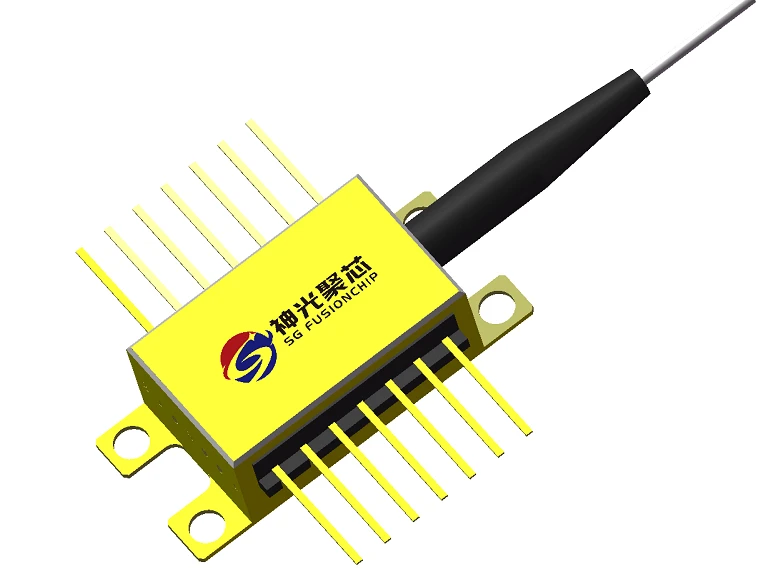
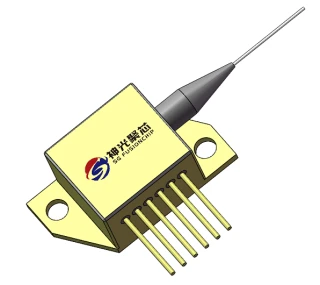
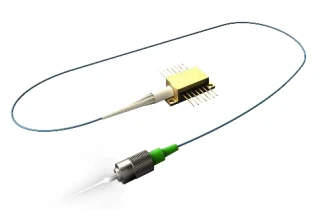
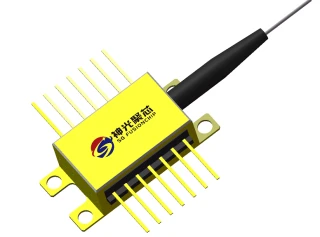
The SGSLD-1310-10-XX-XX-14 is a high‑performance 1310 nm superluminescent diode (SLED) in a 14‑pin butterfly package, engineered for demanding fiber‑optic sensing, metrology, and communication applications. Comparable to other 1310 nm SLED modules used in fiber‑optic gyroscopes and OCT systems, this device combines high output power up to 10 mW with a broad emission spectrum and excellent stability, making it an ideal broadband light source for interferometric and low‑coherence applications. Its wide spectral bandwidth (typically 50 nm FWHM) helps reduce coherence‑related artifacts such as speckle and coherent noise, improving resolution and measurement accuracy in precision systems.
Designed around a hermetic, metal‑coupled 14‑pin butterfly package, the SGSLD‑1310‑10‑XX‑XX‑14 integrates an internal thermoelectric cooler (TEC) and 10 kΩ thermistor for precise temperature control of the laser chip. This active thermal management ensures stable output power, center wavelength, and spectral characteristics over a broad operating case temperature range from −20 °C to +70 °C.
At a typical operating temperature of 25 °C, the device delivers continuous‑wave optical output power from 1 mW up to 10 mW with a typical forward voltage below 2.5 V. The nominal center wavelength is specified from 1290 nm to 1330 nm, with a broad emission profile that supports high‑resolution interferometry and low‑coherence imaging. The spectral ripple is controlled to within 1 dB, helping maintain a smooth spectral profile that is critical for accurate optical testing and fiber‑optic sensing. These characteristics make the module well‑suited for use as a broadband seed source or reference source in advanced optical setups.
The SGSLD‑1310‑10‑XX‑XX‑14 is available with either polarization‑maintaining (PM) or single‑mode (SM) fiber pigtails, allowing system designers to select the configuration that best matches their optical architecture. In the PM fiber version, a high polarization extinction ratio (PER) of typically 15 dB supports applications that rely on stable polarization states, such as fiber‑optic gyroscopes and interferometric sensors. For more general optical test and communication systems, the single‑mode fiber option offers efficient, low‑loss coupling into standard telecom‑grade components at 1310 nm.
The integrated TEC can be driven up to 3.0 V and 1.5 A, enabling tight control of the active region temperature for wavelength tuning and long‑term stability. A 10 kΩ thermistor with a B‑value of approximately 3950 K (25 °C / 50 °C) provides accurate temperature feedback to external controllers or laser diode drivers. Combined with the standard 14‑pin butterfly footprint and clearly defined pin assignments (including separate pins for LD anode/cathode, TEC, thermistor, and ground), the module is straightforward to integrate into existing control electronics designed for telecom‑style butterfly lasers and SLEDs.
With its combination of broad bandwidth, up to 10 mW of output power, and stable 1310 nm operation, the SGSLD‑1310‑10‑XX‑XX‑14 is an excellent choice for fiber‑optic gyroscopes, optical coherence tomography, fiber‑optic test and measurement equipment, and optical fiber transmission systems requiring a low‑coherence source.
SGSLD-1310-10 1310 nm Superluminescent Diode (SLED) – 10 mW 50 nm 14-Pin Butterfly
Specifications
| SLED Type: | Fiber Coupled |
|---|---|
| Operating Power (typical): | 10 mW |
| Center Wavelength (typical): | 1310 nm |
| Bandwidth (FWHM): | 50 nm |
| Model: | SGSLD-1310-10-XX-XX-14 |
| Package Type: | 14-pin butterfly |
| Output Power (optical): | 1–10 mW CW @ 25 °C |
| Forward Voltage: | ≤ 2.5 V CW @ 25 °C |
| Center Wavelength: | 1290–1330 nm @ 25 °C |
| Bandwidth (FWHM): | 30–50 nm @ 25 °C |
| Spectral Ripple: | ≤ 1 dB CW @ 25 °C |
| Low Polarization Chip: | ≤ 1.5 dB |
| High Polarization Chip, PM Fiber: | ≥ 15 dB |
| Thermistor Resistance: | 9.5–10.5 kΩ @ 25 °C |
| Thermistor B-Value: | 3950 K (25 °C / 50 °C) |
| Operating Case Temperature: | -20 to 70 °C |
| Storage Temperature: | -55 to 85 °C |
| Laser Reverse Voltage: | ≤ 3 V |
| Forward Current: | ≤ 300 mA |
| TEC Voltage: | ≤ 3.0 V |
| TEC Current: | ≤ 1.5 A |
| Lead Solder Temperature: | ≤ 260 °C |
| Lead Soldering Time: | ≤ 10 s |
| Fiber Type Option 1: | BS = BTF SM Fiber |
| Fiber Type Option 2: | BP = BTF PM Fiber |
| Connector Options: | 00 = None; FA = FC/APC; SA = SC/APC |
| Wavelength Option (Low Polarization Rate): | 1310 |
| Wavelength Option (High Polarization Rate): | 13 |
| Encapsulation & Fiber Selection Code: | BS, BP, … |
| Connector PIN Code: | 00, FA, SA, … |
| Fiber / Connector Options: | SM or PM fiber; no connector, FC/APC or SC/APC |
| Dimensions Tolerance: | ±0.1 mm |
Got questions about specs? Use the inquiry form to ask.
 Download Data Sheet

Features
- High power output
- Metal-coupled and hermetic package
- TEC inside
- Polarization-maintaining or single-mode optical fiber
- 14pin butterfly package
Applications
- Fiber-optic gyroscope
- Optic test
- Optical fiber transmission system
- Fiber-optic sensor
- OCT
Frequently Asked Questions
What is the SGSLD-1310-10-XX-XX-14 SLED butterfly device and what are its main features?
What are the typical applications of the SGSLD-1310-10-XX-XX-14 SLED?
What are the key optical and electrical specifications of the SGSLD-1310-10-XX-XX-14?
What are the operating and storage temperature ranges and reliability considerations?
What fiber types and polarization options are available for this 1310 nm SLED?
How do I interpret the SGSLD-1XX0-XX-XX-XX-14 ordering code and connector options?
What are the 14-pin butterfly pin assignments and how should the module be driven and handled?
Got more questions? Use the inquiry form to ask the supplier directly.
Similar Products
Your inquiry has been received.
Create an account by adding a password
Why create an account?
- Auto-complete inquiry forms
- View and manage all your past messages
- Save products to your favorites
- Close your account anytime — no hassle