

Description
The SLD Broadband Light Sources from Yogel are high‑performance superluminescent diode (SLD) based illumination modules engineered for applications that demand a wide spectral range, excellent stability, and low polarization dependence. Covering key telecom and sensing windows from 1250 nm to 1650 nm, these sources are ideal for precision fiber‑optic sensing, interferometric systems, and characterization of passive components. They deliver a smooth spectral profile with minimal ripple, ensuring accurate and repeatable measurements even in demanding laboratory and industrial environments.
Unlike traditional laser sources, SLD broadband sources provide a wide optical bandwidth combined with low coherence, making them particularly well suited for optical coherence tomography (OCT), medical imaging, and high‑resolution fiber‑optic sensing. The available spectral ranges – 1250–1450 nm, 1450–1650 nm, 1250–1610 nm, and 1250–1650 nm – allow users to select a bandwidth tailored to their specific application, whether it is structural health monitoring, refractive index profiling, or testing of WDM and passive optical components in the O‑, E‑, S‑, C‑, and L‑bands. With a spectral power density of at least –25 dBm/nm and spectral ripple below 0.5 dB, these sources offer the combination of power and uniformity required for high‑fidelity measurement systems.
Stability is a critical metric for broadband light sources, and this series is designed to minimize output drift over both short and extended operating periods. The short‑term stability is within ±0.02 dB over 15 minutes, and long‑term stability is within ±0.05 dB over 8 hours, corresponding to less than about 0.5% and 1.2% power variation respectively. This level of stability is comparable to or better than many benchtop SLD sources used in advanced test and measurement setups. As a result, users can rely on consistent output for long data acquisition runs, calibration tasks, and unattended operation in continuous monitoring systems.
The optical output is delivered via standard SMF‑28 single‑mode fiber terminated with an FC/APC connector, ensuring low back‑reflection and seamless integration into existing fiber networks and measurement benches. The emission is partially polarized with a polarization extinction ratio of ≤ 2 dB, which helps reduce polarization‑dependent effects in many sensing and imaging configurations. This low degree of polarization makes the source well suited for polarization‑sensitive systems where excessive polarization can introduce measurement artifacts or instability.
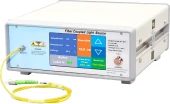
Housed in a compact benchtop enclosure, the SLD Broadband Light Sources are designed for straightforward integration into laboratories, manufacturing lines, and R&D environments. A touchscreen interface provides convenient local control of operating parameters, while an RS232 serial communication port (DB9 female interface) supports remote operation and easy incorporation into automated test systems. Universal AC input from 100 to 240 V with modest power consumption around 30 W allows deployment worldwide with standard laboratory power infrastructure. The specified operating temperature range of –5 to +35 °C and humidity range from 0 to 70% accommodate typical indoor conditions for both research and production facilities.
With their broad spectral coverage, high stability, low ripple, and flexible control interfaces, these SLD Broadband Light Sources offer a robust platform for fiber‑optic sensing, optical component characterization, interferometry, and medical imaging applications. They provide performance on par with other advanced broadband SLD sources used globally, while using familiar telecom‑grade fiber and connectors for maximum compatibility. Configurable spectral bands and the availability of custom options make this series a versatile choice for both standard and specialized optical setups spanning the 1250–1650 nm range.
1250 - 1650nm SLD Broadband Light Source
Specifications
| SLED Type: | Fiber Coupled |
|---|---|
| Spectral Range: | 1250–1610 nm; 1250–1450 nm; 1450–1650 nm; 1250–1650 nm |
| Spectral Power Density: | ≥ -25 dBm/nm |
| Spectral Ripple: | ≤ 0.5 dB |
| Short-term Stability (15 Min): | ≤ ±0.02 dB (≈ ±0.5%) |
| Long-term Stability (8 Hr): | ≤ ±0.05 dB (≈ ±1.2%) |
| Polarization State: | Partially Polarized |
| Polarization Extinction Ratio (PER): | ≤ 2 dB |
| Output Fiber Type: | SMF-28 |
| Connector Type: | FC/APC |
| Control Method: | Touchscreen / RS232 Serial Communication |
| Communication Interface: | DB9 Female Port |
| Power Supply: | AC 100–240 V, 30 W |
| Package / Form Factor: | Benchtop (Code B1) |
| Operating Temperature Range: | -5 to +35 °C |
| Operating Humidity Range: | 0–70% |
Got questions about specs? Use the inquiry form to ask.
 Download Data Sheet

Features
- Ultra-Wide Spectral Coverage (1250–1650 nm)
Delivers a broad, continuous spectrum across key telecom and sensing windows (O-, E-, S-, C-, and L-bands), enabling versatile use in fiber-optic sensing, component characterization, and medical imaging. - Multiple Spectral Range Options
Available standard configurations: 1250–1450 nm, 1450–1650 nm, 1250–1610 nm, and 1250–1650 nm, allowing users to optimize bandwidth and power for specific test or sensing requirements. - High Spectral Power Density (≥ –25 dBm/nm)
Provides strong, uniform output power across the selected band, ensuring high signal-to-noise ratio in measurement systems and enhanced sensitivity for interferometric and distributed sensors. - Low Spectral Ripple (≤ 0.5 dB)
Minimizes spectral fluctuations to deliver a smooth, flat output profile; ideal for accurate insertion loss, spectral response, and wavelength-dependent loss measurements in fiber-optic components. - Excellent Output Stability
Short-term stability ≤ ±0.02 dB (15 min) and long-term stability ≤ ±0.05 dB (8 hr) help maintain highly repeatable test results and stable system performance in laboratory and production environments. - Low Degree of Polarization / Partially Polarized Output
Reduces polarization-dependent effects in components under test and sensing systems, improving accuracy in devices sensitive to polarization such as AWGs, WDMs, and interferometric setups. - Ultra-Low Polarization Extinction Ratio (PER ≤ 2 dB)
Very low PER ensures quasi-unpolarized light, which is beneficial for characterization of polarization-dependent loss (PDL) and for minimizing polarization-induced measurement errors. - Optimized for Fiber-Optic Sensing
Ideal for FBG interrogation, optical coherence domain reflectometry (OCDR/OFDR), and distributed fiber sensing (DTS/DAS/DSS) systems that require broadband, stable, low-coherence sources. - Suitable for Medical and Imaging Applications
The 1250–1650 nm band supports biomedical imaging and spectroscopy, including near-infrared and tissue diagnostic systems that demand broad, smooth spectra and reliable performance. - SMF-28 Fiber Output with FC/APC Connector
Industry-standard single-mode SMF-28 fiber and FC/APC connector reduce back-reflection and simplify integration with existing fiber networks, test benches, and sensing setups. - User-Friendly Benchtop Design
Compact benchtop package (Code: B1) for easy placement on optical tables or in rack environments, with clear front-panel interface for quick setup and monitoring. - Touchscreen and Remote Control
Supports local touchscreen operation and remote control via RS232 serial communication (DB9 female port), enabling seamless integration into automated test systems and monitoring platforms. - Wide AC Power Compatibility
Operates from AC 100–240 V with low power consumption (≈ 30 W), suitable for global deployment in laboratories, production lines, and field environments. - Robust Environmental Performance
Designed for operation from –5 to +35 °C and 0–70% relative humidity, ensuring stable output in typical lab and light industrial conditions. - Ideal for Fiber-Optic Component Testing
Well-suited for testing WDM components, couplers, splitters, filters, AWGs, and passive/active fiber components where broadband, low-ripple light sources are required. - Telecom-Grade Reliability
Uses high-quality SLD technology and SMF-28 fiber widely adopted in telecom systems, delivering reliability and consistency expected for R&D, manufacturing, and network testing applications. - Low-Coherence Broadband SLD Source
SLD-based architecture provides low coherence length, reducing interference artifacts and speckle in imaging and measurement applications. - Flexible Configuration and Customization
Standard models cover 1250–1610 nm and full 1250–1650 nm bands; custom spectral ranges, power levels, fiber types, and connectors are available on request to match specific system requirements. - Easy Integration into OEM and Research Systems
Standard optical interface, remote control capability, and stable performance make this source suitable for OEM integration, academic research setups, and industrial measurement platforms.
Applications
Applications of SLD Broadband Light Sources (1250–1650 nm Band)
- Fiber-Optic Sensing
- Distributed fiber optic temperature and strain sensing (DTS/DSS) based on OTDR/OFDR
- Fiber Bragg Grating (FBG) interrogation for structural health monitoring in civil engineering, aerospace, and energy
- Quasi-distributed sensing systems for oil & gas pipelines, power cables, and perimeter security
- High-resolution interferometric sensors for acoustic and vibration monitoring
- Optical Coherence Tomography (OCT) and Medical Imaging
- Near‑infrared OCT systems for ophthalmology, dermatology, and cardiology
- Endoscopic and catheter‑based imaging in the 1.3 μm window for improved tissue penetration
- Biomedical spectroscopy and functional imaging in the 1250–1650 nm range
- High‑contrast imaging of biological tissues where low coherence and broad spectrum are required
- Fiber-Optic Component and Device Testing
- Spectral characterization of WDM/CWDM/DWDM components (multiplexers, demultiplexers, filters)
- Insertion loss, isolation, and passband testing of optical couplers, splitters, and circulators
- Characterization of optical amplifiers (EDFAs, Raman amplifiers) and passive components around 1310 nm and 1550 nm
- Testing of tunable filters, VOAs, and reconfigurable optical add-drop multiplexers (ROADMs)
- Optical Network Development and Lab Use
- Broadband source for research in metro and long‑haul telecom systems in the O‑, E‑, S‑, C‑, and L‑bands
- Characterization and calibration of optical spectrum analyzers (OSAs) and monitoring equipment
- General‑purpose laboratory light source for photonics R&D and prototyping
- Interferometry and Coherence-Based Metrology
- Low‑coherence interferometry for precise distance, thickness, and surface profile measurements
- Optical path length calibration and dispersion characterization of fibers and components
- High‑resolution optical delay line measurements in the 1250–1650 nm band
- Spectroscopy and Material Characterization
- Broadband NIR spectroscopy of glasses, polymers, semiconductors, and optical coatings
- Refractive index and absorption measurements in the telecom wavelength window
- Characterization of novel photonic materials and integrated photonic devices
- Fiber Laser and Supercontinuum Source Development
- Seed source and pump diagnostics for fiber lasers operating around 1.3 μm and 1.55 μm
- Optimization and testing of supercontinuum generation in nonlinear fibers
- Mode‑locking and cavity diagnostics in ultrafast laser research
- Telecommunications and Datacom Testing
- Characterization of passive optical networks (PON), FTTH components, and access networks
- Channel and filter alignment testing in WDM systems across 1250–1650 nm
- Verification of broadband performance and spectral flatness in optical links
- Optical Sensor Interrogation Units
- Broadband source for multi‑channel FBG sensor interrogators
- Interrogation of interferometric, Mach‑Zehnder, Fabry–Perot, and ring‑resonator sensors
- Integration into compact bench‑top or rack‑mount sensor readout systems
- Education and Training in Photonics
- Demonstration of broadband source principles and low‑coherence interference in teaching labs
- Hands‑on experiments in fiber‑optic communication, sensing, and spectroscopy courses
- Training systems for technicians and engineers working with NIR fiber‑optic technologies
Frequently Asked Questions
What is the YOGEL SLD Broadband Light Source and what spectral ranges are available?
What are the main applications of this SLD broadband light source?
How stable is the YOGEL SLD broadband source over time?
What is the polarization state and why is the low degree of polarization important?
What fiber type and optical connector does the YOGEL broadband source use?
How is the benchtop SLD broadband light source controlled and what interfaces are available?
What are the power, size, and operating environment specifications, and can the product be customized?
Got more questions? Use the inquiry form to ask the supplier directly.
Similar Products


Your inquiry has been received.
Create an account by adding a password
Why create an account?
- Auto-complete inquiry forms
- View and manage all your past messages
- Save products to your favorites
- Close your account anytime — no hassle