


Description
Introducing the Multi-Channel Superluminescent Diode Light Source (Multi-SLED) Optical Spectral Engine (OSE2) by DAYY Photonics. This innovative product is a compact broadband light source designed to operate in the near-infrared region. Encased in a 32-pin butterfly package, the Multi-SLED OSE2 utilizes a set of superluminescent diodes, each equipped with a monitor diode for enhanced power control and monitoring capabilities. The inclusion of a thermoelectric cooler (TEC), an integrated isolator, and a spectral stitching design ensures overlapping spectral coverage, making this product a versatile choice for various applications.
The Multi-SLED OSE2 is engineered to deliver stable power and center-wavelength performance over time, maintaining consistent optical performance across a broad spectrum of wavelengths. Its compact design and ease of use make it an ideal component for a wide range of manufactured assemblies that require reliable light power. With the ability to configure up to six light sources, this product offers flexibility and adaptability to meet specific needs.
DAYY’s advanced spectral stitching technology is at the heart of the Multi-SLED, providing extensive spectral coverage by integrating multiple wavelengths into a single spatially coherent beam. This results in low temporal coherence and broad spectral coverage, allowing for exceptional flexibility and usability. The Multi-SLED product line can be tailored to suit specific application requirements, making it a perfect fit for various industrial and biomedical imaging systems, optical sensing, test and measurement, and research and development projects.
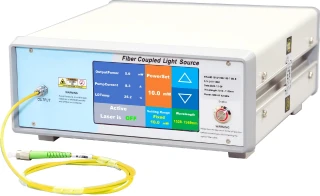
DAYY Multi-SLED OSE2 Multi-Channel Superluminescent Diode Light Source
Specifications
| SLED Type: | Fiber Coupled, No Fiber Coupling |
|---|---|
| Operating Power (typical): | 30 mW |
| Center Wavelength (typical): | 1000 nm |
| Bandwidth (FWHM): | 100 nm |
| Number Of SLEDs: | 2 to 6 |
| Fiber-coupled Output Power: | 10mW to 40mW |
| Free Space Output Power: | 30mW to 130mW |
| Bandwidth FWHM: | 40nm to 460nm |
| SLED Wavelength Range: | 770nm to 1680nm |
| Light Output Connector: | FC/APC (Optional FC/PC or SMA) |
Got questions about specs? Use the inquiry form to ask.
 Download Data Sheet

Features
- Multi-Channel Superluminescent Diode Light Source (Multi-SLED): Compact broadband light source operating in the near-infrared region.
- Optical Spectral Engine (OSE2): Features a 32-pin butterfly package with superluminescent diodes and a monitor diode for each SLED for enhanced power control and monitoring.
- Configurable Light Sources: Supports between two and six superluminescent diodes (SLEDs) in a single unit.
- Power Control: All SLEDs can be operated from 0-100% of their maximum rating.
- Output Power:
- Fiber-coupled output power ranges from 10mW to 40mW.
- Free Space output power ranges from 30mW to 130mW.
- Bandwidth: Full Width at Half Maximum (FWHM) from 40nm to 460nm.
- Spectral Range: SLEDs ranging from 770nm to 1680nm.
- Spectral Stitching Technology: Provides optimum power and bandwidth with overlapping spectral coverage.
- Integrated Components: Each SLED includes a built-in independent monitor photodiode and a common thermoelectric cooler (TEC).
- Connector Options: Light output available with FC/APC Connector (Optional FC/PC or SMA).
- Free Space Models: Available for applications not requiring fiber optic coupling, delivering a collimated beam.
- Stable Performance: Ensures stable power and center-wavelength performance over time across a wide spectrum of wavelengths.
- Compact and User-Friendly: Designed for ease of use and integration into various manufactured assemblies requiring light power.
Applications
Applications for the Multi-Channel Superluminescent Diode Light Source OSE2 Multi-SLED
- Medical Optical Coherence Tomography: Broadband near-infrared SLED illumination for high-resolution OCT imaging in ophthalmology, dermatology, dentistry, cardiology, and other biomedical imaging systems.
- Industrial Optical Coherence Tomography: Low-coherence broadband light source for non-destructive inspection, surface profiling, layer thickness measurement, defect detection, and in-line quality control.
- Optical Component Testing: Stable broadband source for characterization of fiber optic components, filters, couplers, isolators, circulators, splitters, connectors, and integrated photonic devices.
- Telecom Test and Measurement: Wide spectral coverage for testing WDM, CWDM, DWDM, passive optical networks, fiber links, optical amplifiers, and telecom transmission components across near-infrared wavelength bands.
- Fiber Optic Sensor Interrogation: Broadband SLED source for fiber Bragg grating sensors, distributed sensing systems, strain sensing, temperature sensing, pressure sensing, and structural health monitoring.
- Biomedical Imaging Systems: Compact NIR broadband illumination for imaging platforms that require low temporal coherence, high spatial coherence, stable output power, and selectable wavelength coverage.
- Life Science and Laboratory Research: Flexible multi-wavelength SLED source for spectroscopy, microscopy, tissue imaging, optical diagnostics, and experimental photonics setups.
- Near-Infrared Spectroscopy: Broadband NIR light generation for absorption spectroscopy, material analysis, chemical sensing, biological sample analysis, and spectral response measurements.
- Low-Coherence Interferometry: Ideal source for interferometric distance measurement, surface metrology, optical path length measurement, and precision displacement sensing.
- Optical Coherence Domain Reflectometry: Broadband source for locating reflections, faults, splices, connectors, and discontinuities in optical fibers, waveguides, and photonic assemblies.
- Photonic Integrated Circuit Testing: Broadband optical engine for evaluating silicon photonics, waveguide devices, optical filters, arrayed waveguide gratings, modulators, and integrated optical components.
- Free-Space Optical Testing: Collimated free-space output options support optical alignment, beam delivery, detector testing, lens evaluation, and laboratory optical bench applications.
- Detector and Camera Calibration: Stable broadband NIR illumination for testing and calibrating photodiodes, InGaAs detectors, optical receivers, spectrometers, cameras, and imaging sensors.
- Spectrometer and Instrument Calibration: Broadband spectral output for calibration, wavelength response testing, sensitivity verification, and performance validation of optical measurement instruments.
- Material Inspection and Characterization: Near-infrared broadband light for analyzing coatings, polymers, semiconductors, composites, thin films, and multilayer structures.
- Semiconductor and Electronics Inspection: NIR illumination for wafer inspection, package analysis, subsurface imaging, defect detection, and optical metrology in electronics manufacturing.
- Precision Metrology: Low-coherence, broadband optical source for thickness gauging, surface roughness analysis, profilometry, dimensional measurement, and high-resolution metrology systems.
- Optical Alignment and System Integration: Fiber-coupled or free-space broadband output for alignment, validation, and integration of optical assemblies, photonic modules, and imaging systems.
- Research and Development: Configurable multi-channel SLED platform for universities, research laboratories, OEM developers, and photonics engineers requiring custom spectral coverage from 770 nm to 1680 nm.
- OEM Optical System Integration: Compact 32-pin butterfly package with integrated monitor photodiodes, TEC control, isolator, and spectral stitching for incorporation into commercial instruments and manufactured optical systems.
- High-Resolution Imaging Platforms: Broad bandwidth and low temporal coherence make the OSE2 suitable for imaging applications that require improved axial resolution and stable optical performance.
- Environmental and Structural Monitoring: Broadband source for optical sensing systems used in bridges, pipelines, aerospace structures, wind turbines, industrial facilities, and harsh-enviro
Frequently Asked Questions
What is the DAYY Photonics OSE2 Multi-SLED broadband light source?
What wavelength range does the OSE2 Multi-SLED cover?
How much optical output power is available from the OSE2 Multi-SLED?
What bandwidth can the OSE2 Multi-SLED light source provide?
How does spectral stitching work in a Multi-SLED source?
Why are monitor photodiodes and a TEC important in this SLED light source?
What output coupling options are available for the OSE2 Multi-SLED?
Got more questions? Use the inquiry form to ask the supplier directly.
Similar Products


Your inquiry has been received.
Create an account by adding a password
Why create an account?
- Auto-complete inquiry forms
- View and manage all your past messages
- Save products to your favorites
- Close your account anytime — no hassle